Choosing the right development approach for your mobile app is one of the most consequential decisions you will make. It affects your budget, timeline, performance, user experience, and long-term maintenance costs. Get it right, and you build a scalable app that serves your business for years. Get it wrong, and you face costly rewrites, poor user experience, or a product that cannot grow with your needs.
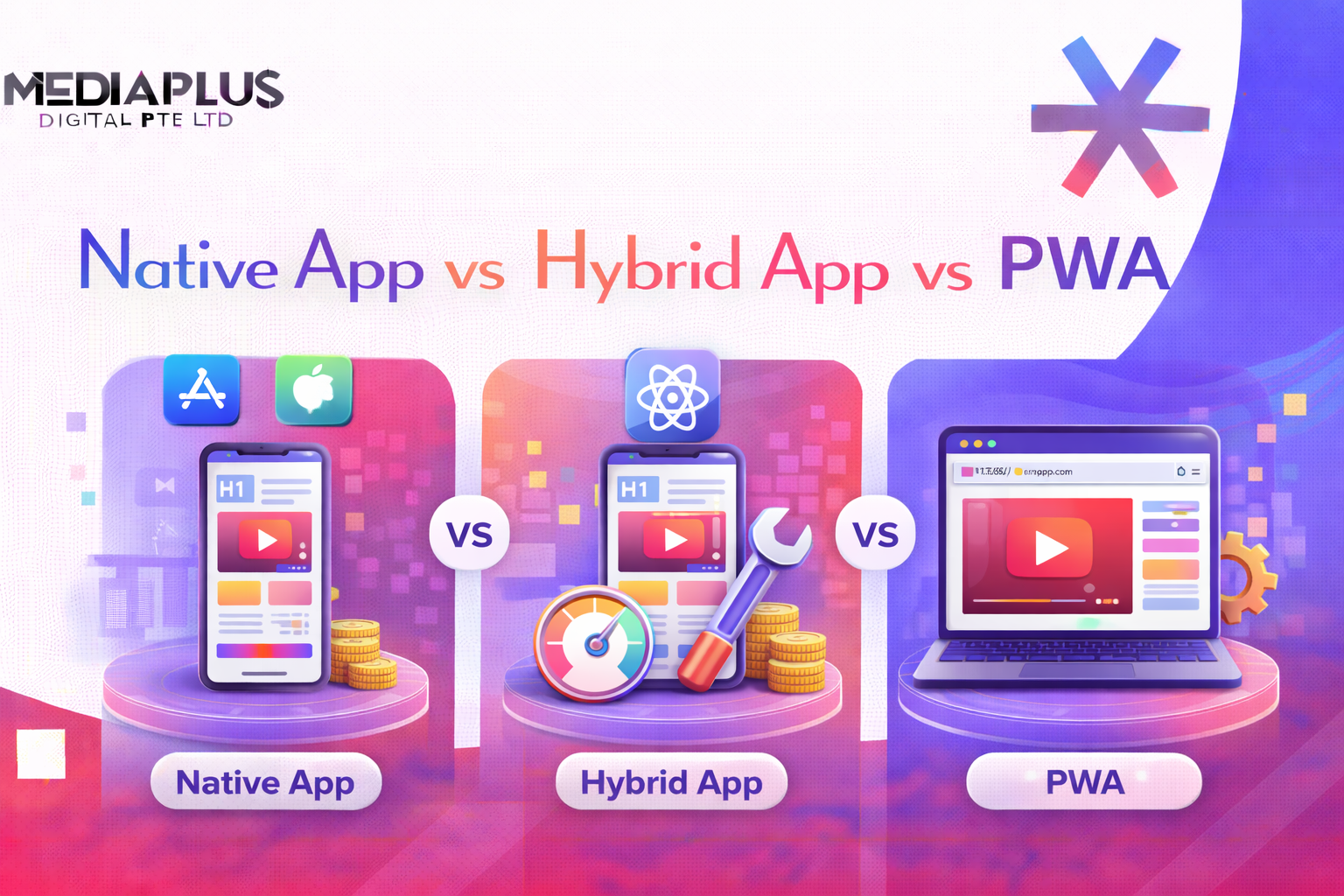
In 2026, three main approaches dominate mobile app development: native apps, hybrid apps, and Progressive Web Apps (PWAs). Each has distinct strengths, limitations, and ideal use cases. This guide provides an honest, detailed comparison to help you choose the right approach for your specific project.
What Is a Native App?
Native apps are built specifically for a single platform using platform-specific programming languages and tools. iOS apps are built with Swift or Objective-C using Xcode. Android apps are built with Kotlin or Java using Android Studio.
- Separate codebase for each platform: An iOS version and an Android version are developed independently, each using the platform’s native SDK.
- Full device access: Camera, GPS, Bluetooth, NFC, biometrics, background processes, push notifications, and every hardware feature are fully accessible.
- Platform-native UI: The app follows iOS Human Interface Guidelines or Android Material Design conventions, providing the experience users expect on each platform.
- App store distribution: Published through Apple App Store and Google Play Store.
What Is a Hybrid App?
Hybrid apps use a single codebase to build apps that run on both iOS and Android. Modern hybrid frameworks like Flutter and React Native compile to native code, delivering near-native performance from a shared codebase.
- Single codebase, multiple platforms: Write once, deploy on iOS, Android, and sometimes web from the same code.
- Near-native performance: Flutter and React Native compile to native components, delivering smooth animations and responsive interactions that are indistinguishable from native apps for most use cases.
- Good device access: Through plugins and packages, hybrid apps can access most device features including camera, GPS, push notifications, and biometrics.
- App store distribution: Published through Apple App Store and Google Play Store, just like native apps.
In 2026, Flutter holds approximately 46% of the cross-platform market compared to React Native at 35%. Flutter excels in UI consistency and animation-heavy apps, while React Native benefits from a larger developer pool and strong JavaScript ecosystem.
What Is a PWA (Progressive Web App)?
Progressive Web Apps are web applications that use modern web technologies to deliver app-like experiences through a browser. They can be installed on a device’s home screen without going through an app store.
- Built with web technologies: HTML, CSS, and JavaScript. Any web developer can build a PWA.
- No app store required: Users access the PWA through a browser URL and can “install” it to their home screen. No app store approval process or fees.
- Cross-platform by default: A single PWA works on any device with a modern browser: phones, tablets, desktops, ChromeOS.
- Limited device access: PWAs can access camera, GPS, and push notifications (with iOS limitations), but cannot access Bluetooth, NFC, advanced biometrics, or run complex background tasks.
- SEO benefit: PWAs are indexed by search engines, meaning your app content can appear in Google search results.
Native vs Hybrid vs PWA: Comparison Table
|
Factor |
Native |
Hybrid |
PWA |
|
Performance |
Excellent (60fps) |
Very good (near-native) |
Good (browser-dependent) |
|
Development cost |
High (2x for both platforms) |
Medium (40 to 60% less) |
Low (single web build) |
|
Time to market |
Slowest |
Faster |
Fastest |
|
Device feature access |
Full |
Good (via plugins) |
Limited |
|
Offline capability |
Excellent |
Excellent |
Good (service workers) |
|
User experience |
Platform-native |
Near-native |
App-like web |
|
App store distribution |
Yes |
Yes |
No (optional) |
|
SEO benefit |
No |
No |
Yes (indexable) |
|
Maintenance cost |
High (2 codebases) |
Medium (1 codebase) |
Low (web updates) |
|
Push notifications |
Full support |
Full support |
Limited on iOS |
|
Update process |
App store review |
App store review |
Instant (no review) |
Cost Comparison
|
Complexity |
Native (both platforms) |
Hybrid |
PWA |
|
Simple |
USD 80K to 150K |
USD 40K to 80K |
USD 25K to 50K |
|
Medium |
USD 150K to 300K |
USD 80K to 150K |
USD 50K to 100K |
|
Complex |
USD 300K to 500K+ |
USD 150K to 250K |
USD 100K to 180K |
For Malaysia-specific pricing, review this detailed guide on mobile app development cost in Malaysia.
When to Choose Native
- Performance-critical applications: Gaming, AR/VR, real-time video processing, and graphics-intensive apps where every frame matters.
- Hardware-dependent features: Apps that rely heavily on Bluetooth, NFC, advanced biometrics, or complex background processing.
- Regulated industries: Banking, healthcare, and government apps where platform-specific security certifications and compliance are required.
- Large budget and long-term investment: If budget allows and the app is a core business asset that justifies premium development and separate platform teams.
When to Choose Hybrid
In 2026, hybrid is the smartest default for most businesses. Nearly 55% of enterprise mobility leaders plan to invest in hybrid app development, up from 38% the previous year.
- Cross-platform reach on a budget: You need both iOS and Android but cannot justify the cost of two native codebases.
- Faster time to market: Hybrid accelerates time-to-market by 30 to 50% compared to native development.
- Most business apps: E-commerce, social platforms, productivity tools, booking systems, and most B2B applications perform excellently as hybrid apps.
- Startups and MVPs: Validate your idea faster and cheaper. If the app gains traction, you can optimise or go native for specific features later.
- Unified team: One development team maintaining one codebase is simpler and more cost-effective than managing separate iOS and Android teams.
When to Choose PWA
- Content-first applications: News sites, blogs, catalogues, and media platforms where search discoverability is valuable.
- Budget-constrained projects: When a native or hybrid app is not financially viable but you still want an app-like experience.
- Complementary to an existing website: Enhance your website with offline support, push notifications, and home screen installation without building a separate app.
- E-commerce (with caveats): PWAs can work well for e-commerce if you do not need advanced device features. Instant updates and SEO benefits are significant advantages.
- Rapid prototyping: Test an app concept quickly with minimal investment before committing to native or hybrid development.
Pros and Cons Summary
Native Apps
- Pros: Best performance, full device access, platform-native UX, maximum security, best for app store optimisation.
- Cons: Double development cost, longer time to market, requires platform-specific expertise, higher maintenance.
Hybrid Apps
- Pros: Single codebase, 40 to 60% cost reduction, faster development, near-native performance, simultaneous platform updates.
- Cons: Slight performance lag for very complex tasks, framework dependency, some platform-specific customisation still needed.
PWAs
- Pros: Lowest cost, no app store approval, SEO indexable, instant updates, cross-device compatibility, fastest development.
- Cons: Limited device feature access, iOS restrictions, no app store presence (discoverability challenge), potential trust concerns, weaker offline capabilities for complex tasks.
Common Mistakes When Choosing an Approach
- Defaulting to native without justification: Many businesses choose native because it sounds “better” without considering whether they actually need platform-specific performance advantages.
- Underestimating hybrid capabilities: Flutter and React Native handle production apps serving hundreds of millions of users. The performance gap with native is negligible for most applications.
- Ignoring total cost of ownership: Native development costs 1.5 to 2x more upfront and doubles maintenance costs indefinitely. Factor in long-term costs, not just initial build.
- Choosing PWA for the wrong use case: PWAs are not suitable for apps requiring Bluetooth, NFC, advanced background processing, or heavy computational tasks.
- Not planning for scale: Choose an approach that supports your 3-year growth plan, not just your immediate needs.
Choose the Right Approach for Your App
The right development approach depends on your specific requirements, budget, timeline, and growth plans. There is no universally “best” option. The best choice is the one that matches your project needs.
MediaPlus Digital helps businesses choose and execute the right mobile development strategy. The team builds apps across native and hybrid frameworks as part of comprehensive mobile app development services. From requirements and UX design to development, testing, and post-launch support, every project is guided by what is best for the business, not a one-size-fits-all approach.
Not sure which approach is right for your app? Contact MediaPlus Digital for expert guidance.