Headless commerce went from niche to mainstream fast. In 2026, roughly 42 percent of growing D2C brands globally now run headless or composable stacks. The Malaysian market is catching up quickly, driven by Shopify Hydrogen, fast-launching Next.js storefronts, and merchants outgrowing the limits of monolithic platforms.
But “best headless CMS” is the wrong question without context. The right question is “best headless CMS for what?”. A Shopify Plus brand replatforming to Hydrogen needs different things from a WooCommerce content-heavy store, which needs different things from a marketplace built on Medusa.
This guide compares 8 headless CMS platforms with honest takes on cost, learning curve, and fit for Malaysian merchants in 2026. For the broader picture of building an online store here, see our pillar guide on ecommerce web development in Malaysia.
First: What Actually Is “Headless” in Ecommerce?
In a traditional (“monolithic”) ecommerce platform like Shopify or WooCommerce, the storefront (what customers see) and the commerce engine (cart, checkout, inventory, payments) are tightly coupled. Easy to launch, harder to customise deeply.
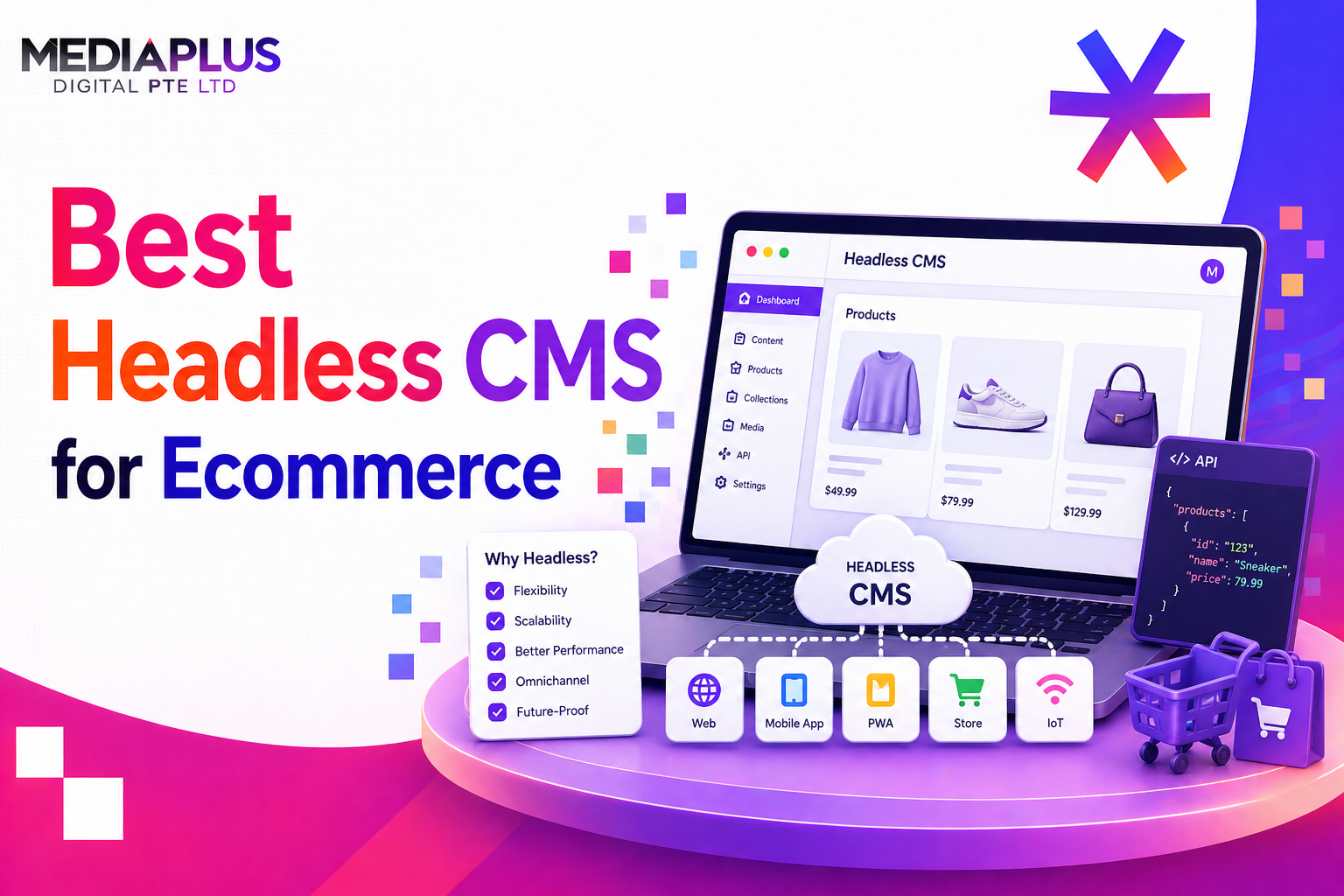
In a headless setup, you separate the two:
- Backend or commerce engine: Shopify, WooCommerce, BigCommerce, Medusa, commercetools. Handles products, orders, checkout.
- Frontend or storefront: Custom-built with Next.js, Remix (Shopify Hydrogen), Nuxt, or Astro. Connects to the backend via API.
- Headless CMS: Manages content such as product descriptions, blog, landing pages, and marketing assets independently.
Why bother? Three reasons that actually matter for Malaysian merchants:
- Performance. Custom Next.js storefronts routinely hit sub-1 second LCP. Standard Shopify themes hit 2 to 4 seconds. That difference is 15 to 25 percent in conversion rate.
- Content flexibility. Marketing teams can ship landing pages, campaigns, and blog content without touching product data or risking the checkout.
- Future-proofing. When you are ready to add a mobile app, in-store kiosk, or social commerce surface, the same content and commerce APIs power them all.
Why not bother? It costs more upfront (RM 45,000 to 150,000 versus RM 8,000 to 30,000 for a standard build) and needs ongoing developer support. Headless is not right for everyone.
Quick Comparison: The 8 Best Headless CMS Options
|
CMS |
Best for |
Starting cost |
Learning curve |
Malaysia-relevant strengths |
|
Sanity |
Shopify plus content-heavy brands |
Free to USD 99+ / month |
Medium |
Real-time editing, custom Studio |
|
Storyblok |
Marketing-led teams |
Free to EUR 99+ / month |
Easy |
Visual editor non-devs love |
|
Contentful |
Enterprise multi-brand |
USD 300+ / month |
Medium to Hard |
Mature ecosystem, integrations |
|
Hygraph |
API-first / GraphQL teams |
Free to USD 299+ / month |
Medium |
GraphQL native, fast |
|
Strapi |
Self-hosted, full control |
Free (self-host) to USD 99+ |
Hard |
Open-source, no vendor lock-in |
|
Prismic |
Slice-based marketing sites |
Free to USD 150+ / month |
Easy |
Slice Machine for reusable sections |
|
Weaverse |
Shopify Hydrogen specifically |
USD 19+ / month |
Easy |
Built for Shopify Hydrogen |
|
Builder.io |
Visual page building plus AI |
Free to USD 599+ / month |
Easy |
Drag-and-drop, AI page generation |
Deep Dive: The Top Headless CMS for Ecommerce
1. Sanity: The Developer’s Favourite
Best for: Shopify Hydrogen and Next.js commerce brands with frequent content updates and a need for custom content models.
Strengths:
- Highly customisable Studio (the editing interface). Developers can build any content schema.
- Real-time collaboration. Think Google Docs for content.
- Excellent image pipeline (CDN, on-the-fly transforms, focal point).
- GROQ query language is more flexible than GraphQL for complex content.
- Generous free tier (3 users, 10,000 documents).
Weaknesses:
- Studio customisation requires real React and TypeScript skills.
- Pricing scales fast at enterprise (Growth USD 99 per month plus per-user, Enterprise custom).
- Less marketing-friendly out-of-the-box than Storyblok.
Pricing (2026):
- Free: 3 users, 10,000 documents
- Growth: USD 99 per month plus USD 15 per user
- Enterprise: custom
Verdict for Malaysian ecommerce: First choice if you have technical capacity and want maximum content modelling flexibility. Pairs beautifully with Shopify Hydrogen, supported through our Shopify development service.
2. Storyblok: The Marketer’s Choice
Best for: Content-heavy brands where the marketing team edits pages daily without involving developers.
Strengths:
- Visual Editor: see exactly what the page will look like while editing. Rare in headless world.
- Component-based “Bloks”. Non-technical users assemble pages from pre-built sections.
- Built-in image optimisation and CDN.
- Strong i18n support, useful for Malaysian multi-language stores (BM, EN, ZH, Tamil).
- Native integrations with Shopify, BigCommerce, Stripe.
Weaknesses:
- Visual Editor adds latency for very complex pages.
- Schema flexibility is narrower than Sanity.
- Per-user pricing gets expensive for big teams.
Pricing (2026):
- Free: 1 user, 1,000 entries
- Entry: EUR 9 per month (1 user)
- Business: EUR 99 per month (3 users, 10,000 entries)
- Enterprise: custom
Verdict for Malaysian ecommerce: Best pick if your marketing team is non-technical and wants to ship campaigns or landing pages independently. Great for D2C brands running frequent promos (9.9, 10.10, 11.11, 12.12 mega sales).
3. Contentful: The Enterprise Standard
Best for: Multi-brand, multi-region enterprises with mature processes and budget.
Strengths:
- Mature platform, longest track record.
- 100-plus integrations, especially with enterprise tools (Salesforce, SAP, Oracle).
- Robust permissions and roles for large teams.
- Strong personalisation features.
- Compose (visual page builder) for marketing teams.
Weaknesses:
- Expensive (starts USD 300 per month for serious use).
- Slower iteration than Sanity or Storyblok.
- Overkill for SME ecommerce.
Pricing (2026):
- Free: deprecated for new accounts
- Lite: USD 300 per month
- Premium: custom, typically USD 2,000+ per month
Verdict for Malaysian ecommerce: Only justified if you are a regional enterprise (think Petronas, Maxis, Maybank scale) running multiple brands or markets. Most SMEs should look elsewhere.
4. Hygraph (formerly GraphCMS): GraphQL-Native
Best for: Developer teams building complex content relationships and microservices.
Strengths:
- GraphQL-first from day one. Cleaner queries than REST-based alternatives.
- Federated content. Combine multiple sources into one API.
- Fast performance at scale.
- Generous free tier.
Weaknesses:
- Less mature than Sanity or Contentful.
- Editor UI less refined for non-tech users.
- Smaller community and fewer tutorials in 2026.
Pricing (2026):
- Free: limited
- Pro: USD 299 per month
- Enterprise: custom
Verdict for Malaysian ecommerce: Excellent technical choice but a smaller pool of local Malaysian developers familiar with it. Choose if you have a strong technical team.
5. Strapi: Open-Source and Self-Hosted
Best for: Brands that want to own the CMS code, host it themselves, and avoid vendor lock-in.
Strengths:
- 100 percent open-source (MIT license).
- Self-hosted means full data control (good for PDPA peace of mind).
- No per-seat pricing.
- Highly customisable.
- Strong plugin ecosystem.
Weaknesses:
- You manage hosting, scaling, security, and updates yourself.
- Higher TCO when you factor in DevOps time.
- Setup complexity higher than SaaS alternatives.
Pricing (2026):
- Free: self-host
- Cloud: USD 99+ per month if you do not want to self-host
- Enterprise: custom
Verdict for Malaysian ecommerce: Smart choice for compliance-sensitive verticals (financial services, healthcare, government suppliers) or brands that value total ownership. Needs DevOps capacity. We can handle this through our web maintenance services.
6. Prismic: Slice-Based Simplicity
Best for: Marketing teams who want to ship landing pages weekly using reusable component “slices”.
Strengths:
- Slice Machine: define reusable page sections once, reuse infinitely.
- Great Next.js integration.
- Simple, focused product (does not try to do everything).
- Fast time to launch.
Weaknesses:
- Less flexible than Sanity for complex content models.
- Smaller ecosystem.
- Limited multi-language flexibility for non-Latin scripts.
Pricing (2026):
- Free: 1 user
- Starter: USD 7 per month
- Small: USD 15 per month
- Medium: USD 50 per month
- Platinum: USD 150+ per month
Verdict for Malaysian ecommerce: Underrated for SME D2C brands. Great if your team’s main task is shipping landing pages weekly.
7. Weaverse: Built Specifically for Shopify Hydrogen
Best for: Shopify Plus and Hydrogen brands wanting visual page building on top of Hydrogen storefronts.
Strengths:
- Built from the ground up for Shopify Hydrogen.
- Visual drag-and-drop page builder for non-developers.
- Native Shopify product integration (no separate API plumbing).
- Affordable starting tier.
Weaknesses:
- Locked into the Shopify ecosystem.
- Newer product (less mature than Sanity or Contentful).
- Limited use outside Shopify Hydrogen.
Pricing (2026):
- Free trial
- Pro: USD 19 per month
- Advanced: USD 49 per month
Verdict for Malaysian ecommerce: If you are on Shopify Plus and committed to Hydrogen, Weaverse is the easiest on-ramp to headless. Cheaper than Sanity for marketing-team-led editing.
8. Builder.io: AI-Native Visual Building
Best for: Teams that want AI-assisted page generation plus drag-and-drop visual editing.
Strengths:
- Visual drag-and-drop editor with live preview.
- AI-powered page generation from text prompts (2026 feature mature).
- Visual A/B testing built in.
- Works with any frontend framework.
- Strong personalisation features.
Weaknesses:
- Pricier than alternatives at scale.
- Lock-in risk if you build heavily in Builder.
- AI features can produce generic-looking output if not curated.
Pricing (2026):
- Free: 1 user
- Pro: USD 99 per month
- Growth: USD 599 per month
- Enterprise: custom
Verdict for Malaysian ecommerce: Interesting for teams that want AI-assisted page production. Good for high-velocity marketing teams.
Which Headless CMS Should Your Malaysian Ecommerce Brand Choose?
If you are on Shopify Plus going headless
Sanity plus Hydrogen (most flexibility) or Weaverse plus Hydrogen (easier marketing edits).
If you are on WooCommerce and want a faster frontend
Sanity plus Next.js plus WooCommerce REST API, or Storyblok plus Next.js. We build both through our WooCommerce development service.
If your marketing team edits content daily and they are not developers
Storyblok (visual editor) or Weaverse (if on Shopify Hydrogen).
If you need full control, PDPA compliance, or on-prem hosting
Strapi (self-hosted).
If you are a multi-brand regional enterprise
Contentful (mature, enterprise-grade).
If you are testing the headless waters with a smaller budget
Prismic (USD 15 to 50 per month) or Sanity (generous free tier).
The Real Cost of Going Headless in Malaysia
Beyond the CMS subscription, here is what a full headless build typically costs Malaysian merchants in 2026:
|
Component |
Cost range |
|
Headless CMS subscription |
RM 0 to 2,500 per month |
|
Commerce engine (Shopify Plus or Adobe Commerce) |
RM 0 to 15,000 per month |
|
Custom Next.js storefront development |
RM 45,000 to 150,000 (one-time) |
|
Hosting (Vercel or Cloudflare Pages) |
RM 100 to 2,000 per month |
|
Ongoing developer maintenance |
RM 3,000 to 8,000 per month |
|
Content migration |
RM 5,000 to 20,000 (one-time) |
Realistic total Year 1 budget for a Malaysian headless ecommerce launch: RM 100,000 to RM 350,000.
When does the investment pay back? Typically at 18 to 30 months through:
- 15 to 25 percent lift in mobile conversion rate (from sub-1 second LCP)
- 30 to 50 percent reduction in marketing-team time to ship campaigns
- Lower long-term plugin or theme costs versus Shopify themes
Common Mistakes Malaysian Brands Make Going Headless
- Going headless too early. If your store is under RM 100,000 per month in revenue, the ROI rarely justifies the cost. Optimise standard Shopify first.
- Underestimating developer dependency. Headless means every major change goes through developers. If your marketing team likes to ship landing pages independently, pick a CMS with a strong visual editor (Storyblok, Weaverse, Builder).
- Forgetting SEO migration. Switching from Shopify themes to Hydrogen kills 30 to 60 percent of organic traffic if redirects, schema, and metadata are not properly migrated. Budget 2 to 4 weeks for SEO migration planning. Our SEO services team handles this routinely.
- Overspending on Contentful when Sanity would do. Enterprise tiers of Contentful are 5 to 10 times the cost of Sanity for similar capability.
- Ignoring local payment integration. A headless storefront still needs to support FPX, Boost, Touch n Go eWallet, GrabPay, and ShopeePay. Make sure your commerce engine and frontend support these natively.
Frequently Asked Questions
What is the best headless CMS for ecommerce in 2026?
There is no single answer. For most Malaysian D2C brands on Shopify Plus, Sanity (developer-led) or Storyblok (marketing-led) lead. For WooCommerce, Sanity plus Next.js. For Shopify Hydrogen specifically, Weaverse. For enterprise, Contentful.
Is headless ecommerce worth it for a small Malaysian business?
Usually not. If you are under RM 100,000 per month in revenue, standard Shopify or WooCommerce with a well-built theme will outperform a poorly-resourced headless build. Going headless makes sense when you have outgrown the customisation limits of standard platforms.
Can I run headless on WooCommerce?
Yes. WooCommerce exposes a REST API and, with the WPGraphQL plugin, a GraphQL API that any frontend can connect to. Common setup: WooCommerce plus Sanity plus Next.js. Works well but needs developer maintenance.
How does headless affect SEO?
Headless storefronts built well (server-side rendering, proper schema, fast Core Web Vitals) typically improve SEO due to better performance. Headless built poorly (client-side rendering only, missing meta tags, slow first paint) destroys SEO. The architecture matters more than the technology.
How long does it take to build a headless ecommerce store?
Realistic timeline: 12 to 24 weeks for a custom Hydrogen or Next.js build with a headless CMS. Standard Shopify themes launch in 4 to 8 weeks. The extra time pays back in performance and flexibility, if you actually need that flexibility.
Do headless storefronts support Malaysian payment gateways (FPX, Boost, TnG)?
Yes. Payment integrations happen at the commerce engine layer, not the frontend. Shopify, WooCommerce, and BigCommerce headless setups all support FPX, Boost, Touch n Go, GrabPay, and ShopeePay via the same gateways (eGHL, iPay88, Billplz, Fiuu) you would use with standard themes.
Can I migrate from Shopify standard to Shopify headless or Hydrogen?
Yes, and it is increasingly common. Keep your Shopify Plus backend, build a new Hydrogen storefront, migrate URLs with 301 redirects, validate schema, then cut over. Plan 8 to 16 weeks end to end.
Is Strapi safe for a Malaysian business handling customer data?
Yes. It is actually safer in many compliance scenarios because it is self-hosted, meaning customer data stays on infrastructure you control. This matters for PDPA, especially under the 2024 amendments. The trade-off is that you (or your agency) handle hosting, security patching, and scaling.
Related Reading
- 15 Key Features of a Website Every Malaysian Business Needs
- B2B Digital Marketing Malaysia: The 2026 Playbook
- UI Trends 2026: 10 Design Directions Shaping Websites and Apps
MediaPlus Digital Builds Headless Stores for Malaysian Brands
We have built headless ecommerce stores for brands across KL, Penang, JB, and Singapore using Shopify Hydrogen plus Sanity, WooCommerce plus Storyblok, and custom Next.js plus Strapi stacks for compliance-sensitive clients.
Every headless build we deliver includes:
- Full SEO migration (no traffic loss)
- Malaysian payment gateway integration (FPX, Boost, Touch n Go, GrabPay, ShopeePay)
- LHDN e-invoice module
- PDPA-compliant cookie and privacy setup
- Performance contract (sub-1.5 second LCP target)
- 90-day post-launch support
For a deeper read on the full ecommerce stack, see our ecommerce web development pillar. For Shopify-specific headless work, see our Shopify website development service.
Book a Free Headless Commerce Consultation or WhatsApp +60 11 4072 0868 today.