
Someone scrolls through TikTok on the LRT, sees a creator demo a skincare product, taps a pinned link, and checks out before the next station. No browser tab, no separate website, no abandoned cart. That whole loop, from discovery to payment, happened inside one app. That is social commerce, and it now drives a real share of what Malaysians buy online.
This guide explains what social commerce is, why it matters for Malaysian businesses right now, how it works on the platforms your customers already use, and how to start selling without wasting budget on the wrong channel.
What is social commerce?
Social commerce is the buying and selling of products directly inside social media platforms. The customer discovers a product, learns about it, and completes the purchase without leaving the app.
It helps to separate two ideas that often get mixed up:
- Social media marketing points people from social platforms to your website or store. The sale happens elsewhere.
- Social commerce keeps the entire journey, product page, cart, and checkout, inside the platform itself.
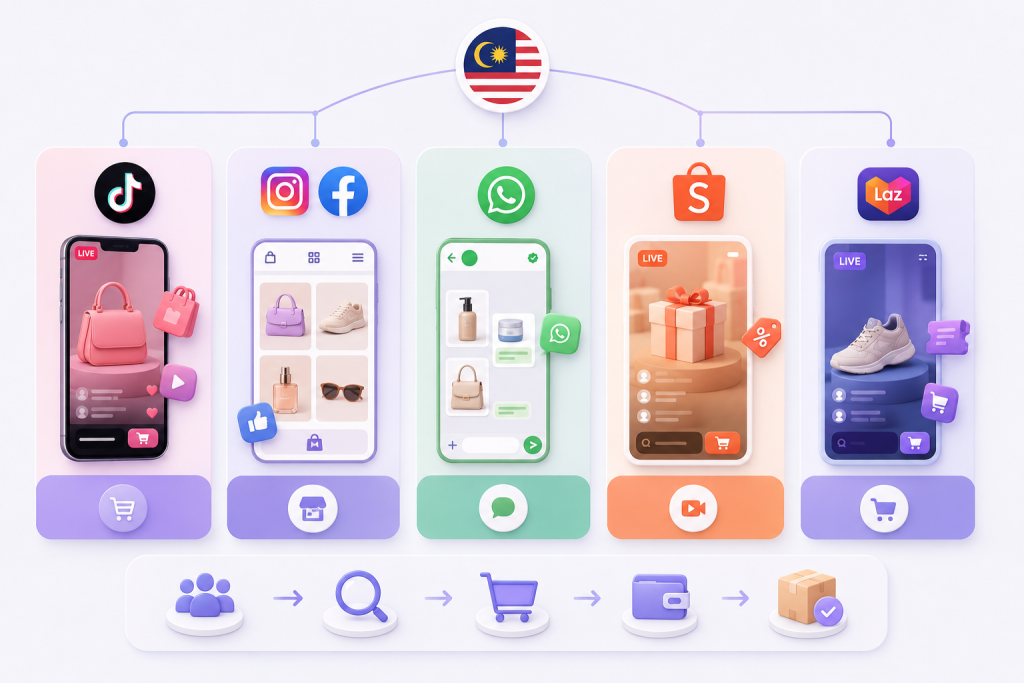
Think of TikTok Shop, Instagram and Facebook Shops, WhatsApp order flows, and live selling on Shopee or Lazada. In each case the platform is not just a billboard. It is the shop, the fitting room, and the till at the same time.

The numbers behind the shift
Social commerce stopped being a side experiment a while ago. A few figures make the scale clear.
Globally, Accenture projected social commerce would grow roughly three times as fast as traditional e-commerce, reaching about USD 1.2 trillion by 2025, up from USD 492 billion, and climb from around 10% of total e-commerce to 17% (Accenture). In the same study, 64% of social media users said they had made a social commerce purchase in the past year, and Gen Z plus Millennials were expected to account for 62% of spend.
Southeast Asia is one of the fastest-moving regions. Mordor Intelligence values the regional social commerce market at USD 47.58 billion in 2025, forecasting growth to USD 186.5 billion by 2030, a compound annual growth rate of about 31.4% (Mordor Intelligence). Not long ago social commerce made up less than 5% of the region’s e-commerce GMV. It now sits closer to 20% to 25%.
Malaysia is part of that story. Statista figures put Malaysia’s TikTok Shop-led social commerce at roughly USD 400 million in 2023, on track to approach USD 1 billion by 2028 (Statista). On the platform side, Malaysia posted one of the highest TikTok Shop growth rates in the region and holds a meaningful slice of Southeast Asian GMV, which tells you Malaysian shoppers are comfortable buying inside these apps (Sellercraft).
The takeaway is simple. Your customers are already buying this way. The only question is whether they are buying from you or from a competitor who set up shop first.
How social commerce works
Under the surface, most social commerce follows the same path. The platform changes, the steps rarely do.
- Discovery. A shopper meets your product through a video, a live stream, a Story, or a creator post. This is usually algorithm-driven, not search-driven, so content quality decides who sees you.
- Interest. They tap a product tag, watch a demo, or read comments from other buyers. Social proof does a lot of the selling here.
- Consideration. They ask a question in the comments or over direct message, compare it against alternatives, and check the price.
- Checkout. They buy inside the app using saved payment details, often in a few taps.
- Retention. After the sale, follow-up content, restock alerts, and repeat live streams bring them back.
The friction that kills normal online sales, loading a separate site, creating an account, re-entering card details, mostly disappears. That is why impulse categories like fashion, beauty, food, and small electronics do so well.
If you already run a store and want the back end to match this speed, that is where solid e-commerce development and inventory sync matter, so a sold-out product on TikTok Shop does not still show as available on your website.
Social commerce vs traditional e-commerce
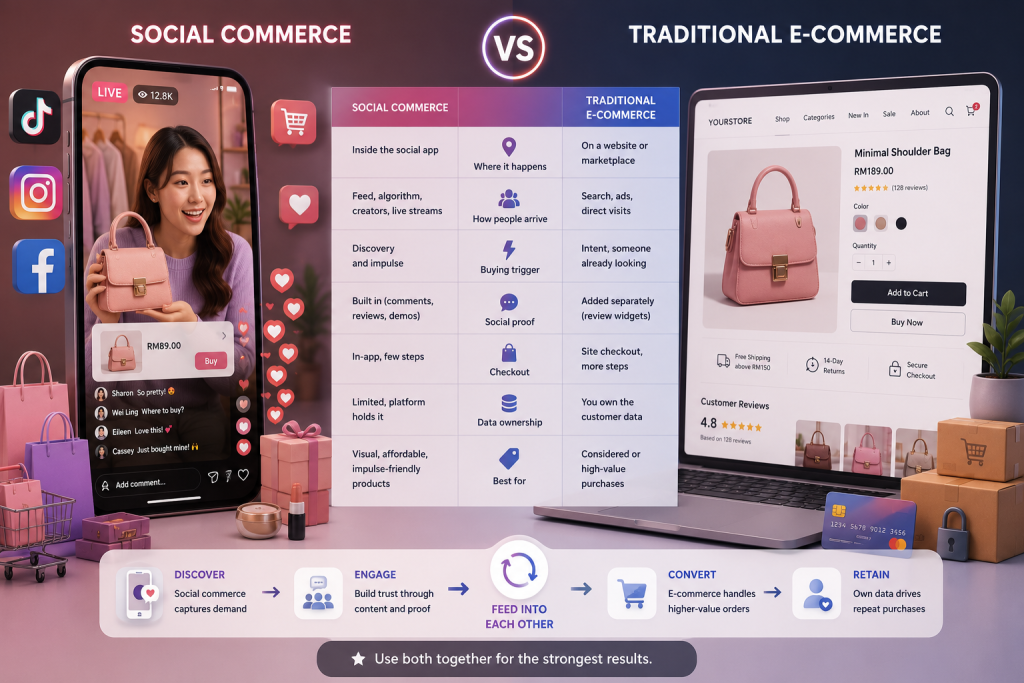
Both sell products online, but they behave differently. Here is a quick side by side.
|
Factor |
Social commerce |
Traditional e-commerce |
|
Where the sale happens |
Inside the social app |
On your website or marketplace store |
|
How buyers arrive |
Feed, algorithm, creators, live streams |
Search, ads, direct visits |
|
Buying trigger |
Discovery and impulse |
Intent, the shopper is already looking |
|
Trust signal |
Comments, live demos, creator credibility |
Reviews, ratings, brand reputation |
|
Data you own |
Limited, held mostly by the platform |
Full, first-party customer data |
|
Best for |
Visual, lower-priced, impulse products |
Considered, higher-value, or complex products |
Neither one replaces the other. Social commerce wins on reach and impulse. Your own store wins on ownership, margin, and control over the customer relationship. Most brands that do well use both, treating social as the top of the funnel and their website as the place they build long-term value and run conversion rate optimization.
Key social commerce platforms in Malaysia
You do not need to be everywhere. You need to be where your buyers are. Here is how the main channels play out locally.
TikTok Shop
TikTok Shop is the headline act in Malaysia. Short videos and live selling sit right next to a full checkout, and the algorithm can put a small seller in front of a large audience without a big following. It suits fashion, beauty, food, gadgets, and anything that demos well on camera. Paid reach usually speeds things up, so pairing organic content with TikTok ads is common once a product starts to move.
Instagram and Facebook Shops
Meta’s platforms remain strong for visual and lifestyle brands. Instagram Shopping lets you tag products in posts, Reels, and Stories, while Facebook Shops and Marketplace reach a broader, often older audience. Both connect neatly to catalog-based advertising, which is why brands lean on Instagram ads and Facebook ads to retarget people who viewed a product but did not buy.
WhatsApp is quietly one of Malaysia’s most effective selling tools. A lot of local purchases still close through a chat: a customer asks about sizing or delivery, gets a quick reply, and pays by transfer or a payment link. It is conversational, personal, and trusted, which is exactly why so many SMEs never left it.
Shopee Live and Lazada Live
The big marketplaces added live streaming to keep shoppers engaged during the browse. Hosts demo products, drop time-limited vouchers, and answer questions in real time, all while the checkout sits one tap away. If you already sell on Shopee or Lazada, live sessions are a low-friction way to lift conversion on stock you already list.
Picking the right mix depends on your product, margin, and audience. A well-run social media advertising plan usually starts on one platform, proves the economics, then expands.
Benefits for businesses
Why bother building this out? A few reasons stand out.
- Shorter path to purchase. Fewer clicks between wanting and buying means fewer drop-offs.
- Lower barrier to entry. You can start selling on TikTok Shop or WhatsApp without building a full website first.
- Built-in trust. Comments, live demos, and creator endorsements answer objections before you have to.
- Rich discovery. The algorithm hands you reach you would otherwise pay heavily for, at least while your content performs.
- Fast feedback. You learn what sells within days, not quarters, and can adjust pricing or bundles quickly.
For smaller Malaysian businesses, that last point matters most. Social commerce lets you test an idea cheaply before you commit to inventory or a bigger storefront.
Challenges to watch
It is not free money, and a few things trip sellers up.
- Platform dependence. You are building on rented land. An algorithm change or account suspension can cut your reach overnight, so keep a channel you own.
- Thin data ownership. The platform holds most of the customer data, which makes it harder to remarket outside the app.
- Margin pressure. Platform fees, ad spend, and constant voucher expectations can eat into profit if you do not price for them.
- Content demand. Social selling runs on a steady stream of video and live sessions. That is real ongoing work, not a one-time setup.
- Logistics and service. Fast checkout raises buyer expectations for fast delivery and quick replies. Weak fulfilment shows up in your ratings fast.
The fix for most of these is the same. Use social commerce to acquire customers, then move the relationship onto channels you control so you are not fully exposed to any single platform.
How to get started
You do not need a huge budget to begin. You need a sensible sequence.
- Pick one platform. Match it to your product. Visual and impulse items lean TikTok Shop or Instagram. Considered or service-led sales often start on WhatsApp.
- Set up your shop properly. Complete the catalog, write clear product descriptions, and add real photos and prices. Half-finished listings lose sales.
- Create content built for the feed. Short demos, honest reviews, and behind-the-scenes clips beat polished ads that look like ads.
- Test paid reach. Once something sells organically, put budget behind it to scale what already works.
- Sort out fulfilment and replies. Decide who ships orders and who answers messages before volume climbs.
- Connect it to your own store. Send buyers to a website you control for repeat purchases, email capture, and e-commerce SEO that keeps bringing traffic long after a video stops trending.
Start small, measure honestly, and double down on the channel that returns the most per ringgit. Chasing every platform at once is the fastest way to burn budget and attention.
Near-term trends to prepare for
A few shifts are worth planning around rather than reacting to.
Live shopping keeps growing. Live selling already drives a real chunk of TikTok Shop sales, and Malaysian shoppers respond well to real-time demos and limited-time offers. Expect more brands to run regular live schedules, not one-off events.
Social plus AI. Platforms are folding AI into recommendations, chat replies, and content creation. Practically, that means faster customer responses, sharper product targeting, and quicker content production for sellers who adopt the tools early.
Creators and UGC stay central. Buyers trust a person more than a logo. Partnering with small and mid-tier creators, and encouraging real customers to post, tends to convert better than glossy brand ads. Accenture’s research points the same way, with the majority of social commerce spend flowing through younger, creator-influenced audiences.
None of this is exotic. It is the current playbook getting faster and more automated. The brands that show up consistently now will have the reviews, followers, and data to compete later.
Frequently asked questions
Is social commerce only for B2C businesses?
Mostly, yes. It fits consumer products best because the buying decision is quick and visual. B2B companies can still use social platforms to generate leads and build authority, but the actual sale usually closes off-platform through a quote or a sales conversation.
Do I still need a website if I sell on social media?
It is strongly recommended. Social channels are great for reach, but you do not own them. A website gives you first-party data, better margins, search traffic, and a home base that no algorithm change can take away. Treat social as the front door and your site as the house.
Which platform should I start with in Malaysia?
Start where your customers already spend time and match it to your product. TikTok Shop suits visual, impulse-friendly items. Instagram and Facebook work for lifestyle brands. WhatsApp is excellent for personal, chat-led selling. Begin with one, prove it works, then expand.
How much does it cost to start selling on social commerce?
You can open a TikTok Shop or sell through WhatsApp with almost no upfront cost beyond your products and time. The real spend comes later, on content creation, advertising, and fulfilment, and scales with your ambitions. Test cheaply before committing budget.
How do I measure whether social commerce is working?
Track the metrics that tie to money: conversion rate, average order value, cost per acquisition, and repeat purchase rate. Views and follower counts are nice, but they do not pay the bills. Focus on what turns attention into orders.
Getting started with the right support
Social commerce rewards businesses that treat it as a system, content, platform setup, advertising, fulfilment, and a website that captures the value, rather than a random posting habit. Get the pieces working together and it becomes one of the most efficient ways to reach Malaysian buyers.
If you want a clearer picture of where you stand, MediaPlus Digital offers a free RM300 audit of your current setup, covering your channels, ad performance, and store, with practical next steps you can act on.
Ready to build a social commerce engine that actually sells? Request a quote and let’s map out the right platforms and plan for your business.