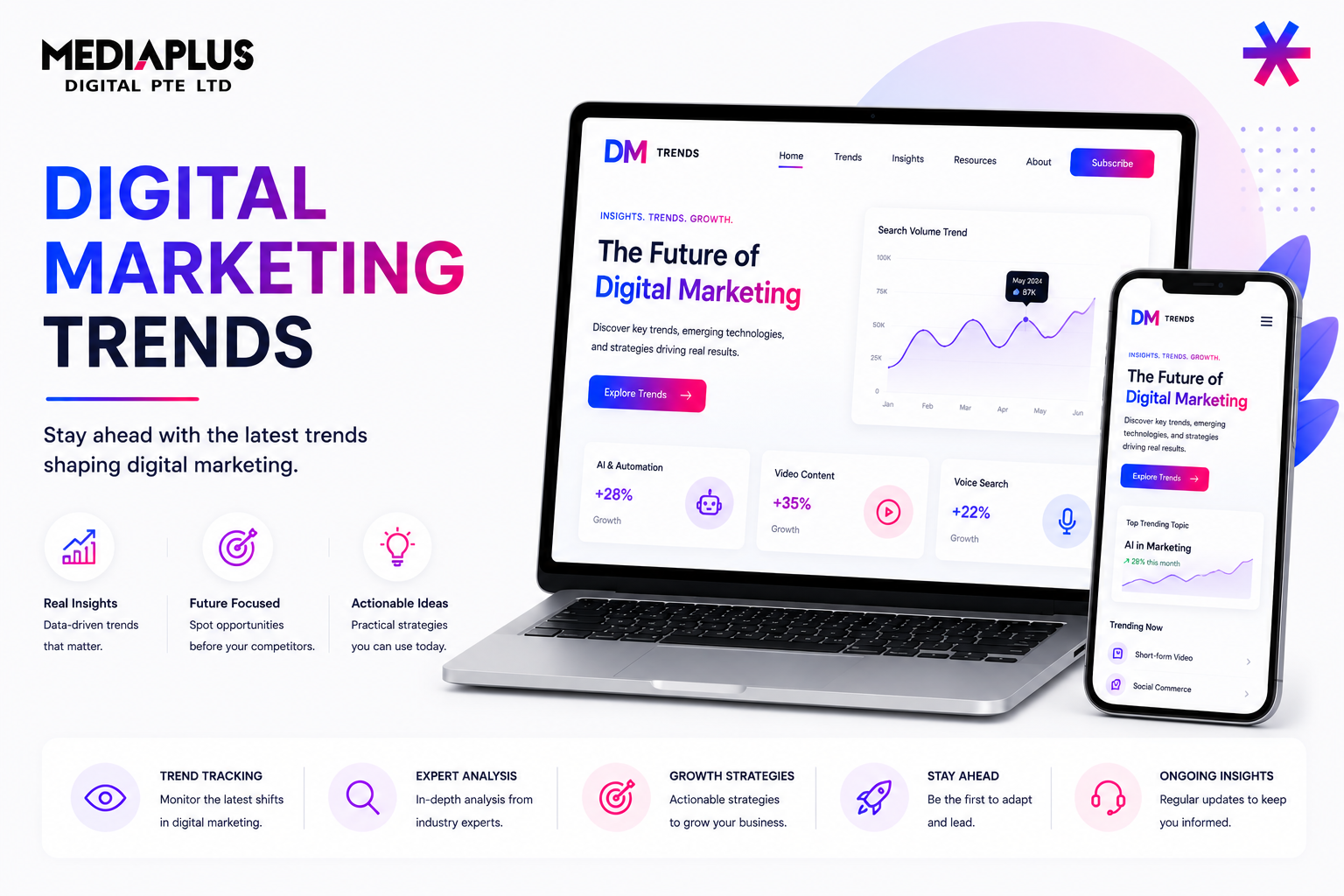
Marketing budgets are moving faster than most teams can plan for. The channels that worked in 2023 still work, but the way people find brands, compare them, and buy has shifted underneath everyone. AI now sits between your customer and your website. Video eats more attention every quarter. Shopping happens inside social apps, sometimes during a live stream at midnight.
The numbers set the scene. Malaysia had 35.4 million internet users at the end of 2025, roughly 98 percent of the population, according to DataReportal’s Digital 2026 report. Social media identities reached 30.7 million, about 85 percent of the country, and that base grew by 5.6 million people (a 22.2 percent jump) in a single year. Digital formats now pull in about 76 percent of total advertising revenue in Malaysia, having overtaken TV, print, radio, and outdoor combined.
So the audience is here and online. The harder question is where they pay attention and how a business earns it. This guide walks through the trends that will shape Malaysian digital marketing in 2026. For each one you get a plain explanation, a reason it matters (with a stat where we have a solid source), and a practical move for a Malaysian business.
AI in Marketing: From Experiment to Daily Operations
For two years AI was the thing marketers tried on the side. In 2026 it runs inside the workflow. Teams use it to draft copy, cut first versions of video, cluster audiences, write ad variants, and summarise campaign data that used to take an analyst a full day.
The shift worth noting is from generative AI (you prompt, it produces) toward agentic AI, where systems plan a task, execute it, check the result, and adjust. Think of a tool that drafts a week of social posts, schedules them, watches early engagement, and rewrites the weak ones without being asked each time.
Why it matters: HubSpot’s 2026 State of Marketing report, based on more than 1,500 marketers, found that short-form video is now the highest-ROI format and that 93 percent of marketers say personalisation improves leads or sales. AI is what makes personalisation at that scale affordable for a mid-sized company.
What a Malaysian business should do:
- Pick two or three repeatable tasks (ad copy variations, product descriptions, first-draft blog outlines) and build an AI workflow for them, with a human checking output before it ships.
- Keep a brand voice document and feed it into every tool so AI output sounds like you, not like everyone else.
- Do not automate the final review. AI drafts, a person approves.
Generative Engine Optimisation (GEO) and the New Shape of Search
Search is no longer just ten blue links. Google AI Overviews now appear on roughly half of queries in some markets, and people increasingly ask ChatGPT, Gemini, or Perplexity a question and read the answer without clicking anything. This changes the goal of SEO. You are no longer only trying to rank a page. You are trying to be the source an AI quotes.
That practice has a name now: Generative Engine Optimisation (GEO), sometimes called Answer Engine Optimisation. Early data suggests the payoff is real. Similarweb and other analysts report that AI search now drives an estimated 12 to 18 percent of referral traffic in some sectors, up from single digits in late 2024, and that visitors arriving from AI tools tend to convert at far higher rates than typical organic search visitors because they arrive with intent already formed.
There is a structural clue in the data too: pages built with structured lists, direct quotes, and specific statistics get cited more often by AI engines than long prose-heavy pages.
What a Malaysian business should do:
- Answer real customer questions directly and early on the page. Put the answer first, the story second.
- Use clear headings, short factual sentences, tables, and named sources. These are the passages AI tends to lift.
- Add structured data (FAQ, product, organisation schema) so machines can read your pages cleanly.
- Do not abandon classic SEO. Traditional rankings still feed AI answers. GEO sits on top of good SEO, it does not replace it.
If your organic visibility has slipped as AI answers grew, this is the area to fix first. MediaPlus Digital covers both sides through its SEO services and dedicated GEO services.
Short-Form Video and TikTok
Short-form video keeps winning attention in Malaysia, and marketers keep reporting it as the format with the best return. TikTok alone reaches 30.7 million users aged 18 and over in the country, per DataReportal, and YouTube reaches 23.6 million. Vertical video is where discovery happens now.
The bar for entry is low, which is both good and bad. Anyone can post, so anyone competes. What separates brands that grow is a steady output of native-feeling clips: fast hook in the first two seconds, real faces, captions on, and a point that lands before people swipe.
What a Malaysian business should do:
- Commit to volume over polish. Ten scrappy but useful clips beat one expensive ad nobody sees.
- Shoot vertical, add captions, and localise. Mix Bahasa Malaysia, English, and dialect where it fits your audience.
- Repurpose. One filmed session can become a dozen short clips for TikTok, Reels, and YouTube Shorts.
For paid reach, TikTok Ads let you put spend behind the clips that already earn organic traction.
Social Commerce and Live Shopping
Buying now happens inside the app. Malaysia’s social commerce market is valued around USD 18.98 billion in 2026 and is projected to keep growing at roughly 11 percent a year, according to Research and Markets. Shoppers in Malaysia spent about RM12.07 billion on TikTok Shop in 2024, one of the highest totals in the world, and the market crossed USD 5 billion in TikTok Shop GMV with triple-digit year-on-year growth.
Live shopping is a big part of this. One Malaysian creator generated RM2.3 million in a single 12-hour TikTok livestream. That is not a fluke, it is a channel.
The buying journey has compressed. Someone sees a product in a video, taps, reads a review, and checks out without ever visiting a website. If your funnel still assumes people land on your homepage first, you are missing where the sale now happens.
What a Malaysian business should do:
|
Move |
Why it works |
|
Set up TikTok Shop and Shopee storefronts |
Meets buyers inside the app where the purchase happens |
|
Run regular live sessions |
Live drives urgency and answers objections in real time |
|
Partner with creators for live selling |
Their audience already trusts the recommendation |
|
Keep product info tight and visual |
Compressed journeys reward clarity over long copy |
First-Party Data and Privacy
Third-party cookies are effectively gone, and Malaysia’s own privacy rules have tightened with amendments to the Personal Data Protection Act. The practical result: data you collect directly from customers is now your most valuable marketing asset.
HubSpot’s 2026 report notes that 84 percent of consumers view data privacy as a basic right, and that zero-party data (information customers hand over willingly in exchange for something useful) is becoming central to how brands personalise.
The way to earn that data is a fair trade. People share an email or a phone number when they get something worth it back: a discount, a useful tool, early access, a genuinely helpful quiz result.
What a Malaysian business should do:
- Build value-exchange offers that collect first-party data with clear consent.
- Keep clean, consented lists for email and WhatsApp, both of which perform strongly in Malaysia.
- Make sure your data practices comply with the updated PDPA. Consent has to be explicit and purpose has to be stated.
Hyper-Personalisation
Personalisation used to mean putting a first name in an email subject line. In 2026 it means adapting the actual content, offer, and timing to the individual, powered by first-party data and AI.
The gap here is opportunity. HubSpot found that while 93 percent of marketers say personalisation lifts results, only about 13 percent have reached advanced or hyper-personalisation. Most are still doing basic segmentation. That means a Malaysian business that gets this right can stand out without needing an enterprise budget.
What a Malaysian business should do:
- Segment beyond demographics. Group by behaviour: what people viewed, bought, or abandoned.
- Trigger messages off actions. A cart left behind, a repeat visit to a product page, a first purchase.
- Personalise the landing experience, not just the email. Send different visitors to pages that match their intent.
Turning that traffic into sales is where conversion rate optimisation does its work, testing which personalised experiences actually move the needle.
Influencer and Creator Marketing
Creator marketing in Malaysia has matured past one-off celebrity posts. The money and the results are moving toward smaller, more trusted voices. HubSpot’s data shows marketers get the best results from micro-influencers (about 32 percent success rate), ahead of macro and mega tiers.
The reason is trust. A creator with 40,000 engaged local followers who genuinely uses your product often outperforms a national name with a million passive followers. Their audience listens, and in social commerce that same creator can sell live.
What a Malaysian business should do:
- Work with micro and nano creators whose audience matches yours, not just whoever has the biggest count.
- Judge partnerships on saved posts, comments, and sales, not vanity reach.
- Give creators room to make content in their own voice. Over-scripted posts feel like ads and get ignored.
- Blend it with commerce. A creator who can go live and sell is worth more than one who only posts.
Performance Marketing and Measurement (ROAS)
As data signals get noisier from privacy changes, proving what your spend actually earns matters more. Performance marketing in 2026 is about measurement you can defend: return on ad spend (ROAS), cost per acquisition, and, increasingly, incrementality (did the ad cause the sale, or would it have happened anyway).
Paid channels still deliver in Malaysia, but wasted spend hides easily inside vanity metrics. The teams that win treat every ringgit as a test with a clear read on outcome.
What a Malaysian business should do:
- Set up proper conversion tracking with server-side tagging so you keep measuring accurately as browser signals fade.
- Report on ROAS and cost per acquisition, not just clicks and impressions.
- Test in small controlled batches, keep what beats the benchmark, cut what does not.
MediaPlus Digital runs this through its Google Ads, social media ads, and broader performance marketing services, all built around outcomes rather than surface metrics.
Conversational Marketing and Chatbots
Malaysians live on messaging. WhatsApp is the most-used platform in the country, and conversation is where a lot of buying decisions get made. Conversational marketing meets people there, answering questions, qualifying leads, and booking sales without making anyone fill out a form and wait.
AI has made chatbots genuinely useful rather than the frustrating scripts of a few years ago. A well-built bot now handles product questions, checks stock, books appointments, and hands off to a human at the right moment, day or night.
What a Malaysian business should do:
- Put a chatbot where your customers already are: WhatsApp, your website, Instagram DMs.
- Design it to help first and sell second. Answer the question, then guide toward the next step.
- Set clear handoff rules so a real person takes over when the conversation needs it.
A properly built assistant does more than deflect FAQs. See MediaPlus Digital’s chatbot development service for what that looks like in practice.
Omnichannel: One Brand Across Every Touchpoint
A Malaysian customer might discover you on TikTok, check reviews on Google, ask a question on WhatsApp, and buy on Shopee. Omnichannel means those touchpoints feel like one brand, with consistent pricing, tone, and information, and ideally shared data so the experience carries over.
This is less a single tactic than the glue holding all the others together. The trends above only compound when they work as a system: your video drives discovery, your GEO-ready content answers the research question, your chatbot handles the query, your social storefront closes the sale.
What a Malaysian business should do:
- Map your customer’s real path across channels and find where it breaks or repeats.
- Keep messaging and offers consistent everywhere. Contradictions cost trust.
- Connect your tools so a lead captured in one place is recognised in the next.
How to Prioritise These Trends for 2026
You cannot chase all ten at once, and you should not try. Here is a sane order for most Malaysian businesses.
- Fix the foundation first. Clean SEO, working conversion tracking, and first-party data collection. Without these, everything else measures poorly.
- Get visible where discovery now happens. That usually means short-form video plus GEO-ready content so both people and AI find you.
- Shorten the path to purchase. Social commerce, a helpful chatbot, and personalised landing pages that turn attention into sales.
- Scale what proves out. Once tracking is honest, put paid spend behind the channels showing real ROAS, and layer in creator partnerships.
Match the order to your business. A product brand should lean into TikTok Shop and live selling early. A services firm should prioritise GEO, conversational marketing, and lead-focused performance campaigns.
Frequently Asked Questions
What is the single most important digital marketing trend for Malaysian businesses in 2026?
There is no single one, but if forced to pick, it is the shift in search. AI answers now sit between customers and your website, so being the source AI cites (GEO) plus keeping strong classic SEO protects the visibility everything else depends on.
Is SEO dead now that AI answers so many questions?
No. SEO is changing, not dying. AI engines pull from ranked, well-structured content, so good SEO now feeds AI answers. The work expands to include GEO, which optimises for citations inside AI responses on top of traditional rankings.
Do small Malaysian businesses really need to be on TikTok Shop?
If you sell products to consumers, almost certainly yes. Malaysians spent billions on TikTok Shop in a single year, and live selling has become a genuine sales channel. Service businesses gain less from a storefront but still benefit from short-form video for reach.
How much should a Malaysian SME budget for digital marketing in 2026?
It depends on your goals, margins, and how competitive your sector is, so a fixed figure would mislead. The better approach is to start with clear tracking, test channels in small batches, and scale spend into whatever shows a solid return on ad spend.
What is first-party data and why does it matter more now?
First-party data is information you collect directly from customers with their consent (emails, phone numbers, purchase history). With third-party cookies gone and the PDPA tightened, it is the most reliable foundation for targeting and personalisation you actually own.
Where to Start
None of these trends is a silver bullet. What works in 2026 is a connected system: content that both people and AI can find, video that earns attention, a short path to purchase, and honest measurement telling you what to scale. Most Malaysian businesses do not need all of it at once. They need the right two or three moves, done properly, in the right order.
If you want a clear read on where you stand and what to fix first, MediaPlus Digital offers a free RM300 digital marketing audit that looks at your current visibility, channels, and biggest gaps. Talk to us and we will map a plan built around your business, not a generic checklist.