Quick answer: To get your website cited by AI, you need three things: content structured so AI can extract a clear answer (answer-first blocks and schema), a brand AI recognises and trusts (a clear entity, authority, and backlinks), and freshness plus off-site validation (recent updates, mentions on Reddit, Quora, and YouTube). Each AI engine sources information a little differently, so this guide covers how ChatGPT, Perplexity, and Google AI Overviews pick sources, and the exact tactics to become the source they cite.
What “getting cited by AI” means
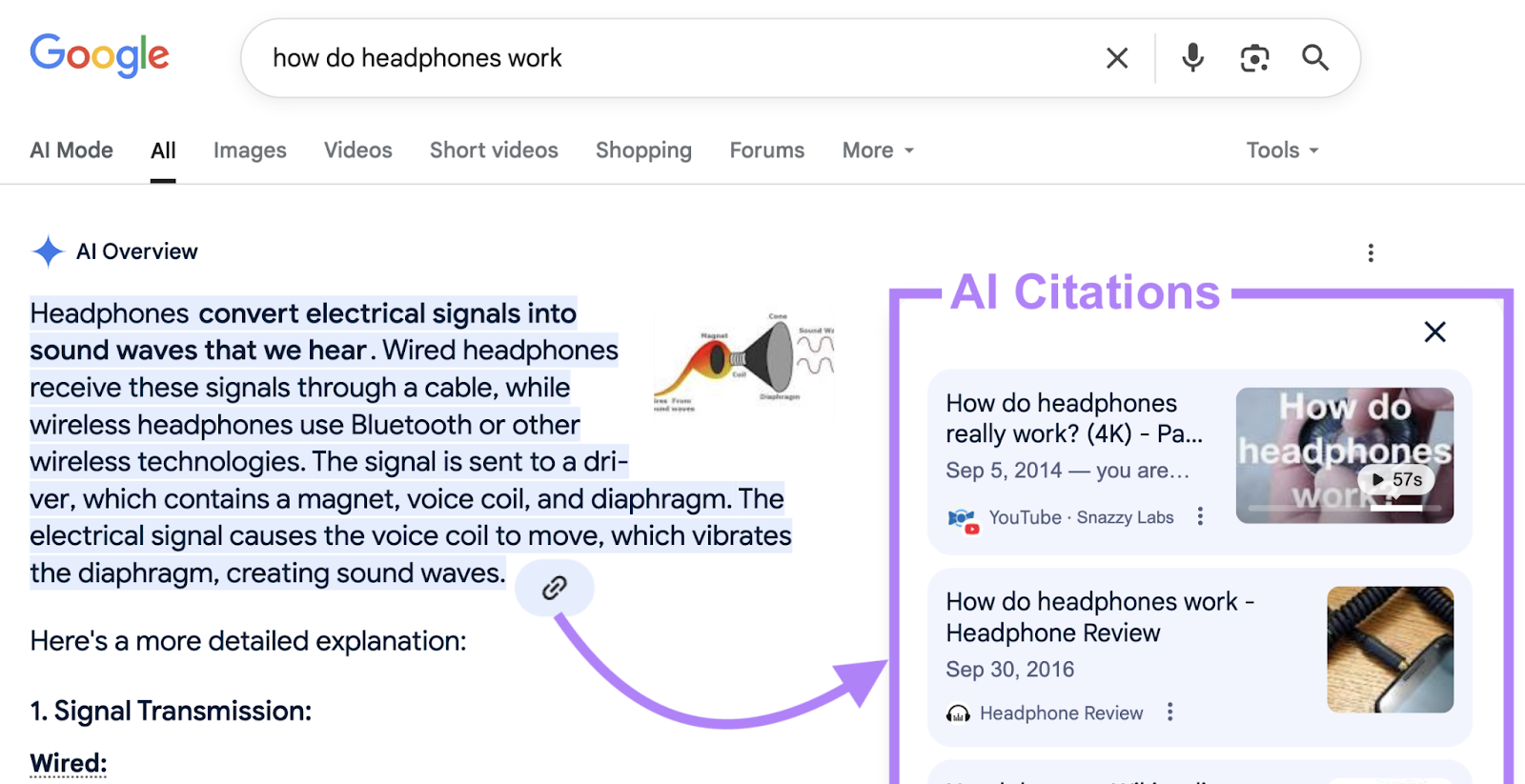
When someone asks ChatGPT, Perplexity, Google AI Overviews, or Gemini a question, the AI writes an answer and often names a few sources. Getting cited means your website is one of those named sources. It is the new version of ranking number one: instead of a click from the results, you get quoted inside the answer, with a link. As more searches end in an AI answer, being cited is how you stay visible.
How AI chooses what to cite
Across platforms, AI systems favour sources that are:
- Clear and extractable. Content that directly answers the question in a quotable way.
- Authoritative. Trusted brands and sites, with backlinks and a strong reputation.
- Well-structured. Schema markup and clean formatting that machines can parse.
- A recognised entity. A brand the AI understands as a known, consistent thing.
- Fresh. Recently published or updated content. Perplexity in particular weights freshness heavily, and a large share of AI crawler activity targets recently updated pages.
- Validated off-site. Mentioned and discussed on other trusted places (Reddit, Quora, review sites, YouTube).
How each AI engine sources information (this matters)
The engines differ, so optimise for each.
|
Engine |
How it sources answers |
What to prioritise |
|
Google AI Overviews |
Draws mainly from existing organic results; most cited sources come from the top of page one |
Rank well organically, add schema, answer-first content |
|
Perplexity |
Runs a real-time web search for every query (Google and Bing APIs) and synthesises with inline citations |
Freshness, clear answers, strong SEO, be indexable and current |
|
ChatGPT (Search) |
Blends its model with live search and looks for external validation |
Authority, mentions on Reddit, Quora, G2, and a clear entity |
|
Gemini |
Tied closely to Google Search and the knowledge graph |
Organic visibility and a well-defined entity |
The common thread: strong classic SEO still powers AI citations, because AI answers are assembled from the indexed, trusted web.

How to get cited by AI: the tactics
1. Write answer-first, quotable content
Lead each section with a clear, direct answer AI can lift, then expand. Use question-style headings that match how people ask, and include concise “quotable blocks” (a definition, a stat, a step list). If AI cannot extract a clean answer, it cannot cite you.
2. Add structured data (schema)
Mark up your content with schema (FAQ, HowTo, Article, Product, Organisation). It helps AI understand and trust your content, and win featured results. FAQ and HowTo schema are especially useful for AI answers.
3. Make your brand an unambiguous entity
AI cites sources it recognises. Build a clear, consistent entity: consistent name and details everywhere, an “about” and author information, a Wikipedia or Wikidata presence where warranted, and consistent mentions across the web. The clearer your entity, the more confidently AI can cite you.
4. Build authority and backlinks
AI leans on the same authority signals as search: backlinks and reputation from relevant, trusted sites. Earn them with link-worthy content and digital PR. Authority is often what tips AI toward citing you over a competitor.
5. Keep content fresh
Freshness is a strong signal, especially for Perplexity. Update key pages regularly, add an honest “Updated [month, year]”, refresh stats, and re-publish improved versions each quarter. Stale pages get cited less.
6. Publish an llms.txt file
An llms.txt file at your site’s root is the “robots.txt for the AI age”: a machine-readable summary of your brand and key pages that helps AI understand what you offer. It is an emerging but easy step to help AI models find and use your content.
7. Win off-site validation
AI, especially ChatGPT, looks for external proof. Get your brand mentioned and discussed on Reddit, Quora, review platforms (like G2), and industry sites. These third-party signals build the trust AI looks for.
8. Use YouTube and multi-channel presence
YouTube has become one of the most-cited sources in AI Overviews, with brand mentions in video titles and transcripts strongly correlating with AI visibility. A presence across video, social, and the web widens your citation surface.
9. Keep your SEO foundation strong
Because AI answers are built from indexed, trusted pages, everything that makes you rank (technical health, content, links) also makes you citable. AEO and GEO build on SEO, not instead of it. See our AI SEO and GEO service.

How to measure AI citations
You cannot improve what you do not track. To measure AI visibility:
- Pick target prompts, the questions your customers ask AI where you want to appear.
- Run them monthly across ChatGPT, Perplexity, Gemini, and Google AI Overviews.
- Record whether you are cited, and your share of answers versus competitors.
- Track the trend over time, and use AI-visibility monitoring tools to scale this.
Share of AI answers is the new share of voice.
Common mistakes to avoid
- Burying the answer. If AI cannot extract a clear answer, it will not cite you.
- No schema or structure. Machines need clean, marked-up content.
- A weak or inconsistent entity, so AI is not sure who you are.
- Stale content, which loses to fresher sources.
- Ignoring off-site signals like Reddit, Quora, and YouTube.
- Treating AEO as separate from SEO, when it builds on it.

Frequently asked questions
How do I get my website cited by AI?
Structure content as clear, answer-first blocks with schema, build a recognised, authoritative entity with backlinks, keep content fresh, publish an llms.txt, and earn off-site validation on Reddit, Quora, and YouTube. Strong SEO underpins all of it.
How does ChatGPT decide what to cite?
ChatGPT blends its model with live search and looks for external validation, favouring authoritative, well-known sources mentioned across trusted places like Reddit, Quora, and review sites, with a clear brand entity.
How do I get cited in Google AI Overviews?
AI Overviews draw mainly from existing organic results, with most cited sources coming from the top of page one. So rank well organically, add schema, and write answer-first content.
Does freshness matter for AI citations?
Yes, a lot, especially for Perplexity, which runs a live search and weights recent content. Keep key pages updated and refreshed.
What is an llms.txt file?
An llms.txt file sits at your site’s root and gives AI models a machine-readable summary of your brand and key pages, like a robots.txt for AI. It helps AI understand and use your content.
Do I still need SEO to get cited by AI?
Yes. AI answers are assembled from indexed, trusted pages, so strong technical, content, and off-page SEO is what makes you citable in the first place.
The bottom line
Getting cited by AI comes down to being the clearest, most trusted, freshest answer, structured so machines can extract it. Write answer-first content with schema, build a recognised and authoritative entity, keep it fresh, add an llms.txt, and earn off-site validation on Reddit, Quora, and YouTube, then track your share of AI answers monthly. Do that, and your brand becomes the one AI quotes.
Want your brand cited across AI search? Talk to MediaPlus Digital about our AI SEO and GEO service and claim a free RM300 AI visibility audit.