What is PPC?
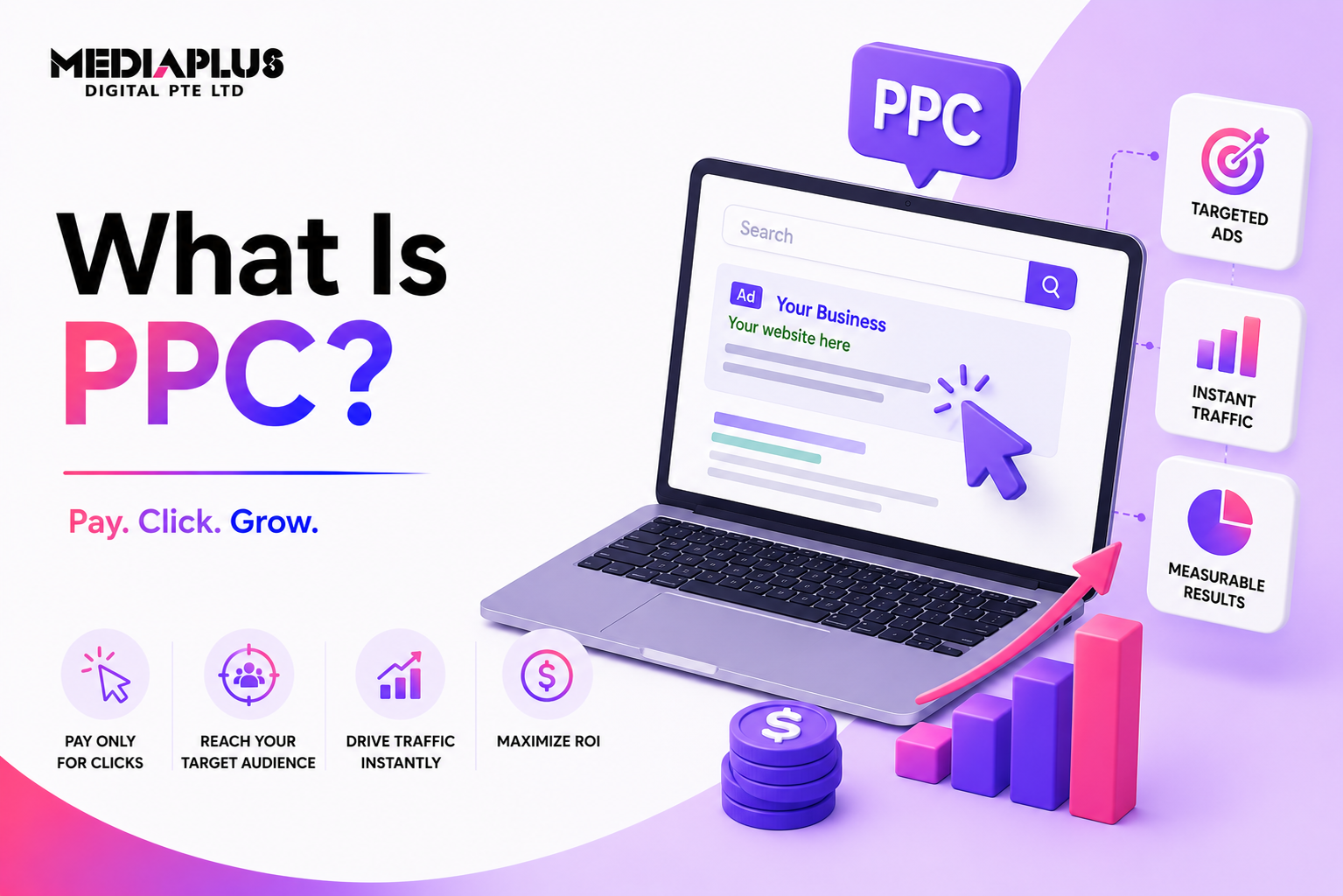
PPC, or pay-per-click, is a form of online advertising where you pay a fee only when someone clicks your ad. Instead of paying for the ad to be shown, you pay for the click that brings a visitor to your site. It is how businesses buy their way to the top of Google and social feeds, on demand, and only pay for actual traffic.
The most common form is search ads on Google, but PPC also runs on Meta, YouTube, TikTok, and across the web. This guide explains how PPC works, what it costs in Malaysia, and whether it is right for you.
How does PPC work?
PPC runs on an auction. When someone searches a keyword, the ad platform runs an instant auction among advertisers bidding on it and decides which ads show and in what order. You do not just pay your way to the top: platforms reward relevance, so a well-matched ad and landing page can rank higher and cost less than a competitor bidding more.
The basics:
- You choose keywords or audiences you want to target.
- You set a bid (the most you will pay per click) and a daily or monthly budget.
- The auction decides which ads show, based on bid and quality.
- You pay only when someone clicks, and your budget cap means you never overspend.
Your total spend is simply your cost-per-click multiplied by the clicks you get, capped by your budget.
PPC vs SEO: what is the difference?
Both get you visibility on Google, but they work differently.
|
PPC |
SEO |
|
|
Speed |
Traffic today |
Builds over months |
|
Cost |
Pay per click, ongoing |
No cost per click, effort over time |
|
Position |
Top ad slots |
Organic results below ads |
|
Stops when |
You pause the budget |
Keeps working after the work |
PPC buys immediate, controllable traffic; SEO earns compounding traffic over time. Most businesses use both: PPC for quick wins and testing, SEO for long-term, lower-cost traffic.
Where PPC ads run
- Search ads (Google, Bing): text ads at the top of search results. The classic PPC.
- Display ads: banner ads across websites, for awareness and remarketing.
- Shopping ads: product ads with image and price, for ecommerce.
- Social ads (Meta, TikTok): ads in feeds, strong for targeting and visuals.
- YouTube ads: video ads, often billed per view rather than per click.
Key PPC terms to know
- CPC (cost-per-click): what you pay for each click.
- CTR (click-through rate): the percentage of people who click after seeing your ad.
- Quality Score: Google’s rating of your keyword, ad, and landing page relevance. Higher scores lower your cost.
- Impressions: how many times your ad was shown.
- Conversion: the action you want (a sale, lead, or call).
- CPA (cost per acquisition): what you pay to get one conversion.
How much does PPC cost in Malaysia?
PPC cost has two parts: your ad spend (paid to the platform) and, if you use one, an agency management fee. Ad spend is driven by cost-per-click, which varies a lot by industry.
|
Industry |
Typical Google Ads CPC (RM) |
|
Food & beverage, retail |
Under 5 |
|
Most SMEs |
3 to 6 |
|
Legal, finance, medical |
8 to 30+ |
In 2026, Google Ads CPC in Malaysia ranges from about RM1.80 in F&B to RM12.50 or more in legal and professional services. Most SMEs sit in the RM3 to RM6 band. To gather enough data for meaningful optimisation, most businesses need at least RM1,500 to RM3,000 a month in ad spend. For a full breakdown, see our Google Ads price in Malaysia guide.
Two things also move your CPC: competition (denser auctions in Kuala Lumpur and Selangor cost more) and relevance (a tight match between keyword, ad, and landing page lowers your cost).
The pros and cons of PPC
Pros:
- Fast: traffic and leads almost immediately.
- Measurable: you can track every click, cost, and conversion.
- Controllable: set your budget, targeting, and pause any time.
- Targeted: reach people by search intent, location, and audience.
Cons:
- It stops when you stop paying, unlike SEO.
- It can get expensive in competitive industries.
- It needs skill to run profitably; wasted spend is easy.
Is PPC right for your business?
PPC is a strong fit if you want fast results, have a clear offer, and can track what a lead or sale is worth. It is especially useful for new websites that have not built SEO yet, for launches and promotions, and for testing which keywords and messages convert. For the best results, pair PPC with a strong landing page and, over time, SEO.
Frequently asked questions
What is PPC in simple terms?
PPC (pay-per-click) is online advertising where you pay only when someone clicks your ad. It is how businesses appear at the top of Google and in social feeds and pay just for the clicks they receive.
What is the difference between PPC and Google Ads?
PPC is the advertising model (paying per click). Google Ads is the largest platform that uses it. So Google Ads is PPC, but PPC also runs on Meta, TikTok, and other platforms.
How much does PPC cost in Malaysia?
Cost-per-click typically runs RM3 to RM6 for most SMEs, under RM5 for F&B and retail, and RM8 to RM30 or more for legal, finance, and medical. Most businesses budget at least RM1,500 to RM3,000 a month in ad spend.
Is PPC better than SEO?
Neither is better; they do different jobs. PPC gives fast, controllable traffic you pay for. SEO builds slower but keeps working without a cost per click. Most businesses use both.
Do I need an agency to run PPC?
Not strictly, but PPC is easy to lose money on. An experienced agency can lower your cost per click and improve conversions, often paying for itself, especially in competitive industries.
The bottom line
PPC is the fastest way to buy visibility and traffic online: you pay only for clicks, control your budget, and measure every ringgit. It works best with a strong landing page and, ideally, alongside SEO for the long term. Done well, it turns ad spend into a predictable source of leads and sales.
Want PPC that turns clicks into customers, not wasted spend? Talk to MediaPlus Digital about Google Ads and performance marketing, and claim a free RM300 audit.