TikTok stopped being just an entertainment app a while ago. In Southeast Asia it now moves real money, and Malaysia is one of the busiest markets on the platform. If you sell anything physical, from skincare to snacks to phone accessories, learning how to sell on TikTok is one of the fastest ways to reach buyers who are already scrolling with their wallets open.
This guide walks through the whole thing: why TikTok works for commerce right now, the different ways you can sell, a genuine step-by-step to set up TikTok Shop in Malaysia (documents, verification and all), the fees you actually pay, how to build content that sells, how to run LIVE and affiliate campaigns, and how to scale with ads. It is written for the Malaysian market but the core mechanics apply wherever TikTok Shop operates.
Why sell on TikTok now
Social commerce, the practice of buying without leaving the app, has gone from a novelty to a serious channel. Globally, TikTok Shop is on track for roughly USD 112 billion in gross merchandise value in 2026, with more than 15 million active sellers. Southeast Asia carries the largest share of that, and Malaysia crossed USD 5 billion in local GMV with triple-digit year-on-year growth.
Two things make TikTok different from a traditional marketplace like Shopee or Lazada:
- Discovery, not search. On most marketplaces a buyer already knows what they want and types it in. On TikTok the feed surfaces products people did not know they wanted. That means a small brand with a good video can outsell a big brand with none.
- Content and checkout in one place. A shopper can watch a demo, tap the product tag, and pay without ever leaving the app. Fewer steps between “that looks good” and “bought” means higher conversion when the content is right.
If you want the broader picture of how buying inside social apps works, we cover it in what is social commerce. The short version: attention is the new shelf space, and TikTok has a lot of it.
The 5 ways to sell on TikTok
“Selling on TikTok” is not one thing. There are five routes, and most sellers eventually use several together:
- TikTok Shop is the in-app storefront. Products live in a Shop tab on your profile and can be tagged inside videos and LIVEs. This is the foundation everything else plugs into.
- Shoppable videos are normal short videos with a product tag. Someone taps the tag, sees the product card, and checks out. This is where most organic sales come from.
- LIVE shopping is real-time selling. You host a stream, demo products, answer questions, and pin items for instant purchase. Strong for flash deals and higher-consideration products.
- Affiliate and creator selling lets other TikTok creators promote your products for a commission you set. It turns creators into a commission-only sales team.
- TikTok Ads put paid budget behind your best content and Shop products so you reach beyond your followers. Covered in detail below.
A sixth, lighter option is a link in your bio pointing to your own website or Shopify store. It keeps the full margin in your pocket, but it adds a step and usually converts lower than in-app checkout. Many Malaysian sellers run TikTok Shop and their own store side by side.
How to set up TikTok Shop in Malaysia, step by step
Step 1: Create a TikTok Business account
If you are still on a personal account, switch it. Open the app, go to Settings and privacy › Account › Switch to Business Account, and pick the category that fits your products. A Business account unlocks analytics, the ads manager, and the commercial music library so you do not get videos muted for copyright. It is free.
Step 2: Register on TikTok Shop Seller Center
Go to seller-my.tiktok.com and register with your TikTok account or your phone and email. You will choose a seller type:
- Individual seller: open to Malaysian citizens aged 18 or older. You register with your MyKad (Malaysian Identity Card).
- Corporate seller: for a registered Malaysian business. You register with your SSM business registration documents and the legal representative’s ID.
Step 3: Submit documents and get verified
Have these ready before you start so verification is not held up:
- Individual: a clear copy of your MyKad. The name must match the name on your TikTok Shop account.
- Corporate: SSM business registration or licence, plus a government ID for the legal representative whose name matches the company documents.
- Bank account: a Malaysian bank account for payouts. The account holder name must match the ID or business used to register. This is the single most common reason verifications get rejected, so double-check it.
Approval usually takes about 1 to 3 business days once your documents are complete and accurate. If something is unclear, TikTok asks you to resubmit rather than rejecting outright.
Verification deadline note: TikTok Shop Malaysia has been tightening seller verification requirements. Existing sellers have periodically been asked to re-verify identity and business details by set deadlines. Keep your documents current so payouts are never paused.
Step 4: List your products
In Seller Center, add each product with a clear title, several images on a clean background, a short benefit-led description, price in RM, stock quantity, and the correct category. A few things that move the needle:
- Lead the title with what the product is and its main benefit, not your brand name.
- Use the first image as the “hero” shot and later images for details, sizing, and what is in the box.
- Fill in every attribute field. Complete listings surface better and reduce buyer questions.
- Group variants (size, colour, flavour) under one listing rather than creating separate products.
Step 5: Connect fulfilment and logistics
TikTok Shop Malaysia gives you two broad fulfilment paths:
- Platform shipping: you use TikTok’s integrated courier partners. You print the label from Seller Center, drop off or arrange pickup, and TikTok handles tracking and much of the shipping subsidy. This is the simplest option for most sellers.
- Self-fulfilment / your own courier: more control, useful for fragile, bulky, or cold-chain items, but you manage tracking and rates yourself.
Set your handling time honestly. Late shipping hurts your seller score, which quietly reduces how often your products get shown. If you already run a store elsewhere, syncing inventory matters so you do not oversell. Our team covers this kind of plumbing in ecommerce development work.
Step 6: Link your Shop to your TikTok account and go live
Connect the verified Shop to the TikTok profile you post from. Once linked, the Shop tab appears on your profile and you can tag products inside videos and LIVEs. Now the actual selling begins.
TikTok Shop fees and commission in Malaysia
You do not pay to open a TikTok Shop. You pay when you sell. There are three main charges to model into your pricing, plus optional affiliate and ad costs. The figures below are illustrative and change often, so confirm current rates in Seller Center before you set prices.
Illustrative TikTok Shop Malaysia seller costs, 2026
|
Cost |
Typical rate (illustrative) |
Notes |
|
Commission fee |
~8% to 10% of item price by category |
Fashion and general categories sit lower (around 8.4%), Food & Beverage higher (around 10.3%). |
|
Transaction fee |
~3.78% of order value incl. shipping |
Covers payment processing. |
|
Platform support fee |
~RM0.54 per completed order |
Introduced in 2026. Some essentials are exempt. |
|
New seller promotion |
0% commission for first ~90 days |
Malaysia runs a generous grace period for new sellers. |
|
Affiliate commission |
You set it, often 5% to 20% |
Only paid when a creator drives a sale. |
|
Ads |
Your chosen budget |
Optional. See the ads section below. |
A rough way to think about it: on a typical order, expect the platform to take somewhere around 12% to 14% once commission, transaction, and support fees stack up, before any ad or affiliate spend. Price with that in mind rather than being surprised at payout time. For a full breakdown of paid promotion, see our guide to TikTok advertising cost in Malaysia.
A content plan that actually sells
This is where most sellers stall. They set up the Shop, post three product photos as a slideshow, and wonder why nothing sells. TikTok rewards content that entertains or teaches first and sells second. You need volume and variety.
Post enough, and mix the types
Aim for a steady cadence of 1 to 3 videos a day when you are building momentum, then settle into a sustainable rhythm you can keep. Consistency beats occasional bursts. The mix matters as much as the count, so plan videos across the funnel:
|
Funnel stage |
Video type |
What it does |
Example |
|
Top (reach) |
Trend or hook-led |
Stops the scroll, gets shown to non-followers |
A trending sound over a surprising before-and-after |
|
Top (reach) |
Relatable / problem |
Names the pain your product solves |
“POV: your foundation slides off by noon in KL heat” |
|
Middle (interest) |
Demo / how-to |
Shows the product working |
Unboxing and first use, close-up texture shots |
|
Middle (interest) |
Comparison |
Positions you against the obvious alternative |
“This or that” side by side |
|
Bottom (purchase) |
Social proof / UGC |
Reduces risk with real users |
Customer reactions, review stitches |
|
Bottom (purchase) |
Offer / urgency |
Gives a reason to buy now |
Limited bundle, festive deal, low-stock alert |
Get the first 3 seconds right
The opening decides whether anyone watches. Strong hook patterns worth rotating:
- A bold claim or result up front (“I stopped buying X after this”).
- A visible problem in frame before you say a word.
- A question the target buyer is already asking themselves.
- A pattern break: unexpected visual, sound, or motion in the first second.
Film vertical, use good light, keep it native. Content that looks like an ad gets skipped. Content that looks like a friend’s recommendation gets watched. This matters even more for younger buyers, which we dig into in Gen Z marketing.
Lean on user-generated content
You cannot out-produce the platform alone. Real customers filming real use build trust faster than polished brand videos, and they give you a library to repost and boost. If you want a system for sourcing and using it, see our guide to user-generated content (UGC). The same demo-first instinct carries over if you also sell on Instagram, which we cover in Instagram ecommerce strategy.
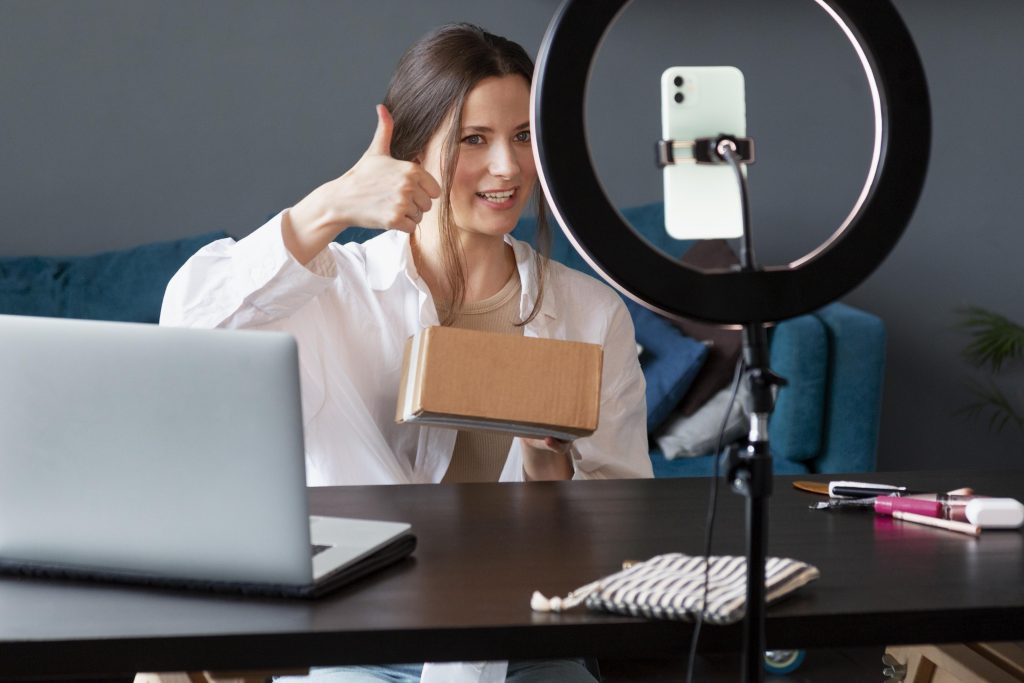
Running LIVE selling sessions
LIVE shopping is where TikTok feels most like a home shopping channel, and in Malaysia it drives a large share of Shop sales. A LIVE lets you demo in real time, answer objections instantly, and create urgency with pinned deals.
A simple format that works:
- Plan a run sheet. List the products in order, the price, and the hook for each. Do not improvise the whole hour.
- Go for length. Longer streams (60 minutes or more) give the algorithm time to bring in viewers. Front-load nothing; keep looping your best offers for people who just arrived.
- Pin and demo. Pin the product being discussed so buyers can tap through without hunting. Show it in use, not just held up.
- Answer by name. Reading out and answering comments keeps people watching and signals interest to the algorithm.
- Create urgency honestly. Time-boxed LIVE-only bundles and limited stock work, as long as they are real.
- Be consistent. A regular weekly slot trains your audience to show up.
Affiliates and creator partnerships
The TikTok Shop affiliate programme lets creators sell your products for a commission you set. It is one of the highest-leverage channels because you only pay on results.
- Open plan: any eligible creator can pick your product and promote it at your set commission. Good for reach and volume.
- Targeted plan: you invite specific creators and can offer higher commissions or free samples. Good for quality and control.
To make it work in Malaysia, send free samples to a batch of small and mid-size local creators rather than chasing one big name. Micro-creators (10k to 100k followers) often convert better because their audience trusts them and the content feels personal. Set a commission that is worth their effort, usually somewhere in the 10% to 20% range for products with healthy margins, and make your best-performing videos easy for them to reference. If you would rather have this run for you end to end, that is the kind of work TikTok ads agencies in Malaysia handle.
Scaling with TikTok Ads and Shop Ads
Organic and affiliate content build a base. Ads pour fuel on what already works. The rule of thumb: do not advertise a product until you have organic content proving it can sell. Then put budget behind the winners.
The formats worth knowing:
- In-feed ads: native videos in the For You feed. The default starting point.
- Spark Ads: boost an existing organic post (yours or a creator’s). Because it keeps likes and comments, it feels less like an ad and usually performs better.
- Video Shopping Ads / Shop Ads: ads tied directly to your Shop products, optimised for purchases, with TikTok’s system finding buyers for you.
- LIVE Shopping ads: drive viewers into an active LIVE.
- TopView and top-feed placements: premium reach for launches and big campaigns.
Start small, let the pixel gather data, and scale the ad sets that hit your target cost per purchase. If you want the numbers behind budgets and bids first, read TikTok advertising cost in Malaysia, and if you want a team to build and manage the campaigns, that is our TikTok ads Malaysia service.
Handling orders, shipping and returns
Sales are only half the job. Fulfilment reliability is what keeps your seller score, and therefore your reach, healthy.
- Ship on time. Process orders within your stated handling window. TikTok tracks late dispatch and it drags down visibility.
- Pack for the courier, not the shelf. Protect fragile items; damaged deliveries become returns and bad reviews.
- Handle returns cleanly. Malaysia’s consumer protection rules give buyers rights around faulty or misdescribed goods. A clear, fair return policy avoids disputes and protects your rating.
- Reply fast. Quick responses in chat lift conversion and reduce cancellations.
Compliance quick note: If you collect customer data, Malaysia’s Personal Data Protection Act (PDPA) applies. Only collect what you need, say how you use it, and keep it secure. Depending on turnover you may also need to account for SST, and certain products (cosmetics, supplements, food) have their own labelling and approval rules. When in doubt, check with a local professional. This is general information, not legal advice.
Measuring what matters
TikTok Shop and the Business account give you plenty of data. Focus on the numbers that connect to money rather than vanity metrics:
- GMV and orders: the topline. Track by product to find your heroes.
- Conversion rate: visitors to buyers. Low conversion usually means listing, price, or trust issues, not a traffic problem.
- Video-to-Shop click-through: tells you whether your content actually pushes people to the product.
- Average order value: lift it with bundles and thresholds for free shipping.
- Return and cancellation rate: a rising rate signals a product, sizing, or expectation problem.
- Cost per purchase (ads): the number that decides whether you scale or pause an ad set.
Look at trends weekly, not obsessively by the hour. For broader levers once you have data flowing, see how to increase ecommerce sales.
Common mistakes to avoid
- Treating it like a marketplace. Uploading products and waiting. TikTok is content-first; no content, no sales.
- Too few videos. Posting once a week and expecting the algorithm to carry you.
- Ads before proof. Spending on a product that has never sold organically.
- Ignoring affiliates. Leaving the cheapest, highest-leverage channel switched off.
- Thin margins. Pricing without accounting for the full stack of fees, then losing money on every “sale”.
- Slow shipping. Quietly killing your reach through a poor seller score.
- One-and-done LIVEs. Streaming once, seeing modest results, and giving up before the format compounds.
If you are earlier than this and still deciding on products and structure, our guide on how to start an ecommerce business is a good companion read.
Want help getting this right the first time?
MediaPlus Digital helps Malaysian brands set up TikTok Shop, build content that converts, and scale with ads that actually pay back. Book a free one-time TikTok and ecommerce strategy session (a RM300 health check) and we will review your setup, content, and growth plan. No obligation.
Frequently asked questions
How do I start selling on TikTok in Malaysia?
Switch to a TikTok Business account, register a seller account at seller-my.tiktok.com, submit your MyKad (individual) or SSM documents (business) plus a matching Malaysian bank account, get verified in about 1 to 3 business days, list your products, connect fulfilment, then start posting shoppable videos and LIVEs.
Is it free to open a TikTok Shop?
Yes. There is no fee to register or list products. You pay commission and a transaction fee only when you make a sale, plus optional affiliate and ad costs.
How much does TikTok Shop take per sale in Malaysia?
Roughly 8% to 10% commission depending on category, plus a transaction fee around 3.78% and a small per-order platform support fee. Together that often works out to about 12% to 14% before ads or affiliate commission. New sellers get a commission-free grace period. Confirm current rates in Seller Center.
Do I need a registered business (SSM) to sell?
Not always. Malaysian citizens aged 18 or older can register as individual sellers with a MyKad. A registered business lets you sell as a corporate seller and is worth it as you grow, especially for tax and scaling.
Do I need a lot of followers to sell on TikTok?
No. There is no follower minimum to open a Shop. Reach on TikTok comes from good content and the For You feed, so a new account with strong videos can still sell.
What sells best on TikTok Shop?
Products under about RM200 with a clear visual demo or before-and-after tend to convert best: beauty, skincare, haircare, supplements, fashion, home, and lifestyle items. Digital products are not supported; TikTok Shop is for physical goods that ship.
How many videos should I post to sell?
When building momentum, aim for 1 to 3 videos a day and mix hook, demo, comparison, and social-proof formats. Consistency over weeks matters more than any single viral hit.
Is LIVE selling worth it for a small brand?
Yes. LIVE lets you demo, answer objections, and create urgency in real time, and it drives a large share of TikTok Shop sales in Malaysia. Start with a regular weekly slot and a simple run sheet.
How does the TikTok affiliate programme work?
You set a commission, and creators promote your products for a cut of each sale they drive. Use the open plan for reach and targeted invites (with samples) for quality. You only pay when a creator makes a sale.
Should I run TikTok ads straight away?
Not before a product has sold organically. Once you have content proving demand, boost the winners with Spark Ads and Shop Ads, start with a small budget, and scale the ad sets that hit your target cost per purchase.
What about tax and data rules?
If you collect customer data, PDPA applies, so handle it responsibly. Depending on turnover, SST may apply, and some product categories have labelling or approval requirements. Check with a local professional for your situation.
This article is general guidance for Malaysian sellers and not legal, tax, or financial advice. Fees, thresholds, and platform rules change; verify current figures in TikTok Seller Center before pricing or launching.