Quick answer: CTA stands for call to action. It is a prompt, usually a button, link, or line of text, that tells someone the next step to take, such as “Buy now”, “Sign up”, or “Get a free quote”. In digital marketing, CTAs turn passive readers into leads and customers by making the next action clear. A good CTA is specific, visible, and easy to act on.
What does CTA mean?
CTA is short for call to action: a direction you give your audience that tells them what to do next after seeing your content or ad. It is the moment you ask for the action, whether that is clicking, subscribing, downloading, or buying.
You see CTAs everywhere: “Buy now” on a product page, “Subscribe” under a video, “Contact us” on a website, “Download the guide” in an email. Each one asks for one clear next step.

What is a CTA in digital marketing?
In digital marketing, a CTA is the visual or text element (a button, link, or phrase) that moves someone from reading to doing. It is how you convert attention into results. Without a clear CTA, even great content leaves people unsure what to do, and they leave.
CTAs matter because they:
- Guide the customer journey. They tell people the next step at each stage.
- Drive conversions. A clear ask turns visitors into leads and sales.
- Make content actionable. They turn passive reading into a measurable action.
- Let you measure results. Clicks and conversions on a CTA show what is working.
How CTAs fit the buying journey
CTAs work best when they match where someone is in their journey:
|
Stage |
What the customer is doing |
Fitting CTA |
|
Awareness |
Learning about you |
“Read more”, “Watch the video” |
|
Consideration |
Comparing options |
“Download the guide”, “See pricing” |
|
Decision |
Ready to act |
“Buy now”, “Book a demo”, “Get a free quote” |
Asking someone to “Buy now” when they just discovered you is too much, too soon. Match the ask to the stage.

Hard CTAs vs soft CTAs
- Hard CTAs are direct requests for the main action: “Buy now”, “Sign up”, “Book a call”. They suit the decision stage and often use urgency.
- Soft CTAs are smaller, lower-commitment asks: “Learn more”, “Subscribe to updates”, “Download a free guide”. They suit the awareness and consideration stages and build the relationship.
A good funnel uses both: soft CTAs to warm people up, hard CTAs to close.
Types of CTAs by format
- Button CTAs: clickable, visually prominent, the most common on websites and emails.
- Text CTAs: a linked phrase inside your copy, useful in articles and blogs.
- Image CTAs: a visual (banner or graphic) with a supporting line, good for offers.
And by purpose: lead generation (sign-ups, downloads), sales (buy, add to cart), navigation (read more, see pricing), and engagement (share, comment, follow).
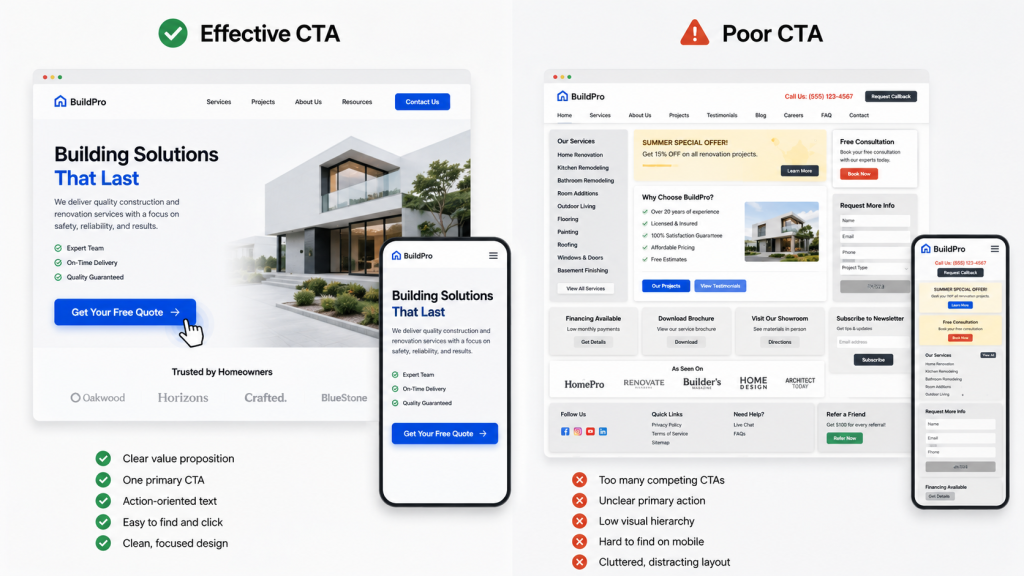
What makes a CTA effective
The strongest CTAs share five qualities:
- Clarity. It says exactly what happens next, in plain words.
- Visibility. It stands out from everything around it in colour and placement.
- Relevance. It matches what the reader wants at that moment.
- Urgency. Where honest, it gives a reason to act now (“Limited slots”, “Ends Friday”).
- Consistency. It matches your brand voice and the promise of the page.
Add a clear value (“Get your free quote”, not just “Submit”), use strong action verbs, and keep it frictionless.
Common CTA examples
- Buy Now
- Sign Up
- Contact Us
- Get a Free Quote
- Download the Guide
- Start Your Free Trial
- Book a Demo
- Get Started Today
- Subscribe to Updates
- Learn More
Notice the best ones lead with a verb and a benefit, not a vague “Click here”.
Where to place CTAs
Put CTAs where intent is highest: above the fold on a landing page, at the end of a blog post, inside emails, on product pages, and repeated through long pages so the ask is always in reach. On mobile, make buttons large and easy to tap. This is core to good conversion rate optimisation.
Test and improve your CTAs
Small changes to a CTA can move conversions a lot. A/B test one thing at a time, wording, colour, size, or placement, and keep the winner. Track clicks and conversions so you know what actually works, not what you assume.
Common CTA mistakes to avoid
- Vague wording like “Click here” or “Submit” with no benefit.
- Too many CTAs competing on one page, so none win.
- Hiding the CTA below the fold or in a busy design.
- Wrong stage: a hard sell to someone just discovering you.
- No mobile thought: buttons too small or too close to tap.
Frequently asked questions
What does CTA stand for?
CTA stands for call to action, a prompt (button, link, or text) that tells someone the next step to take, like “Buy now” or “Sign up”.
What is a CTA in digital marketing?
It is the element that moves someone from reading to doing, turning attention into a lead or sale. It is how digital campaigns convert.
What is an example of a call to action?
“Get a free quote”, “Buy now”, “Book a demo”, “Download the guide”, and “Start your free trial” are all CTAs. The best lead with a verb and a benefit.
What is the difference between a hard and soft CTA?
A hard CTA asks for the main action (“Buy now”); a soft CTA is a smaller ask (“Learn more”, “Subscribe”) that builds toward it.
How do I write a good CTA?
Be clear and specific, lead with a verb and a value, make it stand out, match it to the reader’s stage, and test different versions.
Final thoughts
A CTA, or call to action, is the small prompt that does big work: it tells people what to do next and turns interest into results. Make yours clear, visible, relevant, and matched to the journey, then test and improve. Strong CTAs are one of the cheapest ways to lift conversions on the traffic you already have.
Want a website and campaigns designed to convert? Talk to MediaPlus Digital about web design and digital marketing, and claim a free RM300 consultation.