The difference between on-page and off-page SEO is simple: on-page SEO is everything you do on your own website to rank (content, titles, headings, internal links, structure), while off-page SEO is everything you do outside it to build authority (mainly backlinks, mentions, and reputation). On-page tells search engines what your page is about; off-page tells them how trustworthy and popular it is. You need both, plus technical SEO underneath, to rank well.
This guide explains onpage and offpage SEO, the key difference, what each includes, and how to use them together.
What is on-page SEO?
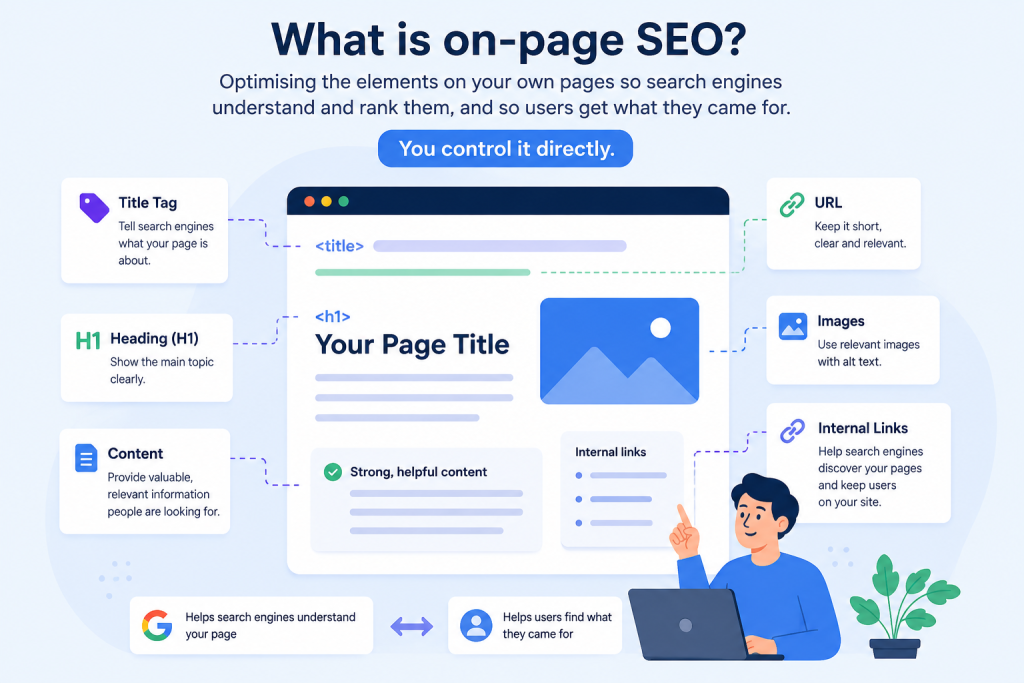
On-page SEO (also written onpage SEO) is optimising the elements on your own pages so search engines understand and rank them, and so users get what they came for. You control it directly.
Key elements of on-page SEO:
- Content that matches search intent and answers the query well.
- Title tags and meta descriptions.
- Headings (one clear H1, logical H2s and H3s).
- URL structure, short and readable.
- Internal links to related pages.
- mage optimisation and alt text.
- Schema markup so machines read your content.
- Keyword use, natural, not stuffed.
What is off-page SEO?
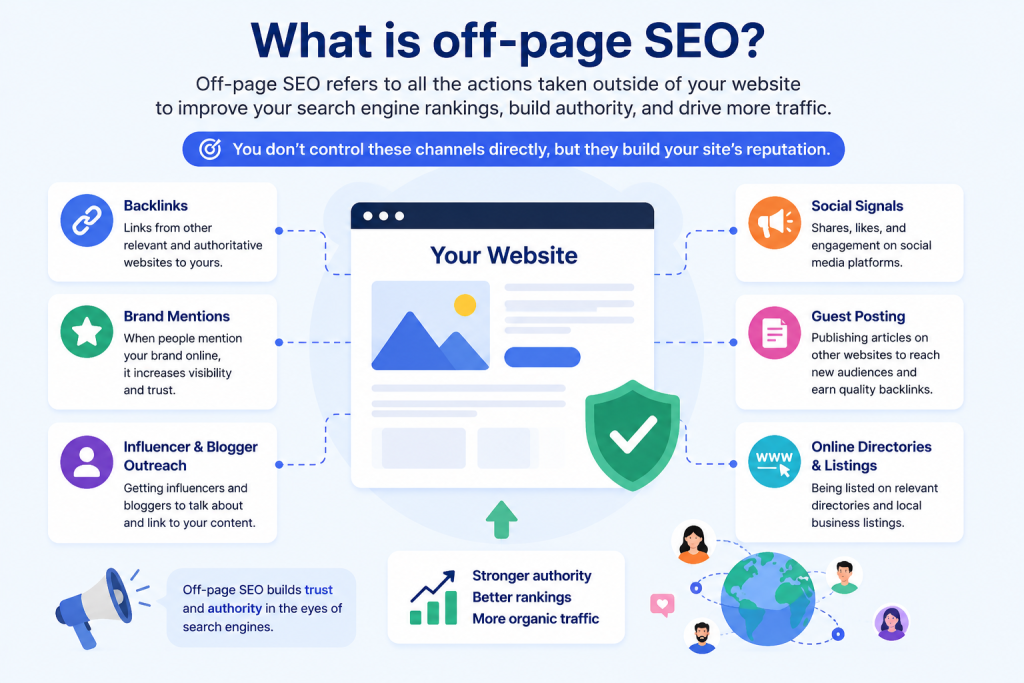
Off-page SEO (offpage SEO) is everything you do away from your site to build its authority and reputation. You influence it, but you do not fully control it.
Key elements of off-page SEO:
- Backlinks from other websites, the biggest off-page factor.
- Brand mentions across the web.
- Reviews and reputation (especially for local businesses).
- Digital PR and outreach.
- Social signals and shares.
- Local citations and directory listings.
Where does technical SEO fit?
There is a third piece: technical SEO, the site’s infrastructure (speed, crawlability, indexing, HTTPS, structure). It is sometimes grouped under on-page because it happens on your site, but it is really its own layer. Think of it as the foundation both on-page and off-page build on.
On-page vs off-page SEO: the difference at a glance
|
On-page SEO |
Off-page SEO |
|
|
Where |
On your own website |
Away from your website |
|
Control |
Full, you own it |
Influence, not full control |
|
Focus |
Relevance: what the page is about |
Authority: how trusted it is |
|
Main elements |
Content, titles, headings, internal links, schema |
Backlinks, mentions, reviews, PR |
|
Tells Google |
What your page covers |
How trustworthy and popular you are |
|
Speed of results |
Faster, you can change it today |
Slower, built over time |
What on-page and off-page SEO have in common
They are not opposites; they serve the same goal, higher rankings and more qualified traffic, and they depend on each other. Both are guided by keyword and audience research, both build authority (on-page through content, off-page through links), and both fail without the other. The best content (on-page) struggles to rank with no authority (off-page); the strongest backlinks (off-page) are wasted on a thin, poorly optimised page (on-page).
When should you focus on each?
- Start with on-page and technical SEO. You control them, they are faster, and links are wasted on a page that is not optimised. Fix the foundations first.
- Then build off-page authority. Once your pages are strong, earn the backlinks, mentions, and reviews that lift them past competitors.
- For local businesses, off-page reviews and citations matter a lot, alongside a well-optimised Google Business Profile.
In practice you work on both continuously, but on-page comes first.
How on-page and off-page SEO work together
Rankings come from combining relevance and authority. On-page makes your page relevant and easy to understand; off-page makes it trusted. A page with great content and strong backlinks beats a page with only one of the two. Add solid technical SEO, and all three reinforce each other. That is why a real SEO strategy always covers on-page, off-page, and technical together.
Common mistakes to avoid
- Doing one and ignoring the other. Great content with no links, or links to a weak page, both underperform.
- Chasing low-quality backlinks, which can hurt more than help.
- Keyword stuffing on-page instead of writing for people.
- Ignoring technical SEO, which caps everything else.
- No internal linking, wasting your own on-page authority.
Frequently asked questions
What is the difference between on-page and off-page SEO?
On-page SEO is what you do on your own website (content, titles, headings, internal links, structure) to show relevance. Off-page SEO is what you do outside it (backlinks, mentions, reviews) to build authority. On-page tells Google what your page is about; off-page tells it how trusted you are.
What is the difference between onpage and offpage SEO with examples?
An on-page example is writing a well-structured, keyword-relevant page with a clear title and internal links. An off-page example is another reputable website linking to that page, or a customer leaving a review. One optimises your page; the other builds its reputation.
Which is more important, on-page or off-page SEO?
Neither works alone. Start with on-page and technical SEO (you control them and they are faster), then build off-page authority with links and mentions. Rankings come from combining relevance and authority.
Is technical SEO on-page or off-page?
Technical SEO (speed, crawlability, indexing) happens on your site, so it is sometimes grouped with on-page, but it is best treated as its own foundational layer that both on-page and off-page build on.
Can I rank with only on-page SEO?
Sometimes, for low-competition or local terms with a strong Google Business Profile. For competitive terms, you also need off-page authority (backlinks and reputation) to rank.
Final thoughts
On-page vs off-page SEO is not a choice; it is a partnership. On-page makes your pages relevant and clear, off-page makes them trusted, and technical SEO holds it all up. Get the on-page foundations right first, then build off-page authority, and keep both going. That combination is what actually moves you up Google.
Want on-page and off-page SEO handled by one team? Talk to MediaPlus Digital about our SEO services and claim a free RM300 SEO audit.