Quick answer: A good accounting firm website in Malaysia proves the firm is licensed for the work it offers (MIA practising certificate, tax agent approval under section 153 of the Income Tax Act 1967, SSM practising certificate for company secretaries, AOB registration for auditors of public interest entities). It explains each service on its own page, collects financial documents through a secure portal rather than email, and turns deadline-driven searches into booked consultations. The copy must follow the MIA By-Laws: honest and truthful, with no exaggerated claims and no disparaging comparisons with other firms.
Most web design advice for accountants is written for American CPA firms and stops at colours and stock photos. This guide is for audit, tax, accounting and company secretarial practices in Malaysia. It covers the rules that decide what your site can say, the pages you need, how to handle client documents, and the content that brings in enquiries around LHDN deadlines.
Why an accounting firm website is its own kind of project
A café can win customers with photos. An accounting firm can’t. Buyers check a narrower set of things:
- Is this firm allowed to do the work? An SME owner hiring an auditor or tax agent wants approvals, not adjectives.
- Does it handle businesses like mine? A dormant Sdn Bhd and a listed company’s subsidiary need very different things.
- What do I need to prepare, and roughly what will it cost?
- Is it safe to send my documents? Bank statements, payroll files and IC copies are personal data.
Traffic behaves differently too. Searches for tax help and e-Invoice advice rise around fixed dates, so a site that copes on an average Tuesday can fail in the last week before a filing deadline. And because one firm often offers services under several regulators, generic websites tend to get the wording wrong.
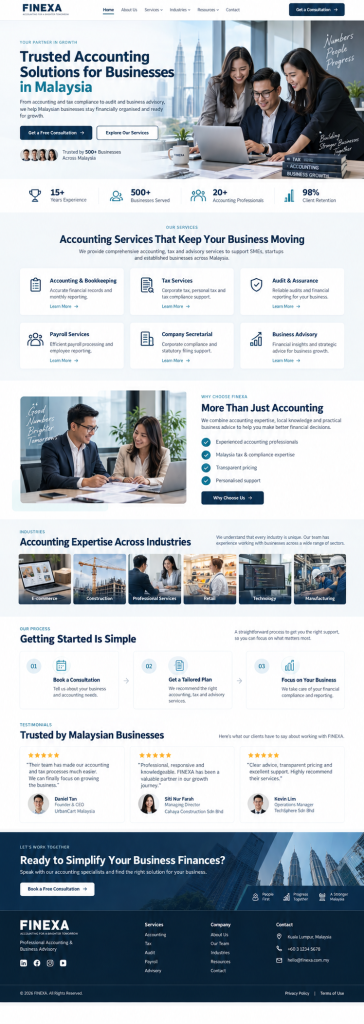
The sitemap: pages an accounting firm website needs
|
Page |
Must include |
|
Home |
Who you serve, core services, credentials, one clear next step |
|
Audit and assurance |
Audit types, what the client must provide, timeline, audit partners |
|
Tax |
Tax agent details, Form C and Form B support, LHDN audits and objections |
|
Accounting and bookkeeping |
Scope per plan, software, monthly close timing |
|
Payroll |
EPF, SOCSO, EIS and PCB handling, payslip delivery |
|
Company secretarial |
Annual return, resolutions, beneficial ownership, secretary certificate numbers |
|
Advisory |
Cash flow, budgeting, due diligence, with example scopes |
|
SST and e-Invoice |
Who must comply, your role, readiness steps |
|
Industries |
Only sectors you actually serve |
|
Team |
Individual profiles with verifiable qualifications |
|
Fees approach |
How you price, what’s included and excluded |
|
Insights |
Dated, reviewed articles on Malaysian compliance |
|
Contact and booking |
Booking, form, WhatsApp, map, office hours |
|
Client portal login |
Secure link for existing clients |
|
Privacy notice |
Bilingual PDPA notice |
Small practices can fold payroll into bookkeeping and advisory into tax. Keep audit on its own page, because people searching for an auditor want a page only about audit.
Page blueprints
Homepage section order
- Header: approved firm name, phone, WhatsApp, “Book a consultation” button.
- Hero: who you serve and where, for example “Audit, tax and company secretarial services for SMEs in Johor Bahru”. Skip lines like “Your partner for growth”.
- Credentials strip: approvals written as text (MIA firm, section 153 tax agents, SSM-licensed secretaries, AOB if applicable).
- Choose your situation: routes such as “I need a statutory audit”, “I received an LHDN letter”, “I’m starting a Sdn Bhd”, “Is my business in the e-Invoice scope?”
- Services grid linking to full service pages.
- How we work: first call, engagement letter, document collection, delivery.
- Industries served and a team preview with designations.
- Latest insights: three dated articles.
- Final call to action with office addresses.
Several Malaysian firm sites we reviewed for this guide already show a credentials row and a WhatsApp button. Few offer “choose your situation” routes, which is an easy way for a new site to stand out.
Service page template
Use one structure on every service page:
- Who this is for (company type, size, stage)
- What’s included
- What we need from you (document checklist)
- Timeline once records are complete
- Who does the work, with approvals
- Related deadlines, linking to your deadline article
- Fee approach
- Four to six real client FAQs
- Booking or quote form, pre-set to this service
|
Service |
What clients look for on the page |
|
Audit and assurance |
Statutory audit under the Companies Act 2016, audit exemption questions, first-year audit needs, changing auditors |
|
Tax |
Form C, Form B and BE, CP204 estimates, responding to LHDN letters, tax audits and objections |
|
Accounting and bookkeeping |
Monthly or quarterly close, supported software, management reports, backlog clean-up |
|
Payroll |
Monthly runs, EPF, SOCSO, EIS and PCB submissions, Form E and EA forms |
|
Company secretarial |
Incorporation, annual return, registered office, share transfers, beneficial ownership, striking off |
|
Advisory |
Cash flow forecasts, valuation, due diligence, internal controls |
|
SST and e-Invoice support |
SST registration and returns, e-Invoice phase checks, MyInvois Portal setup, software choice |
Industry, team and fees pages
Industry pages earn their place only where you have depth. Name the sector’s real issues: progress billing for developers, marketplace payouts for ecommerce sellers, panel billing for clinics, companies limited by guarantee for non-profits. Three strong pages beat twelve thin ones.
Team profiles should be individual pages for each partner, tax agent and company secretary, with photo, designations and approvals as text (only where held), years in practice, sectors, languages, articles they wrote or reviewed, and a booking link. They help clients pick a person and show Google who stands behind your content.
The fees approach page explains fixed monthly fees for bookkeeping and secretarial retainers, per-engagement pricing for audit and tax, surcharges for backlog or urgent work, and exclusions such as LHDN penalties and SSM filing fees. If you publish bands, label them “from” prices and review them yearly.
Insights need an author, a reviewer from the firm and a “last updated” date on every article. An out-of-date e-Invoice article hurts trust more than having none.
Design, accessibility and performance
Use calm, high-contrast colours (navy, deep green or charcoal with one accent), real photos of partners and the office, and sans serif body text of 16px or more. Explain terms like “statutory audit” or “CP204” the first time they appear. Multi-office firms should also read our guide to corporate website design.
Accessibility checklist
- Text contrast and forms meet WCAG 2.2 AA, with visible labels and keyboard access
- Credential logos have text equivalents
- Deadline and fee tables are real HTML tables that work on phones
- Downloadable checklists also exist as web pages
Performance checklist
- Pages pass Core Web Vitals on mobile
- Caching, a CDN and hosting headroom in place before busy filing months
- Booking and chat scripts don’t block page loading
- Uptime monitoring, tested backups and updates through a website maintenance plan
Before going live, use our website launch checklist for Malaysia.
Common mistakes on accounting firm websites
- One generic “Services” page. Audit, tax and secretarial buyers search separately.
- Credentials only as images. Hard to read on phones and invisible to search engines.
- Superlatives in the hero. “Best” and “No. 1” are hard to prove and sit badly with R115.2.
- Blurring entities. A tax or secretarial company presented as the chartered accountants firm.
- Documents by email or public form. A PDPA risk, and a poor signal to careful clients.
- Undated compliance articles. Old e-Invoice thresholds make the whole firm look out of date.
- No plan for busy season. Slow pages and unanswered WhatsApp messages lose the most motivated leads.
Questions to ask a web developer
|
Question |
A good answer |
|
Have you built sites for regulated firms? |
Examples such as accounting, legal or healthcare, like our legal website development work, with how the rules were handled |
|
How will client documents be handled? |
A secure portal or platform, no public uploads |
|
Who owns the domain, hosting and files? |
The firm, in writing |
|
Where is form data stored? |
A named provider and region, with a data processing agreement |
|
Can we update deadline and fee content ourselves? |
Yes, through editable CMS templates, with training |
|
How do you handle traffic spikes? |
Caching, a CDN, load-tested hosting and monitoring |
|
What support comes after launch? |
Security updates, backups and a response time in writing |
What affects the cost
The main cost drivers are the number of service, industry and location pages; languages (English only, or with Bahasa Malaysia and Chinese); whether the portal is a link to an existing platform or a custom build; routing rules for booking and forms; copywriting and compliance review; and integrations with a CRM or practice software. For typical market ranges, see our web design cost guide.
Frequently asked questions
What should an accounting firm website include?
Separate service pages, credentials as text (MIA firm name, tax agent approvals, secretary practising certificates, AOB status if registered), team profiles, a fees approach page, dated compliance articles, booking and WhatsApp, a client portal login and a PDPA privacy notice.
Can accounting firms in Malaysia advertise on their websites?
Yes. The MIA By-Laws allow marketing as long as it doesn’t bring the profession into disrepute, is honest and truthful, and avoids exaggerated claims and disparaging or unsubstantiated comparisons (paragraph R115.2).
Can an accounting firm show its fees online?
We found no ban in the 2022 By-Laws. Paragraph 330.3 A2 lets an accountant quote whatever fee is appropriate, though a fee too low to do the work properly creates an ethical threat. Dated fee bands with clear assumptions are a sensible approach.
Can we call our firm “Chartered Accountants”?
According to the MIA, only members registered as chartered accountants with a valid practising certificate can hold themselves out as chartered accountants in public practice, and the firm name needs MIA approval. Separate tax or secretarial companies should not use the description.
Should we show our tax agent approval on the website?
Yes, it’s a strong trust signal. Only tax agents under section 153 of the Income Tax Act 1967 may act as tax agents, tax consultants or tax advisers, so showing the details as text helps clients confirm who is qualified.
Is it safe to let clients upload documents through the website?
Not through a public form. Use a secure portal with individual logins, multi-factor authentication and encryption. Under the amended PDPA, controllers and processors need a data protection officer, and breaches must be reported to the Commissioner.
How long does an accounting firm website take to build?
It depends on page count, languages and the portal. Content usually takes longest: service descriptions, team profiles and a compliance review of the copy. Start writing early and launch before your busiest filing months.
How do accounting firms get clients from Google?
A well-kept Google Business Profile, location pages for real offices, separate service pages, genuine reviews, and dated articles on e-Invoice and tax deadlines that link to those service pages.
The bottom line
An accounting firm website in Malaysia has to prove the firm is licensed, stay within the MIA’s marketing rules and handle client data properly under the amended PDPA, while turning deadline searches into consultations. Give each service its own page, show credentials as text, keep compliance content dated, and move document collection into a secure portal.
Planning a new site or a rebuild? Request a quote from our web design and development team. We can start with a free website audit worth RM300, covering your current pages, credentials, forms and local search presence.