Quick answer: The ecommerce web design trends that matter for Malaysian online stores in 2026 are: storefronts built for social and content commerce traffic; short video and live replays on product pages; checkouts designed around DuitNow QR, FPX and e-wallets; clear and compliant buy now, pay later (BNPL) messaging under the Consumer Credit Act 2025; shorter checkouts with costs shown early; product pages structured for AI search and Google’s shopping features; fast mobile and desktop performance; accessible, thumb-friendly controls; and visible trust and PDPA signals. Each is backed by 2025 and 2026 data below, with a practical “apply it” list.
Plenty of trend lists recycle the same ideas every year: 3D product viewers, voice search, bold typography. Some of those look good in a pitch deck and do little for a Malaysian store’s sales. This guide sticks to trends with evidence behind them, explains what each one means for your site’s design, and ends with a checklist you can hand to your developer.
Malaysia’s online shopping context in 2026
|
Indicator |
Figure |
Source |
|
Internet users |
35.4 million, 98.0 percent of the population (end of 2025) |
DataReportal, Digital 2026: Malaysia |
|
Social media user identities |
30.7 million, 85.0 percent of the population (October 2025) |
DataReportal |
|
Cellular mobile connections |
44.0 million, 122 percent of the population |
DataReportal |
|
Median mobile download speed |
143.56 Mbps, up 34.2 percent year on year |
DataReportal |
|
Digital payment transactions on the PayNet network |
8.44 billion in 2025 |
PayNet, 22 April 2026 |
|
Platform ecommerce growth in Malaysia |
47.6 percent year on year in 2025, second fastest in Southeast Asia |
Momentum Works, April 2026 |
|
Content commerce share of Southeast Asian platform ecommerce |
32 percent in 2025 |
Momentum Works, April 2026 |
|
Desktop vs mobile share of tracked web traffic |
64.13 percent desktop, 34.88 percent mobile (August 2026) |
StatCounter |
Two things stand out. Shoppers are almost all online, fast mobile networks are normal, and a lot of buying now starts inside social and video apps. At the same time, desktop still carries a large share of browsing across Malaysian websites, so a store cannot treat desktop as an afterthought.
Trend 1: Storefronts designed for social and content commerce traffic
What is happening. Momentum Works reports that content commerce, where people buy through short videos and livestreams, reached 32 percent of Southeast Asia’s platform ecommerce in 2025. TikTok Shop’s Southeast Asian GMV doubled year on year to US$45.6 billion in 2025, with Malaysia among its fastest-growing markets (TechNode, citing Momentum Works, February 2026). DataReportal lists 30.7 million social media user identities in Malaysia.
What it means for your website. Many shoppers now find a product on TikTok, Instagram or Facebook first. When they visit your own store, they arrive inside an in-app browser, on a phone, expecting the product they just saw. A homepage slider is not what they want. The product page is now the real landing page.
Apply it:
- Send social traffic straight to the product or collection page, never the homepage.
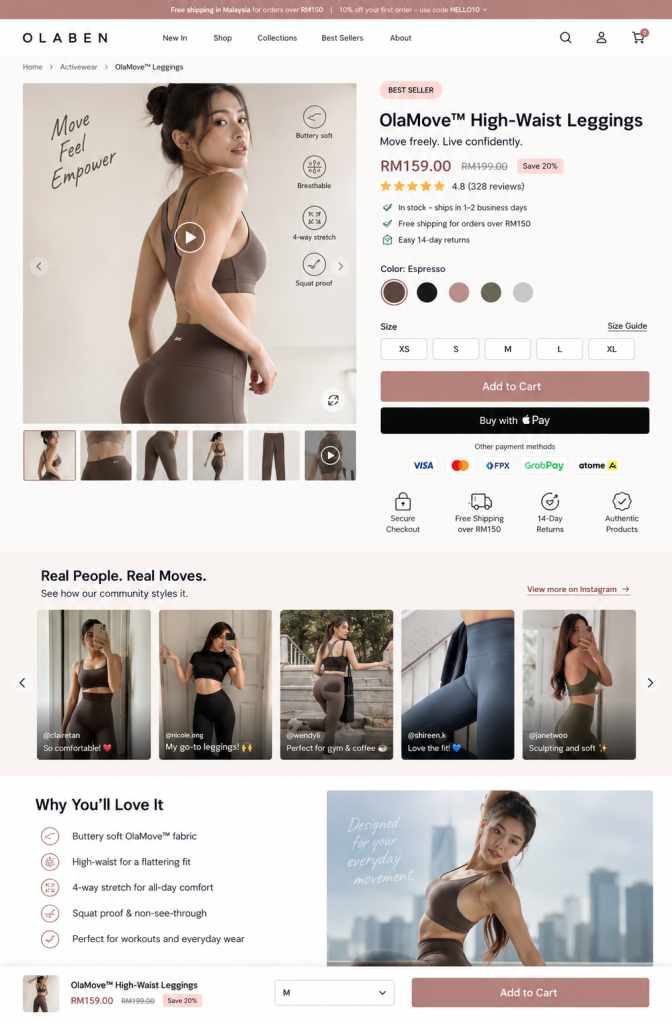
- Make the first screen of the product page match the social post: same product photo or video frame, price, and an add-to-cart button without scrolling.
- Test checkout inside the TikTok, Instagram and Facebook in-app browsers. Logins, pop-ups and payment redirects break more often there.
- Add user-generated photos and reviews near the price, not at the bottom of the page.
- Keep your product catalogue, prices and stock synced between your website and marketplace or TikTok Shop listings, so shoppers do not see different prices.
- Give creators and affiliates short, trackable URLs or discount codes that map to your own store.
Related reading: how to sell on TikTok in Malaysia, what is social commerce and user-generated content.
Trend 2: Short video and live replays on product pages
What is happening. Video is where much of the discovery happens. In the United States, TechNode reports that live commerce made up 14 percent of TikTok Shop GMV in 2025, up from 10 percent in 2024, with video content at 50 percent. Malaysian breakdowns are not published in the free reports, but the regional 32 percent content commerce share shows the same direction.
What it means for your website. Shoppers who are used to seeing a product demonstrated in a 30-second clip find a page of static photos less convincing. Brands that already produce TikTok or Shopee Live content can reuse it on their own store at almost no extra cost.
Apply it:
- Add one short product video (15 to 45 seconds) to the product image gallery, shown as the second item after the main photo.
- Use a poster image and do not autoplay with sound. Load the video file only when tapped, so it does not slow the page.
- Clip the best moments from past livestreams, such as a fabric stretch test or a skincare texture close-up, and place them beside the relevant product details.
- Add captions. Many people watch with the sound off.
- For big sale events, embed a live replay or countdown on a campaign landing page, then link each featured product.
- Host video on a service that delivers adaptive streaming, rather than uploading large MP4 files to your web server.
Trend 3: Checkouts built around DuitNow QR, FPX and e-wallets
What is happening. PayNet processed 8.44 billion digital payment transactions in 2025. It added 681,250 new DuitNow QR acceptance points during the year, 267,780 of them among micro, small and medium businesses, taking the national total past three million. Cross-border QR transactions grew 2.5 times to 29.7 million. Baymard Institute’s checkout research lists “not enough payment methods” as a reason for 9 percent of abandoned checkouts.
What it means for your website. Malaysian shoppers expect to pay the way they pay everywhere else: online banking through FPX, a QR scan, an e-wallet, or a card. A checkout that only offers cards, or hides the local options behind a generic “Pay now” button, loses buyers at the final step.
Apply it:
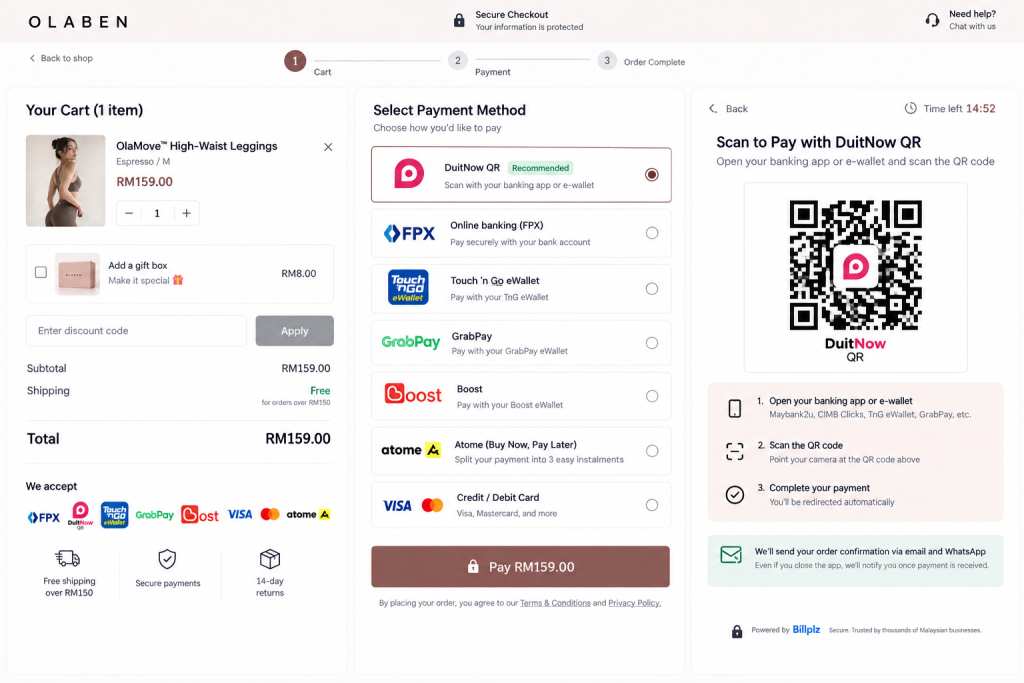
- Show accepted payment logos (FPX, DuitNow QR, Touch ’n Go eWallet, GrabPay, Boost, Visa, Mastercard, and any BNPL option) on the product page and cart, not only at the last step.
- On desktop, offer DuitNow QR so shoppers can pay by scanning with their phone banking or e-wallet app.
- Test the full redirect flow for FPX and each e-wallet on a real phone, including the return to your order confirmation page.
- Make the order confirmation page and email work even if the shopper closes the bank app early. Send the order status by email or WhatsApp.
- Label each option in plain words (“Online banking (FPX)”, “Scan to pay (DuitNow QR)”) rather than only logos.
- Review which methods your payment gateway supports before you design the checkout.
Compare providers in our list of payment gateways in Malaysia.
Trend 4: BNPL messaging that follows the new rules
What is happening. Malaysia’s Consumer Credit Act 2025 (Act 873) was gazetted on 31 December 2025 and came into force on 1 March 2026. The licensing part took effect on 1 June 2026, and BNPL providers have a six-month window to be licensed by the Consumer Credit Commission (The Edge Malaysia). RinggitPlus explains that the Act brings affordability assessments before credit is approved, a requirement to disclose the effective interest rate, and “truth in advertising” rules, so promotions cannot call a product “free” when conditions apply. It names Atome, Grab PayLater and SPayLater among the BNPL services affected. Atome’s Malaysian site describes splitting purchases into three interest-free payments, with other plans carrying fees.
What it means for your website. Instalment messages such as “Pay in 3” on product pages can raise purchase confidence for higher-priced items. They now need to be accurate. Vague or misleading instalment claims are a legal risk as well as a trust problem.
Apply it:
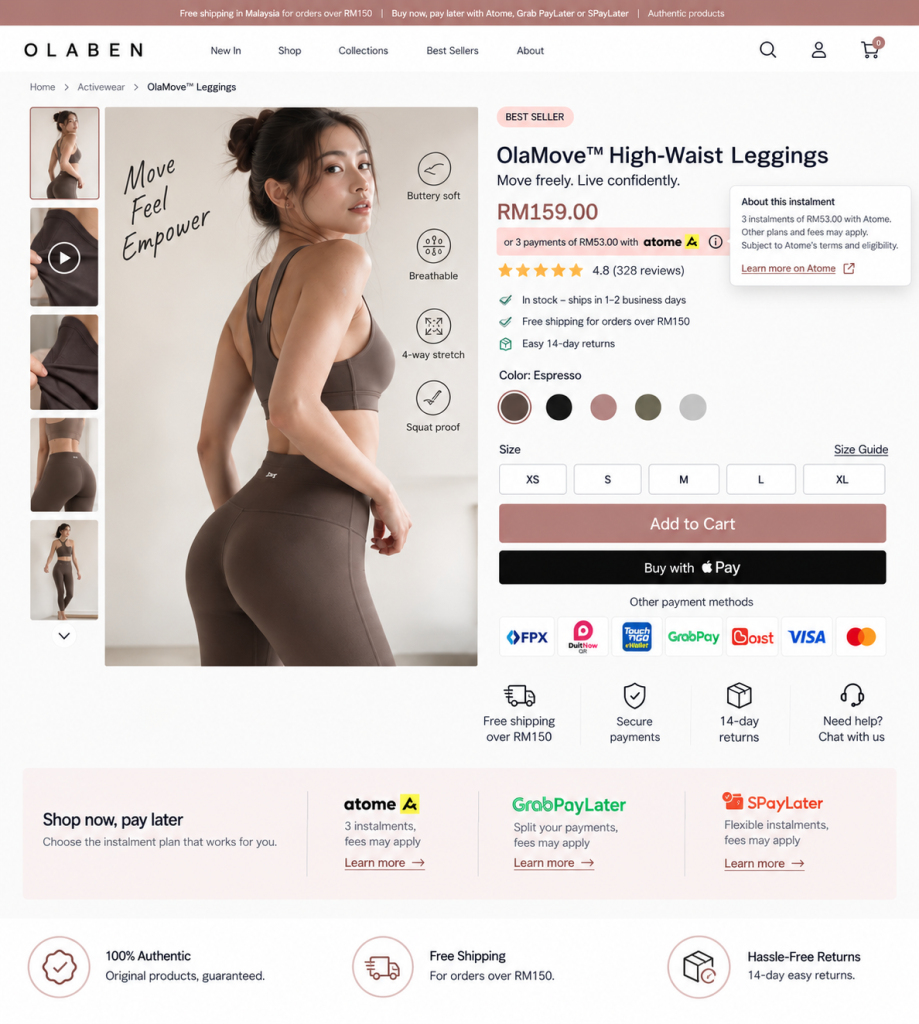
- Show the instalment amount next to the full price, calculated correctly, for example “RM300 or 3 payments of RM100 with Atome”.
- Link to the provider’s own terms and fees. Do not describe a plan as “free” or “0%” unless that is exactly what the provider offers for that purchase.
- Only integrate BNPL providers that are licensed or registered under the new framework. Ask your gateway or the provider to confirm.
- Hide BNPL messages on items below the provider’s minimum order value.
- Keep BNPL as one option among several, not the default selected payment method.
This is not legal advice. Ask your legal adviser to review how your store presents credit options.
Trend 5: Shorter checkouts with every cost shown early
What is happening. Baymard Institute puts the average documented cart abandonment rate at 70.22 percent, based on 50 studies. Among shoppers who abandon during checkout, the top reasons are: extra costs too high (40 percent), delivery too slow (20 percent), not trusting the site with card details (19 percent), being forced to create an account (18 percent), a long or complicated checkout (17 percent), and not being able to see the total cost upfront (12 percent). Baymard’s US research found the average checkout shows 23.48 form elements by default, against an ideal of 12 to 14.
What it means for your website. The design of the cart and checkout decides whether campaign spend turns into orders. Most fixes are simple layout and copy changes, not new technology.
Apply it:
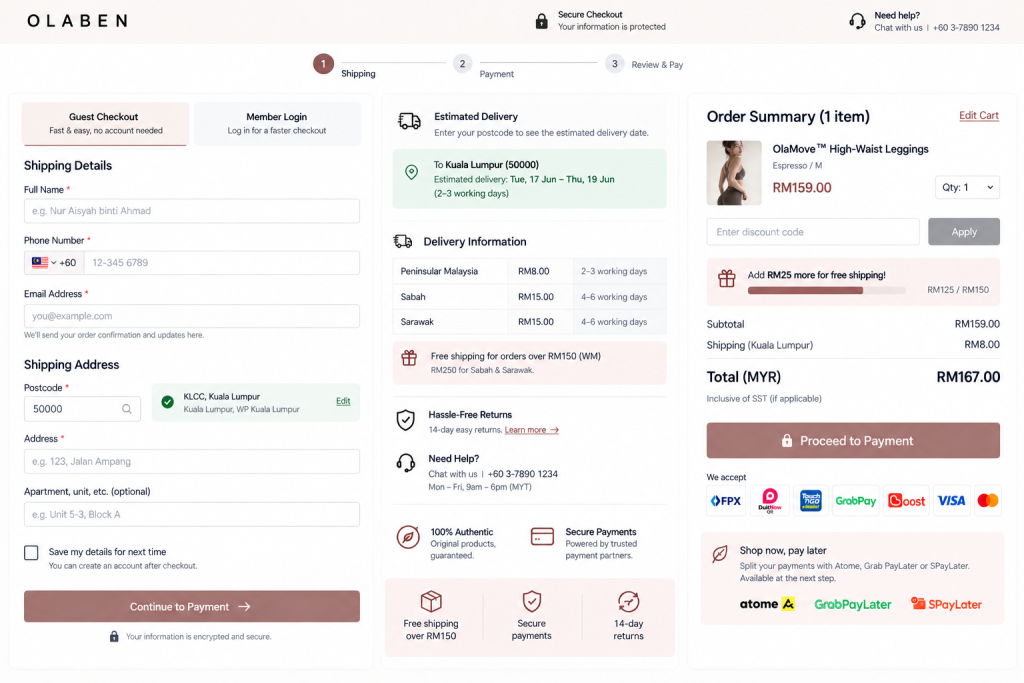
- Add a delivery fee estimator on the product page or cart, using postcode or state. Show separate rates for Peninsular Malaysia, Sabah and Sarawak if they differ.
- Show the free shipping threshold as a progress bar in the cart (“Add RM25 more for free delivery”).
- Offer guest checkout. Invite account creation after payment, on the confirmation page.
- Cut form fields: one name field, phone number with +60 preset, postcode that fills city and state automatically.
- Display estimated delivery dates, not only “3 to 5 working days”.
- Keep the order summary with the total visible on every checkout step, including on mobile.
- Show the return policy link and customer service contact beside the payment button.
For the full playbook, read how to reduce cart abandonment.
Trend 6: Product pages structured for AI search and shopping features
What is happening. Google’s AI Mode began rolling out in Malaysia on 25 August 2025, powered by a custom version of Gemini 2.5 and built for longer questions that would normally take several searches (SoyaCincau). Shoppers can now ask “best waterproof hiking shoes under RM300 for Cameron Highlands” and get a summarised answer. On the traditional results page, Google’s documentation says merchant listing experiences need product structured data with name, image and offers (with price and priceCurrency), and recommends availability, shipping details, return policy, GTIN and aggregate ratings. Google also states that “providing both structured data on web pages and a Merchant Center feed maximizes your eligibility.”
What it means for your website. Product pages need to be readable by machines as well as people. Thin descriptions copied from the supplier, missing prices in the HTML, and specs hidden in images give search and AI systems nothing to use.
Apply it:
- Add complete Product and Offer structured data to every product page: price in MYR, availability, shipping details, return policy and GTIN where you have one.
- Connect a Google Merchant Center feed and keep it in sync with website prices and stock.
- Write original product descriptions that answer real questions: size and fit, materials, what is in the box, who it suits, how to care for it.
- Put key specs in an HTML table, not inside images.
- Add a short FAQ to high-value product pages, based on questions your customer service team actually receives.
- Show genuine reviews on the page, collected through a review system, and only mark up ratings that are visible on the page.
- Build collection pages around how people search, for example “school shoes” or “baju kurung moden”, with a short intro and filters.
Go deeper with AI SEO for Shopify stores and the Google Shopping optimisation guide.
Trend 7: Speed measured on real devices, mobile and desktop
What is happening. Malaysian mobile networks are fast: DataReportal reports a median mobile download speed of 143.56 Mbps. When a store still feels slow, the cause is usually the site itself, meaning heavy images, too many apps and scripts, or a slow theme, rather than the network. Google’s web.dev defines “good” Core Web Vitals as LCP of 2.5 seconds or less, INP of 200 milliseconds or less and CLS of 0.1 or less, measured at the 75th percentile of page loads for mobile and desktop separately.
What it means for your website. Ecommerce themes collect apps over time: reviews, upsells, chat, pop-ups, wishlists, tracking pixels. Each one adds code to every page. INP, which measures how quickly taps and clicks respond, is where many stores now fail, especially on budget Android phones.
Apply it:
- Check the Core Web Vitals report in Google Search Console for product and collection templates, not just the homepage.
- Audit installed apps and third-party scripts every quarter. Remove anything that does not clearly earn its place.
- Serve product images in WebP or AVIF, sized for the screen, with width and height set.
- Do not lazy load the main product image. Lazy load the rest of the gallery and images further down.
- Replace heavy image sliders on the homepage with one strong static banner.
- Test add-to-cart, filters and variant selectors on a mid-range Android phone for responsiveness.
- Design both the desktop and mobile layouts properly, since StatCounter shows desktop still at 64.13 percent of tracked Malaysian web traffic.
See Core Web Vitals explained for what each metric means and how to fix it.
Trend 8: Accessible, thumb-friendly controls
What is happening. WCAG 2.2, the current version of the web accessibility guidelines, added success criterion 2.5.8 Target Size (Minimum) at Level AA: tap and click targets must be at least 24 by 24 CSS pixels, with limited exceptions. The W3C suggests aiming for 44 by 44 CSS pixels for important controls.
What it means for your website. Ecommerce pages are full of small controls: size swatches, colour dots, quantity steppers, filter checkboxes and close buttons on pop-ups. When those are too small, shoppers mis-tap, pick the wrong variant, or give up.
Apply it:
- Make size and colour swatches at least 44 by 44 pixels on mobile, with the selected state shown by more than colour alone.
- Use large quantity buttons, or a simple dropdown, instead of tiny plus and minus icons.
- Give filter checkboxes a full-row tap area.
- Make the close button on any pop-up large and easy to find, or avoid entry pop-ups on mobile altogether.
- Keep colour contrast high enough for prices, sale badges and error messages to be read outdoors.
- Add meaningful alt text to product images, describing the product and variant.
- Allow room for Bahasa Malaysia and Chinese labels, which may be longer or need different line heights.
Our guide to website accessibility standards covers the full requirements.
Trend 9: Visible trust and PDPA signals
What is happening. Baymard’s data shows 19 percent of shoppers who abandon checkout did so because they did not trust the site with their card details. Malaysia’s Personal Data Protection (Amendment) Act 2024 took effect in phases during 2025. It raised the maximum fine for breaching the data protection principles from RM300,000 to RM1,000,000, and from June 2025 it requires data controllers and processors to appoint a data protection officer and notify the Commissioner of personal data breaches.
What it means for your website. Trust signals used to mean a padlock icon. Now shoppers look for a real company behind the store, clear policies, and evidence that their data is handled properly. Newer and smaller brands feel this most.
Apply it:
- Show the registered company name and SSM registration number in the footer, with a physical address and customer service hours.
- Publish clear delivery, return and refund policies, and link them from product pages and checkout.
- Add a PDPA-compliant privacy notice in the languages your store uses, and a consent choice for marketing messages at checkout.
- Collect only the data you need to fulfil the order.
- Display real review counts and ratings from a verified review tool.
- Offer a WhatsApp or live chat contact for pre-sale questions, with honest response times.
For the data protection side, read how to make your website PDPA compliant in Malaysia.
Trends to test before you invest
Some ideas appear on almost every trend list but have little Malaysian evidence of paying off for a typical store. Treat them as experiments, not rebuild priorities.
|
Idea |
When it can make sense |
Why to be careful |
|
AR try-on and 3D viewers |
Furniture, eyewear, high-value items where fit or placement drives returns |
Costly to produce per product; heavy files can slow pages |
|
Voice search optimisation |
Rarely a separate project |
Good product data and FAQs already cover conversational queries |
|
AI chatbots replacing customer service |
High order volumes with repetitive questions |
Poor answers damage trust; keep a route to a human. See AI chatbots for ecommerce websites |
|
Heavy motion and scroll animation |
Brand storytelling pages |
Often hurts INP on budget phones; respect reduced-motion settings |
|
Visual style trends (bold type, bento grids, dark mode) |
A redesign that is already happening |
They change the look, not the conversion basics. See web design trends 2026 |
Frequently asked questions
What are the biggest ecommerce web design trends in Malaysia for 2026?
Storefronts built for social and video commerce traffic, checkouts centred on DuitNow QR, FPX and e-wallets, compliant BNPL messaging, shorter checkouts that show all costs early, product pages structured for AI search, and fast, accessible mobile design.
Which payment methods should a Malaysian online store offer?
At minimum, FPX online banking and major cards. Most stores should also offer DuitNow QR and popular e-wallets such as Touch ’n Go eWallet, GrabPay and Boost through their payment gateway. Add BNPL if your average order value makes instalments useful.
Does the Consumer Credit Act 2025 affect online stores that offer BNPL?
The Act mainly regulates the credit providers, who must be licensed. Stores should still present instalment offers accurately, avoid calling plans “free” when conditions apply, and link to the provider’s terms. Get legal advice for your specific setup.
How does Google AI Mode change ecommerce website design?
AI Mode, available in Malaysia since August 2025, answers longer shopping questions with summaries. Stores give themselves the best chance of appearing by publishing detailed, original product information, complete product structured data and an up-to-date Merchant Center feed.
Should I build my own website or sell only on Shopee, Lazada and TikTok Shop?
Marketplaces bring traffic but control the customer relationship and charge fees. Your own store lets you own customer data, build a brand and run retargeting. Many Malaysian brands use both, with synced stock and prices.
What is a good cart abandonment rate?
Baymard Institute’s documented average is 70.22 percent. Compare your own rate over time and across devices, and focus on the checkout issues Baymard identifies, such as unexpected costs and forced account creation.
Are AR and 3D product viewers worth it for a Malaysian store?
Only for categories where seeing the product in place changes the buying decision, such as furniture or eyewear. For most stores, product video, good photos and clear specs give a better return.
The bottom line
The 2026 trends that move sales for Malaysian stores are practical ones. Shoppers arrive from social video, expect to pay with DuitNow QR, FPX or an e-wallet, want to see delivery costs before checkout, and use AI-assisted search to compare products. Design your product pages for that journey, keep the checkout short and honest, and make the site fast and easy to tap. Leave the showier ideas for tests once the basics convert.
Planning a new store or a redesign? Our ecommerce website development and Shopify design and development teams build stores around these patterns. Contact us for a free ecommerce UX and speed audit worth RM300.