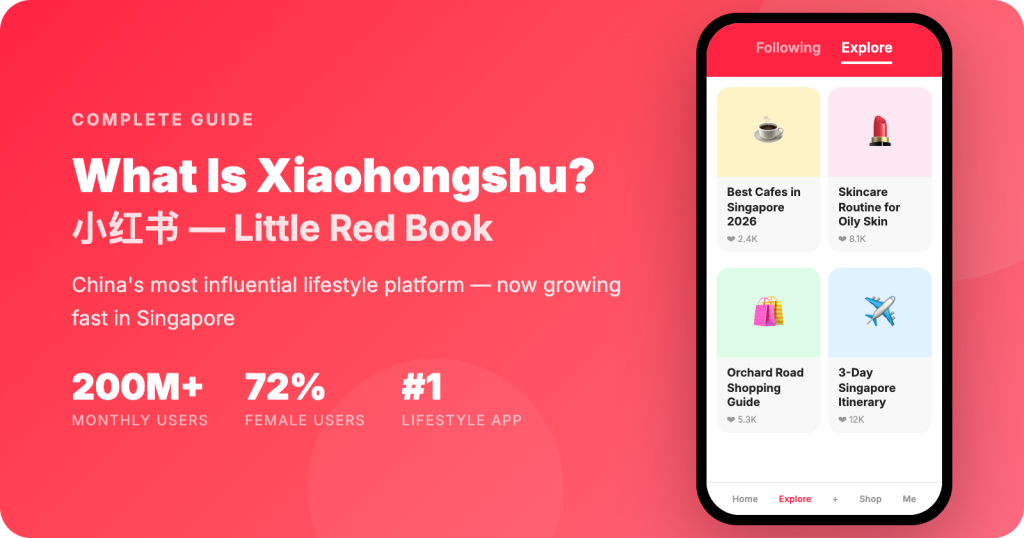
Xiaohongshu (小红书), usually shortened to XHS and sold in app stores under the English name RedNote, is a Chinese social platform where people post reviews, guides and recommendations as “notes”, then search those notes before they buy, eat, travel or book. It was founded in Shanghai in 2013. It works like a cross between Instagram, Pinterest and a review site, with a shop attached, and most of what is on it is written in Chinese.
XHS, Xiaohongshu, RedNote, Little Red Book and 小红书 are all the same app. If you came here because someone told you to “check XHS first”, this page explains what they meant, how to use it from Malaysia, and what it is worth to a Malaysian business.
What does XHS stand for?
XHS is the initials of the app’s name in Hanyu Pinyin, the romanised spelling of Mandarin: Xiǎo Hóng Shū.
|
Form |
What it is |
|
小红书 |
The name in Simplified Chinese characters |
|
Xiǎohóngshū |
Pinyin with tone marks |
|
Xiaohongshu, Xiao Hong Shu |
Pinyin without tone marks, written as one word or three |
|
XHS |
Initials of the pinyin, the usual shorthand in Malaysia and Singapore |
|
Little Red Book |
Literal translation: 小 small, 红 red, 书 book |
|
RED |
An older English brand name, still used in some marketing material |
|
RedNote |
The English name shown in Apple’s App Store and Google Play |
The pronunciation is roughly “shyow-hong-shoo”. In Malaysian conversation you will hear “XHS” spoken letter by letter, “Xiao Hong Shu” from Mandarin speakers, and “RedNote” from people who found the app through English-language news.
Is XHS the same as RedNote?
Yes. RedNote is the English name the app carries in app stores. It became widely known outside China in January 2025, when large numbers of American TikTok users downloaded it during the uncertainty over a TikTok ban in the United States and it briefly went to the top of the US App Store chart, as reported by Fortune on 14 January 2025. The app, the account and the content are the same whichever name you use.
What is XHS in Chinese?
小红书. On the platform, a post is called 笔记 (bǐjì), which means “note”, and an influencer is a 博主 (bózhǔ), which is why you will see Malaysian creators describe themselves as XHS 博主.
What people actually do on Xiaohongshu
The most useful way to understand XHS is that it is a search engine first and a social feed second.
A typical session in Malaysia looks like this: someone types “吉隆坡 咖啡厅” (Kuala Lumpur cafe), “槟城 民宿 推荐” (Penang homestay recommendation) or a product name plus “测评” (review), and reads the notes that come back. Each note is an image carousel or a short video with a block of text underneath. The text usually covers what the person bought or visited, what it cost, what was good, and what was not.
That last part is the reason the app exists. Users trust it because notes read like a friend’s honest account rather than an advertisement. When notes start looking like ads, users stop trusting them, and the platform has its own rules against undisclosed commercial content for exactly that reason.
The main parts of the app:
|
Feature |
What it does |
|
Notes (笔记) |
Image or video posts with a text body, hashtags and a comment thread. The core content type |
|
Search |
The main way content is found. Notes keep appearing in search for months after they are posted |
|
Discover feed (发现) |
A recommendation feed, similar in idea to TikTok’s For You page, built from what you search and save |
|
Saves (收藏) |
Users save notes into collections to act on later. A save is a stronger signal than a like |
|
Comments |
Where follow-up questions get asked and answered. Buyers read the thread for objections |
|
Live streams |
Creators and brands sell and demonstrate products live |
|
Shop and mall |
In-app commerce, mainly built for buyers in mainland China (see the shopping section below) |
Three habits catch new users by surprise. The cover image of a note usually has large text written on it, which is normal here and the opposite of Instagram etiquette. Long text bodies are normal too, often several hundred characters. And the comment section is often more useful than the note itself, because that is where someone asks “how much” or “is it halal” and gets an answer.
How big is Xiaohongshu?
Xiaohongshu is a private company and does not publish audited user figures, so every number you see is either a company statement relayed through the press or a third-party estimate. They do not agree.
|
Figure |
Source and date |
What it measures |
|
About 300 million monthly active users |
Widely cited, including Fortune, January 2025 |
Global, rounded |
|
More than 350 million |
Sacra, end of 2024 |
Third-party estimate |
|
376 million |
Tech Buzz China, end of 2024, attributed to company data |
Monthly actives, with 143 million daily actives |
|
245 million |
QuestMobile via 36Kr, March 2026 |
Measured by a Chinese analytics firm with a different method |
Treat it as a platform with somewhere between 250 and 380 million monthly users depending on how you count, almost all of them in mainland China, with a strong skew towards women under 35 in larger cities. If an agency deck gives you one precise number without a source and a date, ask where it came from.
How many Malaysians use XHS?
There is no audited current figure. The two numbers that circulate:
- More than 2.5 million Malaysian users, reported by The Star in December 2024, citing platform data from February 2023. The Star noted this would be about 36.7% of Malaysia’s ethnic Chinese population of 6.8 million, and described Malaysia as the second largest market outside China after Taiwan.
- 4.3 million users across Malaysia and Singapore combined, reported by Marketing-Interactive in June 2025.
Neither can be split or updated honestly. What is consistent across every source is the shape: Mandarin-reading, mostly female, mostly aged roughly 18 to 35, concentrated in the Klang Valley, Penang, Johor Bahru and Kuching. For comparison, DataReportal’s Digital 2026 Malaysia report puts TikTok’s advertising reach at 30.7 million adults. XHS is a targeted platform in Malaysia, not a mass one. Our guide to social media platforms in Malaysia has the full comparison.
How to use XHS from Malaysia
Download and sign up
Search “RedNote” or “Xiaohongshu” in the App Store or Google Play. The listing shows the red logo with 小红书 on it.
Sign-up methods offered include a phone number with an SMS code, Apple ID, and Chinese logins such as WeChat. International phone numbers are accepted at sign-up and you choose the country prefix from a list. Check that the +60 prefix is offered on the version you install, because we could not confirm that from any official English-language page. You may be asked to complete a slide puzzle before the code is sent.
One phone number gives you one account. If you plan to run a personal account and a business account, use separate numbers from the start.
Is there an XHS web version?
Yes. The web version is at xiaohongshu.com/explore, and it is what ranks first in Google when Malaysians search “xhs”. It lets you browse and search notes in a desktop browser, which is useful for research and for reading long notes on a bigger screen. Posting, messaging and most account functions are built around the app, so treat the web version as a reading tool.
Language
The interface and nearly all content are in Chinese. Simplified Chinese dominates. Malaysian creators write in Simplified Chinese, sometimes mixed with Malaysian terms such as “mamak”, “kopitiam” or “pasar malam” in romanised form, which is one way to recognise local notes.
If you do not read Chinese, you can still browse photos and use your phone’s built-in translation on screenshots, but you will miss most of the value. Search is in Chinese, so your results depend on typing the query the way a Chinese reader would.
Searching well
Malaysian users get far better results by combining a place, a category and an intent word:
|
You want |
Try searching |
|
Cafes in Kuala Lumpur |
吉隆坡 咖啡厅 |
|
Penang food recommendations |
槟城 美食 推荐 |
|
Johor Bahru staycation |
新山 酒店 推荐 |
|
A product review |
Product name plus 测评 (review) |
|
Things to avoid |
Place or product plus 避雷 (avoid, “lightning warning”) |
避雷 notes are worth knowing about. They are posts warning other users away from a shop, a product or a service, and they rank well because people search for them before spending money. A Malaysian business with a 避雷 note against it in a popular search has a reputation problem it may not know about.
How to buy from Xiaohongshu in Malaysia
This is one of the most common questions about XHS, and the honest answer is that shopping from Malaysia is possible but not straightforward.
The in-app shop was built for buyers in mainland China, with Chinese payment methods and Chinese delivery addresses. We could not confirm from any official source that the standard in-app mall checks out to a Malaysian address.
The routes Malaysians actually use:
- Buy from the seller directly. Many notes come from shops that also sell on Taobao or their own sites. The comment thread or the creator’s profile usually says where the product is sold.
- Use a parcel forwarder. Malaysian forwarding services such as Buy&Ship offer proxy shopping on Chinese platforms, RedNote among them, and give you a China warehouse address that ships on to Malaysia. Fees and delivery times are set by the forwarder, so check them before you pay. Many listings are pre-sale items, which adds to the wait.
- Buy the same product locally. A large share of what Malaysian users discover on XHS is available from Malaysian shops, Shopee or Lazada. Searching XHS for the review and buying locally is the most common pattern.
A newer route is opening. Jing Daily reported in April 2026 that Xiaohongshu would launch a cross-border shop called Redshop in June 2026, serving Hong Kong, Macau, the United States, the United Kingdom, Australia, Canada, Singapore and Malaysia, starting with an invited group of 50 merchants focused on handmade goods and intangible cultural heritage crafts. That is a narrow catalogue for now, not a general mall for Malaysian shoppers.
XHS compared with the platforms Malaysians already use
|
Xiaohongshu |
TikTok |
|
Douyin |
|
|
Main behaviour |
Search and save reviews |
Watch a recommended feed |
Follow people and brands |
Watch a recommended feed |
|
Content |
Image carousels and short video with long text |
Short video |
Photos, Reels, Stories |
Short video |
|
Language in Malaysia |
Chinese |
Malay, English, Chinese |
English, Malay |
Chinese, mainland users |
|
Shelf life of a post |
Months, through search |
Days |
Days |
Days |
|
Malaysian advertising access |
No English self-serve portal |
Self-serve, open to Malaysian businesses |
Self-serve, open to Malaysian businesses |
Built for mainland China |
|
Best at |
Research before purchase |
Reach and impulse discovery |
Brand presence and retargeting |
Reach in mainland China |
Douyin is the Chinese domestic version of TikTok and a separate app from XHS. They are often confused because both are Chinese and both are popular, but Douyin is a video feed and XHS is a review search engine.
The practical difference for a Malaysian business: TikTok gets you seen, XHS gets you checked. A Chinese Malaysian customer who sees your cafe on TikTok may well open XHS to read what other people said before going. Our pages on TikTok marketing in Malaysia and Instagram ads in Malaysia cover those two channels.
Why XHS matters to Malaysian businesses
You do not need to advertise on XHS for it to affect you. If your customers include Mandarin-reading Malaysians or visitors from China, notes about your business may already exist, and they are being read before people decide whether to come.
Three things worth doing even if you never post:
- Search your own business name in Chinese and in English on the app or the web version. Read what comes up, including the comments.
- Search your category plus your area, for example your cuisine plus your neighbourhood in Chinese. See which competitors appear and what people praise or complain about.
- Check for 避雷 notes about your business or your category. If there is a recurring complaint, it is worth fixing in the business before it is worth answering online.
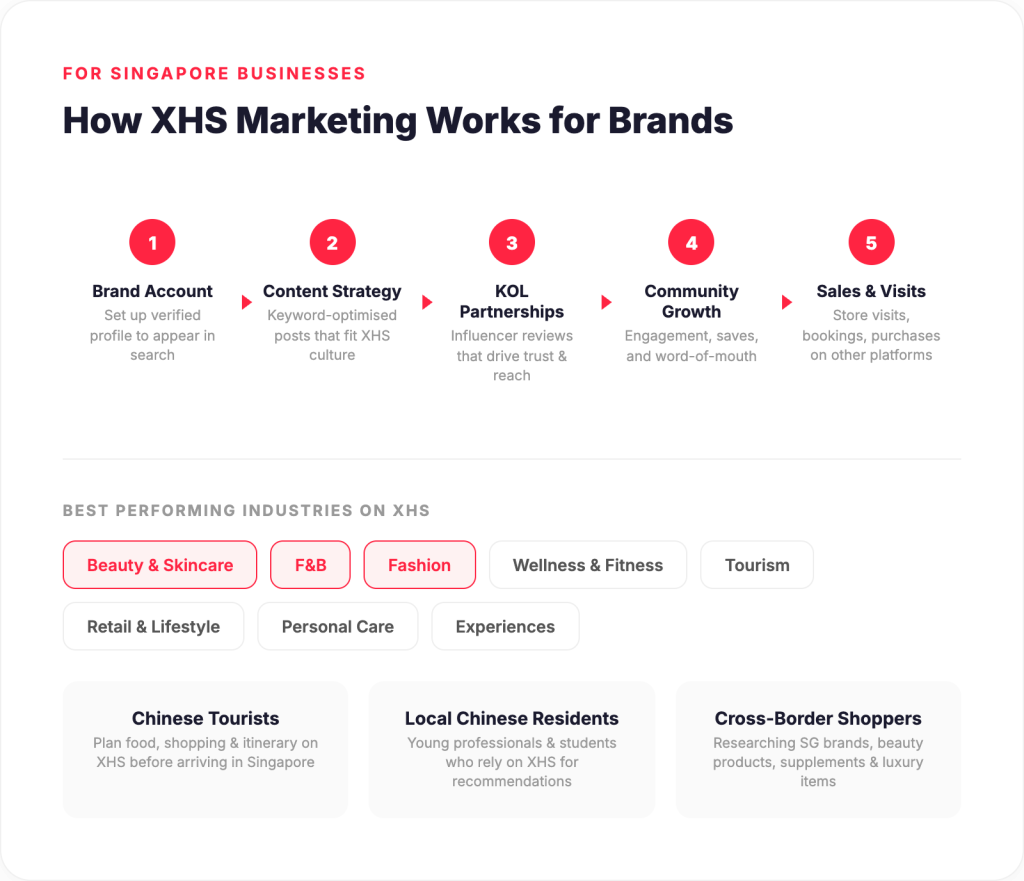
The categories where XHS matters most in Malaysia are the ones people research before spending: cafes and restaurants, beauty and skincare, aesthetics clinics, fashion, travel and hotels, interiors and renovation, education and tuition, and baby and family products. For a business-to-business supplier, an industrial company, or a brand aimed mainly at Malay or Indian Malaysian customers, XHS is unlikely to matter.
Can a Malaysian business advertise on XHS?
Not through an English self-serve portal, because none exists. The official advertising platform, Juguang, is in Simplified Chinese, and sources disagree on what entity a foreign advertiser needs. Most Malaysian brands start by running their own Chinese-language account and paying Malaysian creators for notes, which needs no China entity at all.
We cover setup, verification documents, costs, the creator route and a 90-day plan in Xiaohongshu marketing in Malaysia. The short version: if you cannot write and reply in Chinese every week, the platform will not work for you, and the budget belongs on social media ads you can run in the languages you have.

A short history
- 2013: Founded in Shanghai by Mao Wenchao (Charlwin Mao) and Qu Fang (Miranda Qu), originally as a shopping guide for Chinese tourists buying products overseas.
- Mid 2010s: Shifted from a guide written by the company to content written by users, which became the notes format.
- Later 2010s onwards: Added in-app commerce, live streaming and advertising, and grew beyond beauty and fashion into food, travel, home, education and almost every consumer category.
- January 2025: RedNote went to the top of the US App Store during the TikTok ban uncertainty, which is when much of the English-speaking world first heard of it.
- June 2026: Redshop, a cross-border shop, reported as launching in eight markets including Malaysia, starting with a small set of craft merchants.
The origin explains the culture. XHS began as people telling each other what was worth buying abroad, and that is still what most notes are.
Frequently asked questions
What is XHS?
XHS is short for Xiaohongshu (小红书), a Chinese social and review platform also called RedNote and Little Red Book. People post notes about products, places and services, then search those notes before deciding where to go or what to buy. In Malaysia it is used mainly by Mandarin-reading users, especially women aged roughly 18 to 35, to research cafes, beauty products, travel and home purchases.
What does XHS mean?
XHS stands for Xiǎo Hóng Shū, the pinyin spelling of 小红书, which translates literally as “Little Red Book”. The initials are the usual shorthand in Malaysia and Singapore. RedNote is the separate English name the app uses in app stores, and RED is an older English brand name. All of them refer to the same app and the same account.
Is XHS the same as RedNote?
Yes. RedNote is the English name shown in the App Store and Google Play, and it became widely known in January 2025 when American TikTok users downloaded the app during the TikTok ban uncertainty. Xiaohongshu, XHS, Little Red Book and 小红书 all refer to the same platform. Your account, your notes and your followers are the same whichever name you search under.
What is XHS in Chinese?
In Chinese characters it is 小红书, read as Xiǎohóngshū, meaning Little Red Book. A post on the platform is called a 笔记, meaning “note”, and creators are called 博主. Knowing these terms helps when you search, because Malaysian users often write “XHS 博主” or “小红书笔记” when they talk about the platform.
Can I use Xiaohongshu in Malaysia?
Yes. Download RedNote from the App Store or Google Play, or browse at xiaohongshu.com/explore on a computer. International phone numbers are accepted at sign-up, though you should check the +60 prefix appears in the country list on your version. The interface and most content are in Chinese, so you will get the most from it if you read and search in Chinese.
How do I buy from Xiaohongshu in Malaysia?
The in-app shop was built for mainland China buyers, and we could not confirm that it checks out to Malaysian addresses. Most Malaysians buy from the seller’s other channels, use a parcel forwarder that provides a China address, or find the same product on Shopee, Lazada or a local shop. Redshop, a cross-border shop reported to launch in June 2026, lists Malaysia but started with a small set of craft merchants.
Is XHS bigger than TikTok in Malaysia?
No. TikTok’s advertising reach in Malaysia is 30.7 million adults according to DataReportal’s Digital 2026 report, while the highest published Malaysian figure for XHS is in the low millions and dates from 2023. XHS matters because of who uses it and how: Mandarin-reading users researching a purchase. For reach, TikTok and Meta are far larger.