Quick answer. Shopify Plus publishes its price: US$2,300 a month on a three year term, US$2,500 on a one year term, with your main store plus nine expansion stores included. Adobe publishes no price at all for Adobe Commerce, so every figure you read online is a third party estimate. For a Malaysian store, the deciding factor is usually not the licence. It is that Shopify Payments does not operate in Malaysia, so a Plus store here pays 0.20% of every transaction to Shopify on top of its gateway’s own fees, loses the Plus fee waiver, and loses the Shopify Markets features that depend on Shopify Payments. Adobe Commerce has no platform transaction fee, which means the gap narrows as your volume rises. Pick Shopify Plus if your catalogue is straightforward, your team is small, and you want to launch in a quarter. Pick Adobe Commerce if you sell B2B with contract pricing, run multi warehouse logic, integrate a real ERP, and can afford engineers who know it.
What you are actually comparing in 2026
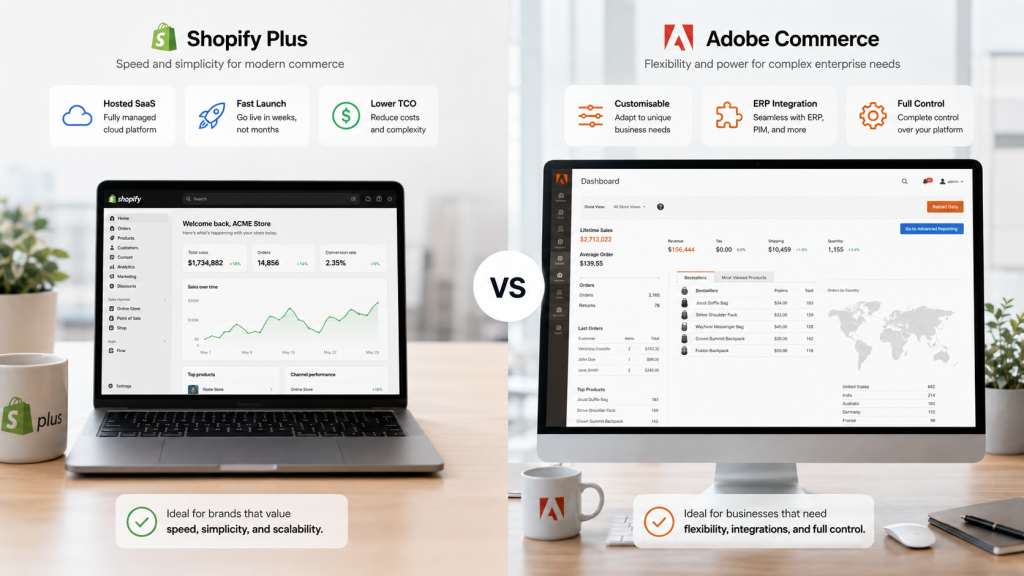
Most Malaysian pages on this topic still compare “Shopify Plus” against “Magento Commerce”, a product name Adobe retired. The naming matters because the three Adobe options now behave very differently.
Adobe’s own documentation splits its commerce products into three deployment models:
|
Adobe product |
Model |
What you control |
Who runs the infrastructure |
|
Adobe Commerce as a Cloud Service |
SaaS, multi tenant, versionless |
APIs, events and App Builder apps only |
Adobe |
|
Adobe Commerce on Cloud |
PaaS |
Full PHP customisation, themes, database, cache, queues |
Adobe manages the platform, you own the code |
|
Adobe Commerce on premise |
Self managed |
Everything |
You or your host |
|
Magento Open Source |
Self managed, free licence |
Everything |
You or your host |
|
Adobe Commerce Optimizer |
SaaS layer on top of an existing back end |
Catalogue views, search, recommendations |
Adobe |
Two facts that older articles get wrong:
Magento Open Source is still alive. Adobe documents Magento Open Source 2.4.9 packages, the same version line as Adobe Commerce 2.4.9, which Adobe released on 12 May 2026 with regular support running to 31 May 2029. The free edition has not been discontinued. Separately, Mage-OS exists as a community governed fork if you want insurance against Adobe’s roadmap.
Adobe Commerce as a Cloud Service is not Magento in the cloud. Adobe introduced it in June 2025 alongside Adobe Commerce Optimizer, and its feature comparison is blunt about the trade off. On the SaaS version, extension is “out of process only (APIs, events, App Builder)”. The available technologies are listed as CSS, CLI, HTML, JS and Node. PHP is not on that list, and “PHP customisation and theming” appears only under PaaS. Email is limited to standard templates. Search indexes need a third party. If you chose Magento because you wanted to write PHP against the catalogue, the SaaS version removes the reason you chose it.
So “Magento vs Shopify Plus” is really three separate comparisons. The rest of this page treats Adobe Commerce on Cloud (PaaS) as the realistic enterprise alternative, because that is what Malaysian merchants with complex requirements actually buy. If you are comparing entry level options instead, our three way comparison of Magento, Shopify and WooCommerce covers the smaller end, and the best ecommerce CMS platforms sets out the wider field.
Shopify Plus in 2026: the published numbers
Shopify is unusual among enterprise platforms in publishing a price. Everything in this table comes from Shopify’s own pages, checked 28 September 2026. For the feature side of the plan rather than the cost side, see the benefits of Shopify Plus.
|
Item |
What Shopify publishes |
|
Platform fee, three year term |
US$2,300 per month |
|
Platform fee, one year term |
Starting at US$2,500 per month |
|
Higher volume alternative |
A variable platform fee based on revenue and business model, rate not published |
|
Stores included |
“Your main store and 9 expansion stores are included as part of your monthly platform fee” |
|
Additional stores |
US$300 per month per store |
|
Brands per contract |
One brand per contract |
|
Third party payment processors |
“You pay your processor fees, plus 0.20% per transaction to Shopify for security and compliance costs” |
|
GraphQL Admin API restore rate |
1,000 cost points per second, against 100 on standard plans and 200 on Advanced |
|
Single query ceiling |
1,000 points, regardless of plan |
The API line matters most. Plus gives ten times the standard throughput, which is what makes real ERP and PIM synchronisation workable. It is not unlimited: the 1,000 point ceiling on a single query applies to Plus too, so an integration pulling 50,000 order lines is still paginating.
Checkout customisation: what changed and what is now impossible
The old answer to “can I customise Shopify checkout?” was “yes, on Plus, by editing checkout.liquid”. That answer is dead. Shopify sunset script tags for Plus stores on 28 August 2025, and for non Plus stores on 26 August 2026. Checkout is now a hosted surface customised through three sanctioned tools:
- Checkout UI extensions for anything visual, placed into approved slots rather than anywhere you like.
- Shopify Functions for backend logic on cart, discounts, shipping and payment. Plus gets the full set, including payment customisation, delivery customisation, order routing and cart transform. Lower plans get discount Functions and a subset of validation.
- Web pixels for analytics.
The practical limit: you can change what appears in checkout and how the rules behave, but you cannot restructure the flow. A custom checkout with your own field order, your own URL pattern and your own server side logic between steps is not something Plus will let you build. Work out which checkout behaviour you are giving up before you sign.
B2B on Shopify: no longer a Plus exclusive
This is the single biggest change since most competing articles were written. On 2 April 2026 Shopify moved core B2B features down to Basic, Grow and Advanced. Companies and company locations, quantity rules and price breaks, net payment terms, payment reminders, vaulted cards, draft orders with PO numbers, quick order lists and sales staff permissions are all on the lower plans now.
What Plus still holds exclusively:
- Unlimited B2B market catalogues, against a cap of three active catalogues across all B2B markets on Basic, Grow and Advanced
- Direct catalogue assignment to a named company or company location, which is how you do customer specific pricing
- Deposit requirements, partial payments, and payment requests per fulfilment
- Contextual checkout and storefront customisation through Shopify Markets
Read that list carefully if B2B is your reason for considering Plus. Twenty accounts on three price tiers: an Advanced plan now covers you, so skip Plus. Two hundred accounts each on a negotiated price list: direct catalogue assignment is what you are buying, and it is Plus only.
The Malaysian complication: no Shopify Payments
Malaysia does not appear on Shopify’s published list of supported countries for Shopify Payments, checked 28 September 2026. Singapore, Hong Kong SAR and Japan are on that list, so the nearest comparable markets have it and Malaysia does not. Shopify’s own wording is that merchants in unlisted countries “need to use a third party payment provider”.
For a Plus store in Malaysia that has four consequences.
You pay the 0.20%. Shopify waives the third party transaction fee for Plus stores using Shopify Payments as their sole provider. A Malaysian store cannot qualify. On RM2 million a month in sales, 0.20% is RM4,000 paid to Shopify for nothing your customer sees. Note also that Shopify’s Malaysian pricing page quotes Plus in US dollars, not ringgit, so the licence carries FX exposure that an Adobe Commerce contract negotiated in ringgit would not.
There is often a second surcharge. Malaysian gateways price Shopify separately. Fiuu, the rebranded Razer Merchant Services, states in its FAQ that Shopify merchants pay an additional 0.25% processing charge on top of the existing transaction fee. Billplz publishes its Shopify row as its standard rate plus 0.3%. So a single FPX order can carry Shopify’s platform fee, the gateway’s own rate, and a Shopify specific surcharge. Ask every provider for its Shopify rate, not its rate card. Our comparison of the best payment gateways in Malaysia sets out the underlying rates.
Markets features go dark. Shopify’s documentation states that selling in local currencies is supported only by Adyen or Shopify Payments, and that orders placed through other third party providers are processed in your store’s default currency. Duty and tax collection on export orders depends on Shopify Payments too. If your plan for Plus was to run one Malaysian store selling into Singapore and Australia in local currency, that plan needs Adyen approval or it does not work.
Native subscriptions do not work. Shopify requires Shopify Payments as the primary gateway for its subscription products. A refill or monthly box model on a Malaysian Shopify store has to go through a third party app with its own limitations.
Adobe Commerce has none of these constraints, because it has no payment product to be absent. You connect any Malaysian gateway directly, pay its rate, and nothing is withheld from you. That is a genuine Adobe advantage in this market, and most pages written outside Malaysia will never mention it. The wider picture of running Shopify from Malaysia is in our guide to Shopify in Malaysia.
One more Malaysian gap that affects both platforms differently: Shopify Shipping is not available here, and carrier calculated live rates at checkout are limited to Advanced and Plus. So Plus does buy you live courier rates through an aggregator like EasyParcel, which a Basic store cannot show at all.
Total cost of ownership, worked for a Malaysian store
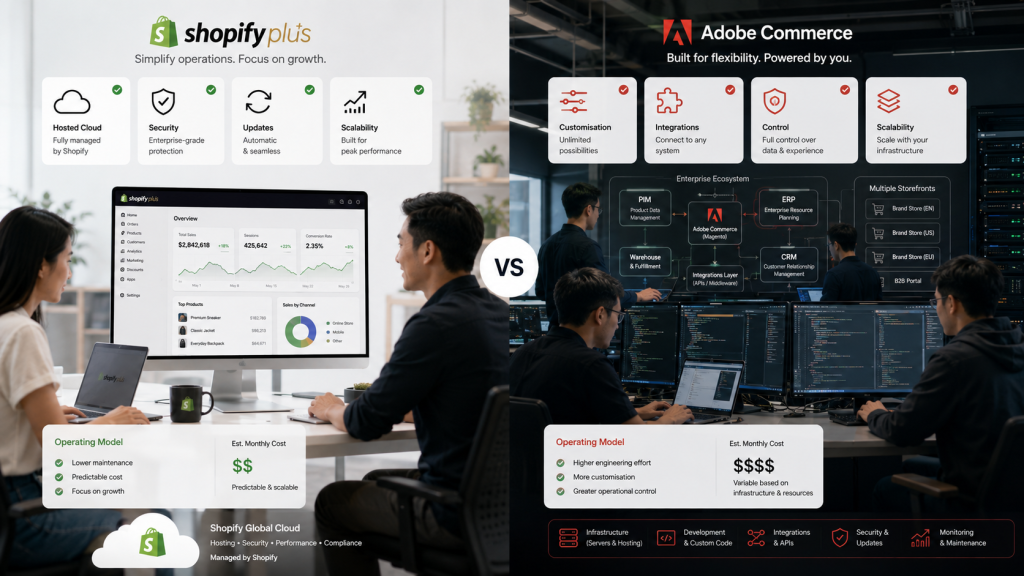
The figures below are illustrative. Shopify’s platform fee is published. Adobe’s is not, and anyone quoting you an Adobe Commerce licence number without saying where it came from is guessing. Treat the Adobe column as a planning range to test against a real quote, not a price.
Assume a store doing RM2,000,000 a month in gross sales, roughly RM24 million a year, with a 3,000 SKU catalogue and both retail and wholesale customers. Currency converted at RM4.20 to the US dollar.
|
Cost line |
Shopify Plus |
Adobe Commerce on Cloud |
|
Platform licence |
RM9,660 a month (US$2,300, three year term, published) |
Not published by Adobe. Quote based, typically tiered on GMV or order volume |
|
Hosting and CDN |
Included |
Included in the Cloud licence. Self hosted Magento Open Source instead: a production ready cluster in Singapore or Jakarta, plus backups and staging |
|
Payment gateway |
Gateway rate plus 0.20% to Shopify, plus any Shopify specific gateway surcharge. On RM2m that is RM4,000 a month to Shopify alone |
Gateway rate only, no platform cut |
|
Apps or extensions |
Recurring app subscriptions, usually the second largest line after the licence |
Extension licences are often one off, but each needs integration work and retesting at every upgrade |
|
Development and maintenance |
Theme and Functions work, no server administration |
Ongoing engineering: security patches, quarterly patch releases, version upgrades, performance tuning, infrastructure |
|
Upgrades |
Handled by Shopify, no version to manage |
Your project. Adobe Commerce 2.4.9 support runs to 31 May 2029, but each minor version is a real upgrade project |
|
Cost shape |
High fixed, low variable, predictable |
Lower fixed licence floor on Open Source, high and lumpy engineering cost |
The honest summary is that Shopify Plus wins on total cost until your engineering requirement stops being optional. The crossover is not a revenue number, it is a complexity number. A store doing RM50 million a year with 500 simple SKUs and no ERP is still better off on Plus. A store doing RM12 million a year with contract pricing for 300 dealers, stock across four warehouses, and a live link to an accounting system is already in Adobe’s territory.
Our breakdown of ecommerce website development costs in Malaysia covers the build side in ringgit.
Talent supply in Malaysia is part of the cost
This is the factor Malaysian merchants underweight most. The platform decision commits you to a hiring market.
Shopify work in Malaysia is served by a wide pool: theme developers, Liquid contractors, app configurators, and a long list of agencies. Rates are competitive because supply is deep, and replacing a departing developer takes weeks.
Adobe Commerce work is a specialist market here. Certified Adobe Commerce developers are fewer, command a premium, and cluster in a small number of agencies. The risk is concentration: if one senior developer leaves mid project, the replacement search is measured in months, not weeks, and may end with an offshore team in India, Vietnam or the Philippines. That is workable, but it changes your working hours, your code review process, and your escalation path when checkout breaks on a Saturday.
Price the hiring market, not just the build. A platform you cannot staff in year three is more expensive than one with a higher licence. If you want to see who does this work locally, we keep a view of Shopify Plus development agencies in Malaysia.
Migration risk, in both directions
Migration is where budgets die. Both directions carry real risk, and the risk is not symmetrical.
|
Risk area |
Magento or Adobe Commerce to Shopify Plus |
Shopify Plus to Adobe Commerce |
|
URL structure |
Magento’s default .html product suffix and layered navigation URLs do not exist on Shopify, which forces /products/, /collections/ and /pages/ prefixes. Every product and category URL changes |
Shopify’s forced prefixes disappear, so every URL changes again. You control the new structure, which is the upside |
|
Redirects |
A full old to new map is mandatory. Layered navigation can generate thousands of indexed filter URLs that need consolidating rather than one to one redirecting |
Same scale of work, plus you now own the redirect layer at server level |
|
Data |
Customer passwords cannot transfer, so customers reset on first login. Order history transfers as records, not as reorderable objects |
Same password problem in reverse |
|
What gets rebuilt |
Every extension becomes an app, a Function, or a compromise. Custom PHP modules have no equivalent and must be rewritten or dropped |
Every app becomes a module or a custom build. Checkout logic built on Shopify Functions has to be rewritten |
|
Checkout |
You inherit Shopify’s checkout as is. Any flow you cannot rebuild with UI extensions and Functions is lost |
You regain full checkout control, which is often the reason for the move |
|
B2B data |
Company accounts, price lists and payment terms rarely map cleanly in either direction. Expect manual rebuilding |
Same |
|
SEO exposure |
Highest at the URL change. Traffic dips are normal for four to eight weeks even when done properly |
Same |
Two rules from projects that went well. Freeze the catalogue during cutover, because a moving product set breaks the redirect map. And keep the old site crawlable in staging for a month afterwards so you can diff what you lost. Our SEO migration plan covers the redirect and monitoring sequence.
If you are heading towards a rebuild rather than a migration, read headless architecture for ecommerce first.

A decision framework you can actually apply
Score each row. Mostly left, choose Shopify Plus. Mostly right, get an Adobe Commerce quote before you commit.
|
Question |
Points to Shopify Plus |
Points to Adobe Commerce |
|
Annual online revenue |
Under RM50 million |
Above RM50 million, where the 0.20% and app fees start to exceed engineering cost |
|
Catalogue size |
Under 10,000 SKUs with standard attributes |
Tens of thousands of SKUs, configurable products, or attribute logic Shopify’s variant model cannot express |
|
Variants per product |
Within Shopify’s limits on option and variant counts |
Complex configurable products with dependent options |
|
B2B requirement |
Price tiers, payment terms, PO numbers, up to three catalogues |
Named account price lists, quote to order with multi tier approval, credit limits |
|
ERP or PIM integration |
Standard connector to a mainstream system |
Deep bidirectional sync, custom middleware, real time stock across warehouses |
|
Warehouses and fulfilment |
Locations that fit Shopify’s inventory model |
Multi source inventory with custom allocation rules |
|
Checkout requirements |
Logic you can express in Functions and UI extensions |
Custom flow, custom steps, or server side logic between steps |
|
In house developer capability |
No engineers, or a marketer who can edit a theme |
A team that can own patching, upgrades and infrastructure, or budget for an agency retainer that does |
|
Payment setup |
Comfortable paying 0.20% to Shopify plus gateway fees |
Wants the gateway relationship with no platform cut |
|
Speed to launch |
Needs to be live this quarter |
Can spend two to four quarters getting it right |
Where Adobe Commerce is simply the better answer, and we say this as a Shopify partner: B2B distributors and manufacturers with negotiated pricing per account, businesses whose product data model does not fit variants, anyone who needs checkout logic Shopify Functions cannot express, and Malaysian merchants for whom the absent Shopify Payments features, particularly local currency selling and native subscriptions, are business critical rather than nice to have.
Where Shopify Plus is the better answer: almost everyone else. That is not a sales line, it is what the cost of running Magento well does to a mid market P&L.
Frequently asked questions
Is Magento the same as Adobe Commerce?
Adobe Commerce is the paid, Adobe owned product. Magento Open Source is the free, self hosted edition, still on the same 2.4 version line and still receiving releases: Adobe documents Magento Open Source 2.4.9 packages. “Magento Commerce” is a retired product name. People still say Magento for all of it.
How much does Adobe Commerce cost?
Adobe does not publish a price. Licensing is quote based and generally tiered on gross merchandise value or order volume, with Adobe Commerce on Cloud including hosting. Any specific annual figure you find online is a third party estimate, not an Adobe rate. Get a written quote before building a business case.
Does the 0.20% Shopify fee apply to Malaysian Plus stores?
Yes. Shopify’s Plus pricing page states that with third party processors you pay your processor fees plus 0.20% per transaction to Shopify. The waiver applies only to stores using Shopify Payments as their sole provider, and Shopify Payments is not available in Malaysia as at 28 September 2026.
Is Shopify Plus still needed for B2B?
Not for basic wholesale. Since 2 April 2026, company accounts, price breaks, payment terms and PO numbers are on Basic, Grow and Advanced. Plus is needed for unlimited catalogues, direct catalogue assignment to a company or location, deposits and partial payments, and contextual checkout through Markets.
Can I still edit Shopify checkout on Plus?
Not through checkout.liquid, which Shopify sunset for Plus stores on 28 August 2025. You customise through Checkout UI extensions, Shopify Functions and web pixels. That covers appearance and rules but not restructuring the flow.
How many stores do I get on Shopify Plus?
Your main store plus nine expansion stores are included. Additional stores cost US$300 a month each, and Shopify limits a contract to one brand.
Which platform is faster to launch?
Shopify Plus, consistently, because hosting, patching and checkout are not your problem. The gap is widest for a straightforward D2C build and narrowest for a complex B2B build where the integration work dominates either way.
Should I migrate off Magento Open Source just because it is old?
Not on age alone. The 2.4 line is maintained and Adobe Commerce 2.4.9 has regular support to 31 May 2029. Migrate when the cost of running it, the security exposure, or a business requirement it cannot meet exceeds the cost of moving.
What to do next
We build and support Shopify and Shopify Plus stores, and we will tell you when Adobe Commerce is the right call. A store on the wrong platform becomes someone else’s project within two years.
Send your revenue, catalogue size, B2B requirements and integration list through our contact page and we will cost both options. If Shopify is already decided, see our Shopify website design and development service, and for a platform agnostic build, our ecommerce development in Malaysia page.