Search “types of B2B marketing” and you get two different answers tangled together. Some sources list strategic models like inbound and account-based marketing. Others list channels like email and content. Both are valid, but mixing them confuses the decision you actually need to make.
This guide separates the two and gives you a clear set of eight B2B marketing types, what each does, and how to choose the right mix for a Malaysian business selling to other businesses. For the broader local picture, B2B Digital Marketing Malaysia is a useful companion read.
What is B2B marketing?
B2B marketing is the process of promoting and selling products or services to other businesses rather than to individual consumers. The defining features are a longer sales cycle, multiple decision-makers, higher transaction values, and messaging built on logic, return on investment, and trust rather than impulse.
That changes everything about how you market. A consumer might buy in minutes. A business buyer researches, compares, consults colleagues, and signs off over weeks or months. Gartner research has found that around 27% of the B2B buying journey is spent on independent online research, which is why being visible and credible across channels matters so much. If you want the full contrast, see B2B vs B2C Digital Marketing.
Two ways to read “types of B2B marketing”
Before the list, the key distinction:
- Strategy types describe your overall approach: inbound, account-based, or traditional outbound. You usually pick a primary strategy.
- Channel types describe where and how you execute: content, email, SEO, social, events, and so on. You combine several.
The eight types below cover both, clearly labelled, so you can build a strategy and then choose the channels that serve it.
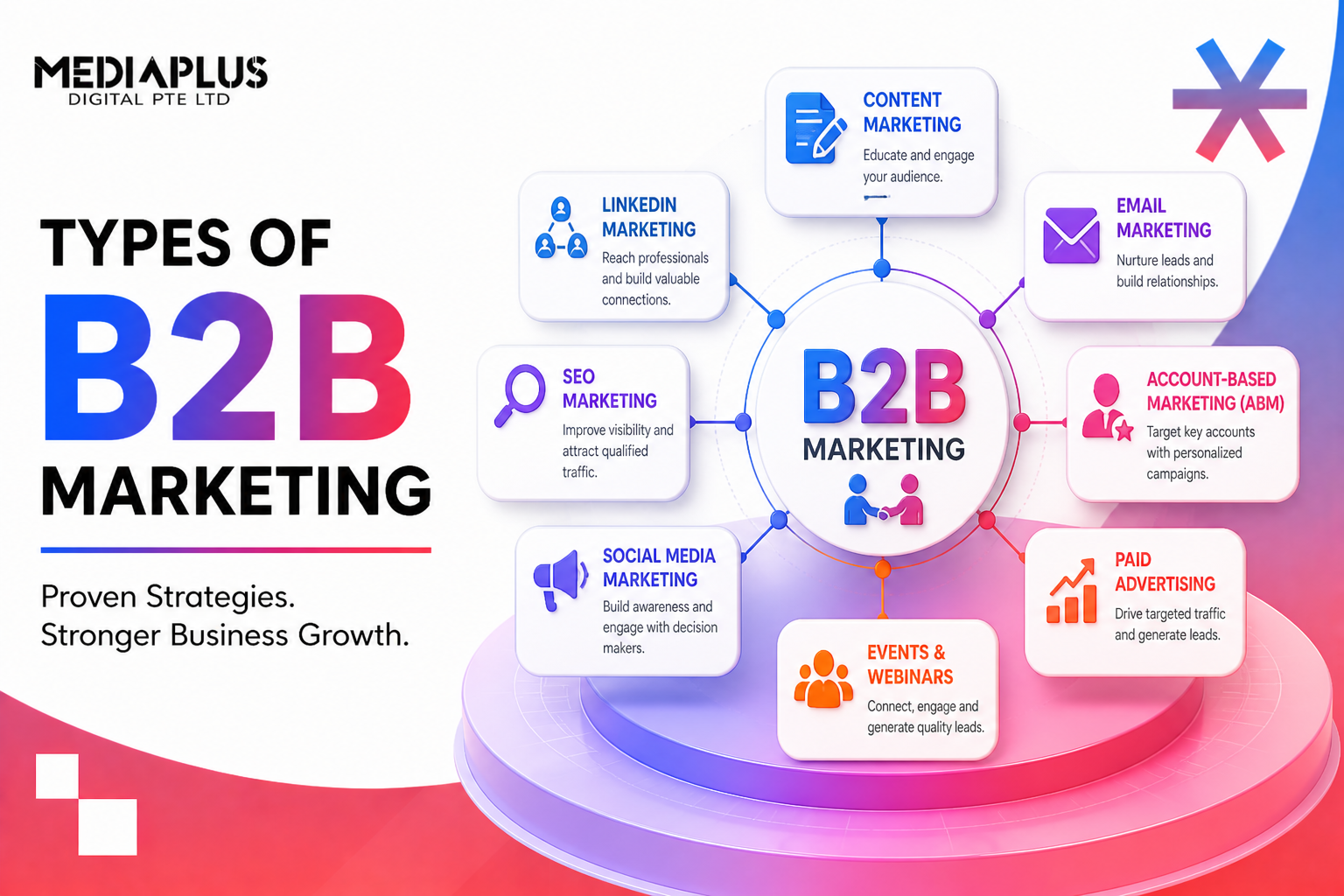
The 8 types of B2B marketing
1. Content marketing
Educational content that helps buyers solve problems and positions you as a credible expert. Think guides, whitepapers, case studies, and comparison articles aimed at each stage of the buying journey. Content marketing is the engine behind most inbound and SEO success.
2. SEO and search marketing
Ranking for the terms business buyers use during research. Because so much of the B2B journey is independent online research, organic visibility is one of the highest-leverage investments you can make. It compounds over time, unlike paid ads that stop the moment you stop spending. Our SEO Services in Malaysia page covers how this works in practice.
3. Email marketing and lead nurturing
Email remains one of the most effective B2B channels because buying decisions take time. Nurture sequences keep your business in front of prospects across a long cycle, delivering the right information at the right stage. This pairs naturally with Lead Generation.
4. Account-based marketing (ABM)
Instead of casting a wide net, ABM targets a defined list of high-value accounts with personalised campaigns, treating each account almost as a market of one. It suits businesses with a small number of large, identifiable target customers. A budget-friendly “ABM-lite” version works well for Malaysian SMEs that cannot run full enterprise programmes. See Account-Based Marketing (ABM) for how to scope it.
5. Social media marketing, LinkedIn-led
For B2B, LinkedIn is the dominant social platform, since its members include the decision-makers you are trying to reach. Organic thought leadership plus targeted LinkedIn advertising is a proven combination. Other platforms support brand awareness, but LinkedIn usually drives the qualified attention.
6. Paid search and paid social
Google Ads and sponsored LinkedIn or Meta campaigns buy visibility immediately, which is valuable when you are launching, entering a new market, or filling a pipeline gap. Paid works best alongside organic rather than as a permanent substitute. If you are weighing the two, SEO vs SEM is a helpful comparison.
7. Webinars and video marketing
Webinars, demos, and short explainer videos let you show expertise and product value to multiple stakeholders at once. Video has become a default format in B2B because it compresses complex information into something a busy buyer will actually consume.
8. Events and thought leadership
Trade shows, industry events, founder-led content, and speaking engagements build the relationships and reputation that long B2B cycles depend on. In relationship-driven markets like Malaysia and the wider region, this still carries real weight.
Strategy types versus channel types at a glance
|
Type |
Category |
Best for |
|
Content marketing |
Channel (inbound) |
Building trust and organic reach |
|
SEO and search |
Channel (inbound) |
Capturing active research demand |
|
Email and nurturing |
Channel |
Long sales cycles, staying top of mind |
|
Account-based marketing |
Strategy |
Few high-value target accounts |
|
LinkedIn social |
Channel |
Reaching decision-makers directly |
|
Paid search and social |
Channel |
Fast visibility, launches, gap-filling |
|
Webinars and video |
Channel |
Demonstrating expertise at scale |
|
Events and thought leadership |
Channel |
Relationship-driven, high-trust deals |
How to choose the right mix for your business
There is no single correct combination. Use these factors to decide.
- Sales cycle length. Longer cycles reward content, email nurturing, and ABM. Shorter ones can lean more on paid.
- Number of target accounts. A handful of large prospects points to ABM. A broad market points to SEO and content.
- Budget and timeline. Need pipeline this quarter? Add paid. Building durable advantage? Invest in SEO and content.
- Where your buyers research. For most B2B audiences in Malaysia, that means Google search and LinkedIn first.
A simple starting stack for many Malaysian B2B firms: SEO and content as the foundation, email nurturing to convert, LinkedIn for reach, and a focused ABM effort for top accounts. As you scale across the region into Singapore or Indonesia, the same stack adapts well to cross-border expansion.
To see how these pieces connect into a single journey, read Digital Marketing Funnel Explained. If your priority is measurable pipeline rather than brand awareness, What Is Performance Marketing is worth a look.
FAQ
What are the main types of B2B marketing?
The core types are content marketing, SEO, email and lead nurturing, account-based marketing, LinkedIn social, paid search and social, webinars and video, and events and thought leadership. Some are strategies, most are channels.
What is the difference between B2B and B2C marketing?
B2B targets organisations with multiple decision-makers and longer, logic-driven sales cycles, while B2C targets individual consumers making faster, more emotional decisions. The full breakdown is in B2B vs B2C Digital Marketing.
Which type of B2B marketing works best in Malaysia?
For most Malaysian B2B businesses, SEO and content combined with LinkedIn and email nurturing deliver the most reliable pipeline, with ABM added for high-value accounts.
What is account-based marketing?
ABM focuses your marketing on a defined list of high-value target accounts with personalised campaigns, rather than marketing broadly to a wide audience.
How long does B2B marketing take to show results?
Paid channels can generate leads quickly, while SEO, content, and reputation-building typically take a few months to compound, then become your most cost-effective source of demand.
Build the right B2B mix
The businesses that win in B2B are not the ones using every channel. They are the ones that pick a clear strategy and combine the few channels that fit their sales cycle and their buyers.
MediaPlus Digital helps Malaysian B2B companies build that mix through full-service digital marketing in Malaysia. For a view of the local landscape, see B2B Marketing Agencies in Malaysia, then contact us to plan your strategy.