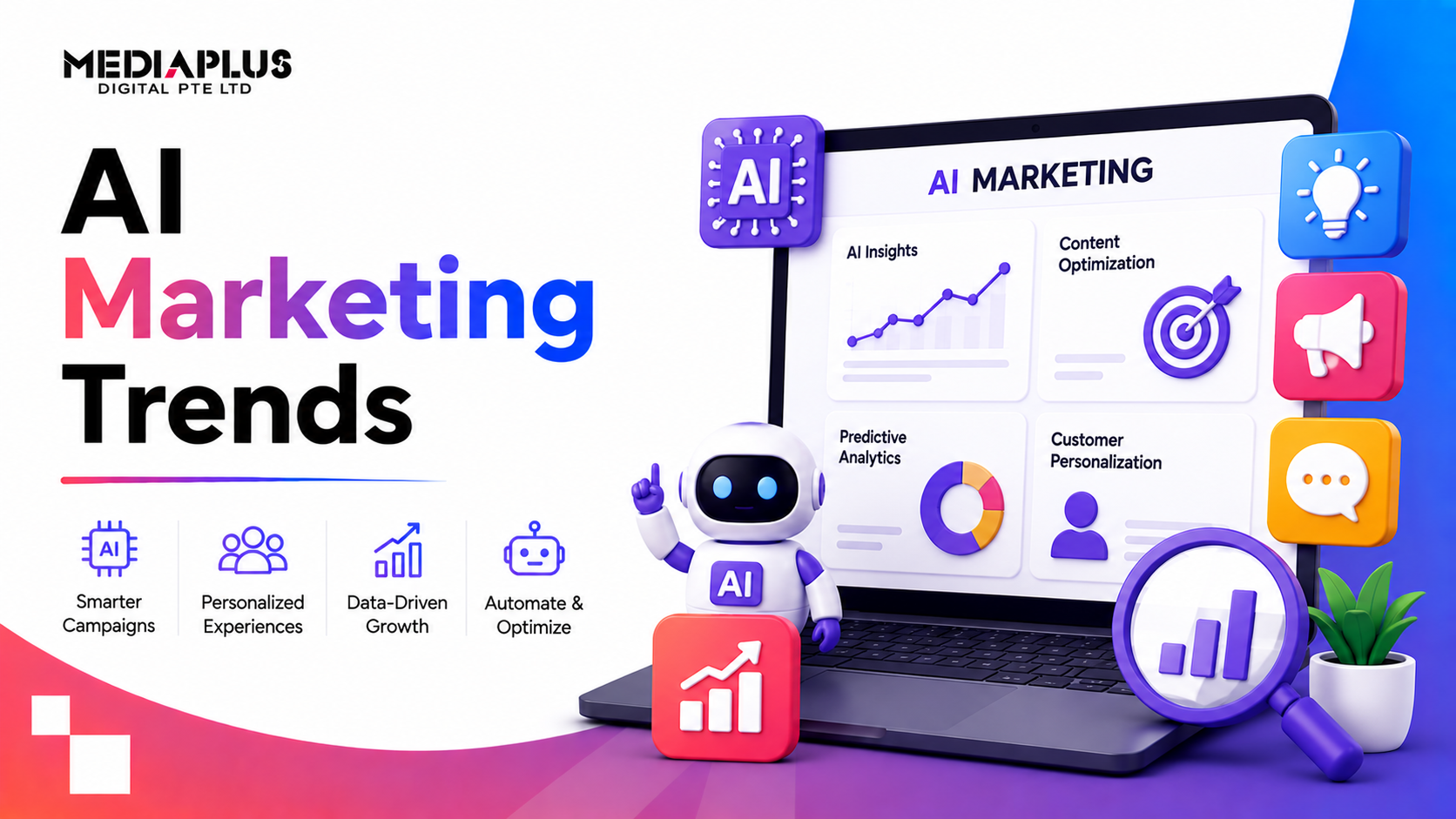
AI has stopped being a novelty in marketing and become the plumbing. Around 87% of marketers now use generative AI in some form. The catch is that most are stuck experimenting: among organisations using AI, roughly two-thirds are still in pilot mode, and only about a third report genuine scaling. So the real story of 2026 is not whether to use AI, but how to move from playing with it to running on it. This guide covers the AI marketing trends that matter, and how to act on them without getting stuck.
The state of AI in marketing
- About 87% of marketers use generative AI, but two-thirds of organisations are still piloting rather than scaling.
- More than 80% say generative AI has not yet moved enterprise profit in a measurable way, which points to an execution gap, not a technology gap.
- Buyers are changing how they discover brands, leaning on AI summaries and assistants before they ever visit a website.
The lesson: the winners in 2026 are not the ones with the fanciest tools, but the ones who build AI into their operating model.
The AI marketing trends for 2026
1. Agentic AI runs real workflows
The biggest shift is autonomous AI agents that do more than answer prompts. They analyse data, personalise campaigns, and optimise spend with little human input. In 2026, agents move from assistants to operators, handling repetitive workflows so teams focus on strategy and creative.
2. Generative engine optimisation (GEO)
As buyers rely on AI answers from Google AI Overviews, ChatGPT, and Perplexity, being cited by those tools becomes as important as ranking on Google. GEO structures your content and data so AI recommends your brand. It is the fastest-growing area of search, and most competitors are not ready for it.
3. Hyper-personalisation at the individual level
Personalisation moves from segments to individuals. AI adapts content, offers, and journeys to each person based on behaviour and intent, in real time. Done well it feels helpful; done badly it feels intrusive, so the balance matters.
4. AI video as the default ad format
Short-form video is already the dominant format, and AI now speeds up its production. Generating and testing video variations at scale, for TikTok, Reels, and Shorts, is becoming standard rather than a luxury.
5. AI-driven commerce and discovery
Buyers increasingly research and even buy through AI assistants and recommendations. That reshapes the funnel, since your brand needs to be visible and trusted inside AI tools, not just on your own site.
6. AI in measurement and planning
AI is moving into analytics and planning: predicting what will convert, modelling attribution, and guiding budget. This is where AI often pays back fastest, because better decisions compound.
7. Conversational marketing and chatbots
AI chatbots have grown into genuine assistants that answer questions, qualify leads, and guide buyers in natural language, across the website and channels like WhatsApp.
8. The consumer-trust gap
As AI content floods every channel, consumers grow more sceptical. Brands that use AI for speed but keep a human voice, real expertise, and honesty will stand out. Trust becomes a differentiator, not a given.
9. New operating models
The deepest change is organisational: pod-based teams, system-based creative production, and AI-driven measurement. The trend is less about a tool and more about restructuring how marketing gets done.
How to prioritise, and avoid pilot purgatory
Most teams stall because they treat AI as scattered experiments. To scale:
- Pick one workflow to automate fully, end to end, rather than dabbling in ten.
- Start where AI pays back fastest: content production, measurement, and performance marketing.
- Get GEO-ready now, since AI search visibility compounds and most rivals are late.
- Keep a human layer for strategy, brand voice, and quality control.
- Measure the business outcome, not just time saved.
Frequently asked questions
What is the biggest AI marketing trend in 2026?
Agentic AI, where autonomous agents run full marketing workflows, along with the shift to AI search visibility (GEO) as buyers use AI to discover brands.
Are most companies actually getting results from AI?
Adoption is high, around 87% of marketers, but most are still piloting. Only about a third report real scaling, and few see measurable profit yet, which is an execution gap.
What is GEO and why does it matter?
Generative engine optimisation structures your content so AI tools like Google AI Overviews and ChatGPT cite your brand. As AI answers capture more searches, GEO protects and grows your visibility.
Will AI replace marketers?
No, but it changes the job. AI handles repetitive tasks and speeds up production, while people focus on strategy, brand, creativity, and judgement. Teams that pair AI with human oversight win.
Where should a business start with AI marketing?
Start with one high-value workflow, usually content, measurement, or ad optimisation, prove the result, then expand. Get GEO-ready early.
Final thoughts
The AI marketing trends of 2026 point one way: AI moving from a tool you try to a system you run on, with agents, personalisation, and AI search reshaping how buyers find and choose you. The advantage goes to businesses that build AI into how they work and stay human where it counts, not to those with the longest list of tools.
If you want help putting these trends to work, from GEO and AI chatbots to AI-assisted content and ads, talk to MediaPlus Digital and claim a free RM300 audit.