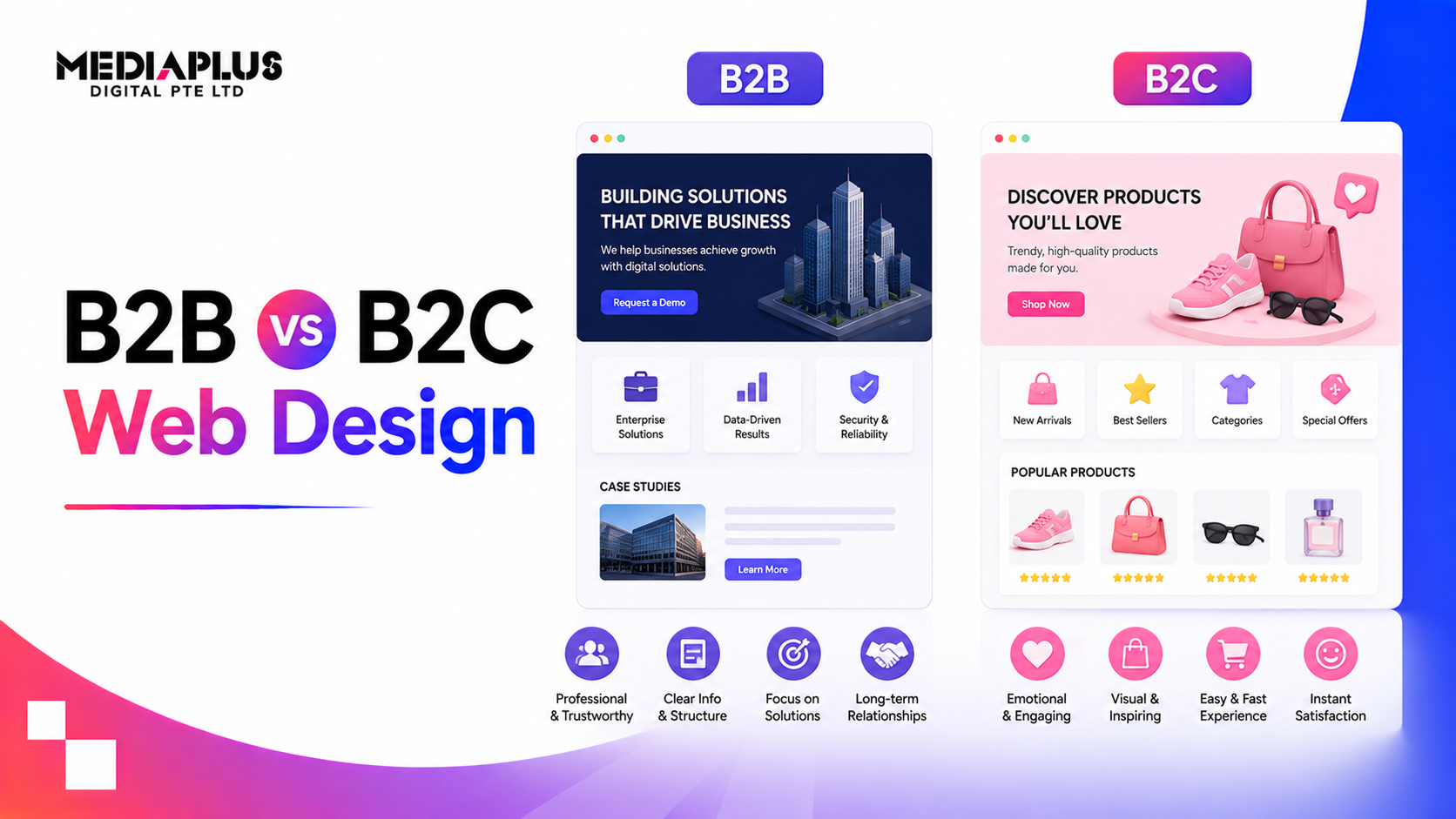
A B2B website and a B2C website may look similar, but they are built to do different jobs. A B2C site is designed to make someone buy now. A B2B site is designed to earn a lead and build trust over a long decision. Design the wrong way for your audience and you lose sales or leads. This guide explains the key differences between B2B and B2C web design, with best practices for each and how to know which rules apply to you.
B2B vs B2C web design at a glance
|
B2B web design |
B2C web design |
|
|
Goal |
Generate a lead (demo, enquiry, call) |
Drive a transaction (buy now) |
|
Audience |
Professional buyers, procurement, executives |
Individual shoppers |
|
Decision |
Logical, needs detail and proof |
Emotional, fast, visual |
|
Sales cycle |
Long, often 6 to 18 months |
Short, often one session |
|
Main CTA |
Request a demo, contact us, download |
Buy now, add to cart, shop the sale |
|
Content |
Depth, specs, ROI, case studies |
Emotion, offers, visuals |
|
Success rate |
3 to 5% visitor-to-lead is strong |
2 to 4% visitor-to-sale is average |
The key differences
The goal: lead versus sale
The biggest difference is what a conversion means. A B2C site converts a visitor into a transaction: add to cart, buy now. A B2B site converts a visitor into a lead: a demo request, a form, or a sales call. Everything else in the design follows from that.
The audience
B2C targets individual shoppers driven by emotion, speed, and visual appeal, who often decide in a single session. B2B targets professional buyers, procurement teams, and executives who need detailed information, proof, and several touchpoints before they commit. You are designing for a careful committee, not an impulse buyer.
The sales cycle
B2C purchases are often impulsive, so the design removes friction and gets people to buy fast. B2B decisions can take 6 to 18 months and involve several people, so the site has to nurture, inform, and build trust across many visits, not close in one.
The call to action
B2C uses direct, punchy CTAs: “Buy Now”, “Get 50% Off Today”, “Shop This Look”. B2B uses relationship-building CTAs: “Request a Demo”, “Download the Whitepaper”, “Talk to Sales”. A “Buy Now” button on a B2B site usually misfires, because the buyer is not ready to buy on the spot.
Content and design
B2C leans on emotion, bold visuals, offers, and a frictionless path to purchase. The homepage pushes sales and discounts to the front. B2B leans on information depth: technical specs, business value, ROI, and case studies, organised so different buyers can find what they need at their stage. It still needs good design, but substance and trust lead.
Trust signals
Both need trust, but they show it differently. B2C uses reviews, ratings, and social proof to reassure a quick buyer. B2B uses case studies, client logos, certifications, and detailed proof of results to satisfy a cautious, high-value decision.
B2B web design best practices
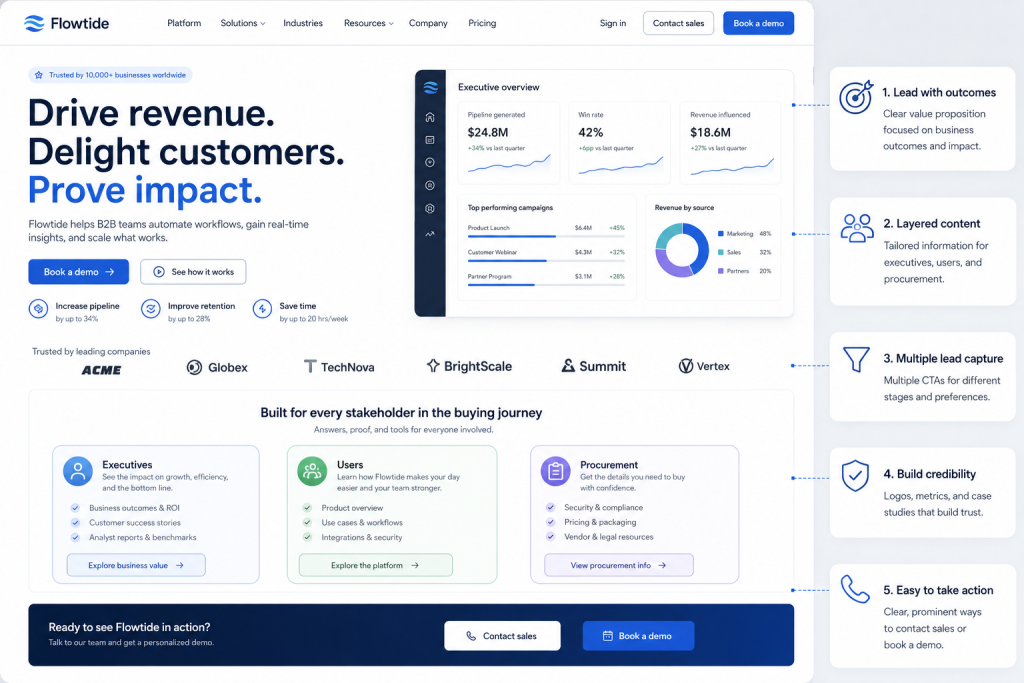
- Lead with outcomes and business value, not features alone
- Layer content so executives, users, and procurement each find their answers
- Offer multiple lead capture points for different buying stages
- Use case studies, logos, and data to build credibility
- Make it easy to contact sales or book a demo
Leading examples like Salesforce, HubSpot, and Slack use outcome-focused messaging, layered content, and several lead capture paths.
B2C web design best practices
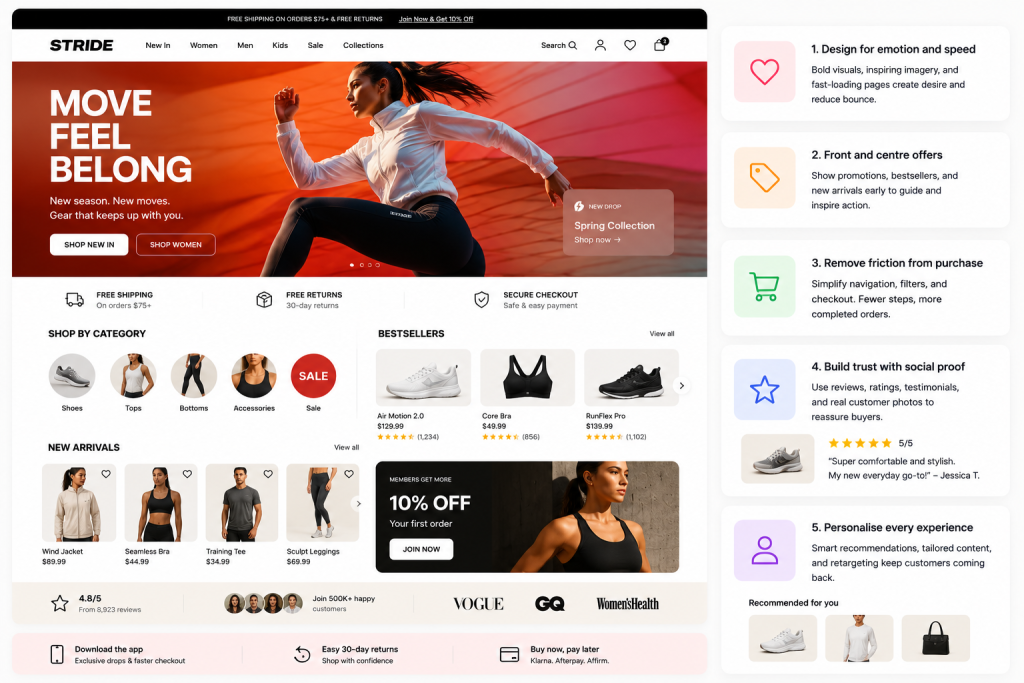
- Design for emotion and speed, with bold visuals
- Put offers, bestsellers, and new arrivals front and centre
- Remove friction from browsing and checkout
- Use reviews and social proof to reassure quick buyers
- Personalise where you can, from recommendations to retargeting
Leading examples like Amazon, Nike, and Apple are built around emotional design, frictionless purchase paths, and personalisation.
What works for both
Some fundamentals apply either way: a fast, responsive, mobile-first site, clear navigation, strong conversion optimisation, and honest, well-written content. The difference is emphasis, not whether these matter.
Frequently asked questions
What is the main difference between B2B and B2C web design?
The goal. B2C web design drives an immediate sale, while B2B web design generates a lead and builds trust over a long decision. Audience, content, and CTAs all follow from that difference.
Do B2B websites need less design than B2C?
No. B2B sites still need strong design, but they lead with substance, proof, and clear structure rather than emotion and offers. Good design makes the trust and information easier to absorb.
Which converts better, B2B or B2C?
They measure different things. A strong B2B site converts 3 to 5% of visitors into leads, while a solid B2C site converts 2 to 4% into sales. Neither number is directly comparable.
Can one agency do both B2B and B2C web design?
Yes, as long as they understand the different goals. The skills overlap, but the strategy, content, and CTAs must match your audience and sales model.
Is an eCommerce site B2B or B2C?
It can be either. Most stores are B2C, selling to consumers, but B2B eCommerce exists too, with features like account pricing, bulk orders, and approvals. The design should match the buyer.
Final thoughts
B2B and B2C web design share the same foundations but pull in different directions. B2C is built to make people buy now with emotion and speed. B2B is built to earn trust and generate leads over a long, considered decision. Knowing which you are, and designing for that buyer, is what turns a website into a sales tool rather than a brochure.
Whether you sell to businesses or consumers, our web design and development team builds sites around your buyer and your goals, from lead generation to eCommerce. Talk to MediaPlus Digital and claim a free RM300 website review.