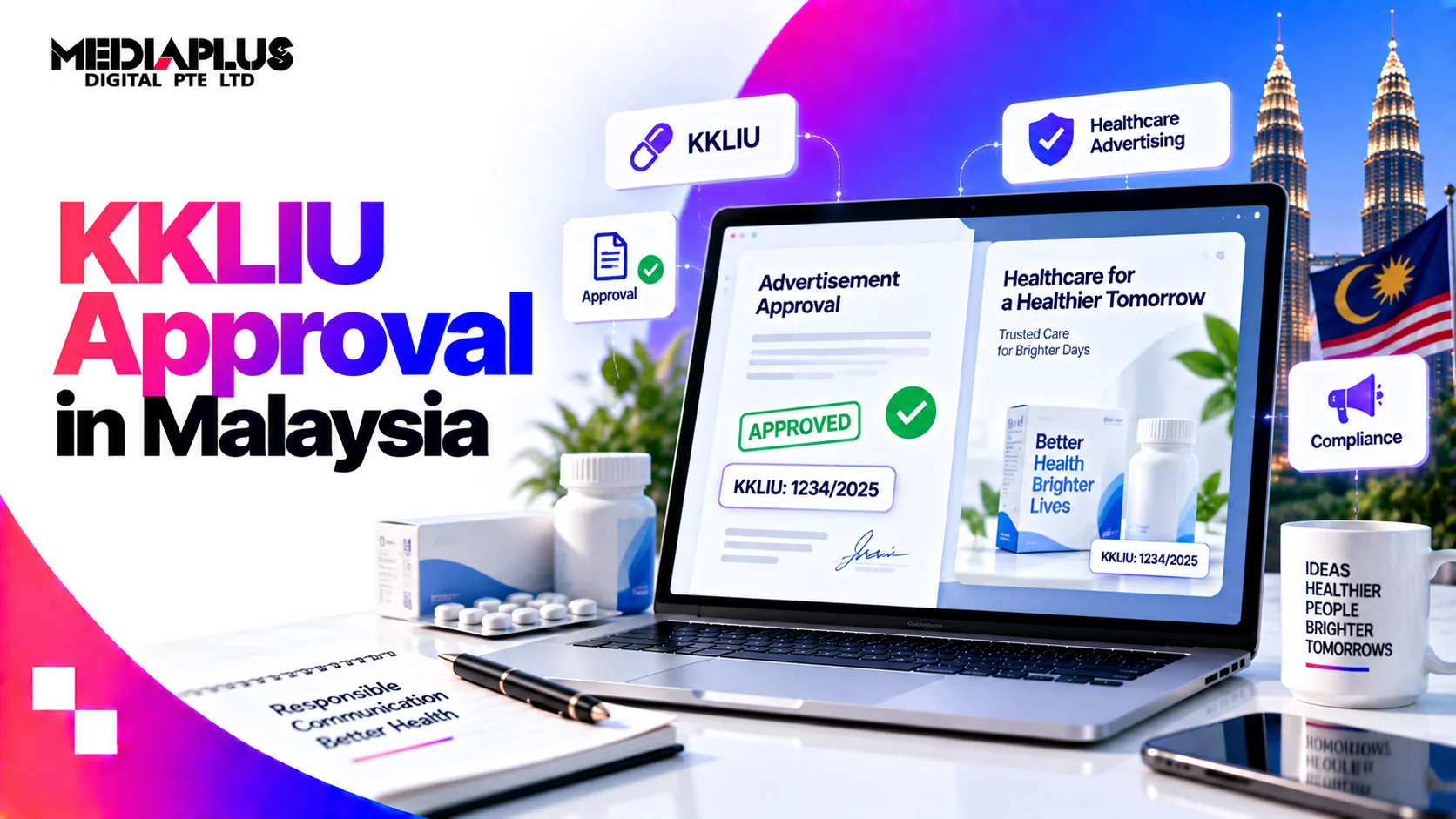
Quick answer: If your advertisement names a skill or service for treating, preventing or diagnosing anything affecting the human body, and invites the reader to come in for it, the Medicine Advertisements Board (Lembaga Iklan Ubat) must approve it first. That covers your website, your Google Ads, your Meta and TikTok creative and your clinic’s own social posts. Approval comes back as a serial you must display, written as KKLIU 1234/EXP 31.12.2028. The fee is RM300 per application and is not refunded. The Board’s charter is 5 working days for most formats and 30 days, weekends and public holidays included, for a website. Approval runs three calendar years and lapses on 31 December of the third year.
Only four kinds of premises can apply: a private hospital, private clinic, private radiological clinic or private medical laboratory, licensed under the Private Healthcare Facilities and Services Act 1998 and run by a registered medical practitioner with a valid Annual Practising Certificate. A wellness centre, fitness studio or non-clinical aesthetic business cannot get approval, so it cannot lawfully advertise treatment at all.
This is general information for marketing teams, not legal advice. Confirm your creative with the Board at liu@moh.gov.my or 03-7841 3200 before publishing.
What a KKLIU number actually is
The Board sits under the Ministry of Health’s Pharmaceutical Services Programme, under the Medicines (Advertisement and Sale) Act 1956 (Act 290) and the Medicine Advertisements Board Regulations 1976. Two sections do the work:
- Section 4A bans any advertisement that refers to a skill or service relating to treatment, prevention or diagnosis of an ailment, disease, injury, infirmity or condition affecting the human body and that carries an invitation, express or implied, to seek the advertiser’s advice. Prior approval is the only escape, and only for the four premises types above.
- Section 4B covers products: registered supplements, traditional medicines and over-the-counter medicines.
Both limbs of section 4A must be met: “we treat diabetic foot ulcers” with a phone number underneath meets both, while a signboard reading “Klinik ABC” with an address meets neither.
Older approvals read KKLIU 1234/2020, where 2020 was the application year; current ones carry the expiry instead. For audio you do not read the digits, and the Board accepts “Iklan ini telah diluluskan oleh Lembaga Iklan Ubat”. Do not confuse the serial with a MAL number, which goes on the product and comes from a different authority.
Who can apply, and who cannot
Only a private hospital, medical clinic, radiological clinic or medical laboratory can apply, and each must be licensed under Act 586 and run by a registered medical practitioner with a valid Annual Practising Certificate. An aesthetic clinic qualifies on the same terms, and its application must list every practitioner with their training in aesthetic medicine. A wellness centre, spa, slimming centre or fitness centre cannot apply at all, so its treatment claims cannot run anywhere. Nor can a foreign hospital advertising into Malaysia. A pharmacy or brand may advertise a registered product, but under section 4B.
Applications also fail for reasons unrelated to the copy: an expired licence, a service not named on it, an expired Annual Practising Certificate, or a practitioner whose registered place of practice differs from the applicant premises. A non-clinical health business may still sponsor a purely educational programme and say only “This programme is brought to you by XYZ Health Centre”, with no address and no phone number.
What needs approval and what does not
|
Item |
Approval needed? |
|
Website page describing treatments or procedures |
Yes |
|
Google Ads, Meta or TikTok creative, or a clinic social post, promoting a treatment |
Yes |
|
Print, brochure, leaflet, billboard or banner promoting services |
Yes |
|
Radio or TV spot, sponsored talk show, in-house video |
Yes. A radio talk show approval lasts 6 months only, needs a complete script, and allows no caller segment |
|
Room rate card, “Klinik mesra keluarga anda” with no service claim, directional signage |
No. None names a skill or service |
|
Calling cards, letterheads, rubber stamps, clinic and directory signboards, seminar or forum notices |
No, but they must follow the Malaysian Medical Council’s rules on disseminating information, and a seminar notice is limited to topic, date, venue, speaker name and place of practice, speaker photo and an enquiry contact |
|
Educational article, health message, award announcement or disease awareness campaign |
No, unless it pushes readers towards the author’s own facility with service or contact details |
|
Cosmetic, food or beverage advertisement |
No. Cosmetics are self-regulated by the National Pharmaceutical Regulatory Agency; food and drink may carry no medical claim |
How to apply, step by step
- Confirm eligibility. Licence current, advertised service named on it, practitioners’ certificates current and tied to this address.
- Build one format per application. Policy MAB 4/2016, amended by MAB 1/2026, allows one format per application for all media except social media, which allows up to three postings. One posting is one scene, frame or poster plus its caption, so two posters in a carousel are two applications, and any posting containing video is a whole posting on its own.
- Pay and submit. The Board’s process infographic states RM300 per application, not refunded once accepted. Submission is still manual, by hand or by post or courier, to Lembaga Iklan Ubat, Lot 36, Jalan Profesor Diraja Ungku Aziz, 46200 Petaling Jaya, Selangor. An online system, MyPharmaC, has been announced but is not yet the published route.
- Wait out the charter. Five working days for non-website formats, 30 days including weekends and public holidays for a website. Plan backwards from 30, because a clinic website submission often runs 20 to 30 pages.
- Display the serial clearly on every advertisement published in any medium.
Two formatting rules catch people out. Since 1 November 2016 every format must leave at least 5cm blank at the bottom for the Board Secretary’s signature, and copy in any language other than Bahasa Malaysia or English needs a certified translation. And under MAB 2/2017, amended by MAB 1/2023, showing a social media logo or link inside an approved ad means quoting that post’s own KKLIU number in the application, so the post must be approved before the ad pointing at it.
How long approval lasts, and what happens when the creative changes
Approval runs three calendar years and lapses on 31 December of the third year. The Ministry’s notice of 5 December 2025 spells it out: advertisements approved in 2023 with a serial ending EXP 31.12.2025 expired on 31 December 2025, and companies were told to stop publishing from 1 January 2026. There is no renewal, so a lapsed advertisement goes back in as a new application.
Under MAB 7/2006, amended by MAB 3/2015, an amendment request must reach the Board within two months of approval, is allowed once only, and is free. Miss the window and you file a new paid application, and you cannot run the changed version while you wait. Some changes need no approval, but you must still write in and tell the Board:
|
Change |
Approval needed? |
|
Charges, hours of service, validity period |
Notify only |
|
Company name, logo, address, email, telephone, fax |
Notify only |
|
Format layout, where the content is exactly as approved |
Notify only |
|
Approved URL for the domain name |
Notify only |
|
New service, new claim, new image, new testimonial |
Full amendment or new application |
That layout exemption is narrower than it looks. Move a headline and keep every word: notify. Reword it: amend.
What you can and cannot say
The Board’s Advertising Guidelines for Healthcare Facilities and Services were reviewed at Board Meeting 1/2026 on 2 March 2026 and took effect on 5 June 2026. The permitted content list is short: name and location, telephone number, hours of service, types of accommodation and facilities, charges, and photographs of registered practitioners.
The photo rule is the 2026 change most agency articles have missed. Practitioner photographs are now allowed in all broadcast media except billboards and banners outside the hospital or clinic, must not exceed MyKad size, and must be information sharing rather than self-promotion. Section 6.8, on websites, still carries the older “not exceeding one third of the format size” wording, so confirm which limit applies to a website submission.
|
Not allowed |
Why |
Rewrite that passes |
|
“Dr Lim, Malaysia’s leading knee surgeon, 2,000 procedures performed” |
Promotes an individual practitioner’s skill, knowledge and experience |
“Orthopaedic surgery. Dr Lim, MBBS, MS Orth, Consultant Orthopaedic Surgeon” |
|
Patient video or influencer reel: “Dr Tan cured my back pain in three sessions” |
Testimonials and endorsements about treatment received, or about a practitioner’s skill, are banned. The guideline counts influencers as celebrities |
Patient or influencer on camera about the premises: “The clinic was spotless and staff explained everything” |
|
“Malaysia’s most advanced cardiac centre” |
Comparison between facilities, direct or implied, is prohibited |
“Cardiology services including echocardiography and stress testing” |
|
“Free health screening for the first 50 patients”, or a free gift with a package |
Free treatment offers and all forms of gift are banned |
“Health screening package RM180, original price RM240” |
Four more rules sit outside the table. Before and after patient photos are banned outright (MAB 2/2019). Real patients and real practitioners cannot appear at all, though models and actors can if the creative carries the line “This image is for illustrative purposes only. It does not represent an actual medical event, procedure, or interaction between healthcare professional and patient” (MAB 12/2007, amended by MAB 1/2025). CSR and charity campaigns cannot be advertised for marketing purposes. And comparing the price of one service between practitioners fails, so “wound care RM100 with a medical officer, RM250 with a specialist” is out even though each price alone is fine.
Packages and discounts are allowed, and this is the point teams most often get wrong. Since 5 July 2023, under amendment LIU 3/2023, packages, discounts and price reductions on healthcare services may appear in advertisements. The guideline’s own examples: an ultrasound at RM200 and a mammogram at RM300 bundled at RM400; 20% off a body check on Mother’s Day; a blood test at RM200 promoted at RM150. Free treatment and gifts stayed banned, so a discount is fine and a freebie is not.
The other rulebooks you still have to satisfy
Act 586. Section 108 bars a private healthcare facility from publishing any advertisement that misleads the public on the type or nature of its facilities or services, or that goes against an advertising direction from the Director General.
Malaysian Medical Council. The Code of Professional Conduct tells doctors to refrain from self-advertisement, covering advertising to obtain patients or for one’s own professional advantage, notices that direct attention to a practitioner’s skill, and employing canvassers. Its 2025 social media guidance adds that claiming to be the best or only practitioner in a field is unethical.
Malaysian Dental Council. Dental practices also work to the MDC and Malaysian Dental Therapists Board “Guidelines and Provisions for Public Information”, 4th edition, in force 1 July 2022. It allows two things the medical guideline does not: fees displayed on the clinic’s webpage or social media under the practice name, with the person in charge as account administrator, and patient testimonials published with consent and no reward involved. But only ten media may be used, comparisons between dental facilities are prohibited, and laudatory terms are out. Do not copy a dental site’s testimonial approach onto a medical brand: the Board’s limits on treatment testimonials govern the advertisement itself.
The Personal Data Protection Act 2012 sits on top, because consent for patient images and for marketing contact are separate things. See our note on making a Malaysian website PDPA compliant.
Penalties
Under section 5 of Act 290, contravening sections 3, 4, 4A or 4B carries, on a first conviction, a fine up to RM3,000 or one year’s imprisonment or both, and on a subsequent conviction up to RM5,000 or two years or both.
Section 108 of Act 586 has no penalty of its own, so the general penalty in section 117 applies: up to RM10,000 or three months for a natural person, plus up to RM500 for each day a continuing offence runs after conviction, and up to RM30,000 for a body corporate, plus up to RM2,000 a day. The person responsible for the body corporate is also liable.
Screening sits with the Advertisement Control Branch of the Pharmaceutical Enforcement Division, so a public complaint reaches an enforcement officer, not a platform moderator.
What this means channel by channel
Website. The long pole: 30 days, not 5, and the whole services section usually goes in as one submission. Approve the copy first, then build, or a finished site waits a month. We schedule it that way on every healthcare website development and dental website design project, and on a spa or aesthetic site whose operator is not a licensed clinic and cannot advertise treatment at all.
Google Ads. Google’s healthcare policy names Malaysia once: pharmaceutical manufacturers may promote over-the-counter medicines in line with Malaysian law and must also be certified with Google. Online pharmacy, telemedicine and prescription drug categories are not open for Malaysia. Your copy, sitelinks and landing page all count as advertisement under Act 290, so our Google Ads team treats the approved format as the copy brief.
TikTok. TikTok’s healthcare policy names Malaysia directly: over-the-counter medicine ads need proof of approval from the local authority, “such as a Medicine Advertisements Board (MAB) license”, plus 18+ targeting, and cosmetic clinics need a Private Healthcare Facilities and Services Act licence. Budget document review inside TikTok ads.
Meta and organic social. Malaysian law governs Facebook and Instagram creative the same way, and the three postings rule makes creative volume the binding constraint: a six-variant test is two applications and RM600 before a single impression, so choose variants deliberately in Facebook ads and paid social. Section 4A catches organic posts too, so clinic calendars should lean towards explanation, not offers. That shapes our healthcare digital marketing work.
Two checklists
Before a clinic website goes live (the technical items are in our website launch checklist)
- Licence current, and every advertised service named on it
- Every practitioner’s Annual Practising Certificate current and tied to this address
- Practitioner photos within the size limit, none on an external billboard
- No superlatives, no comparison with another facility, no treatment testimonial, no before and after images, no free offer, no gift
- KKLIU serial on the page, approved domain URL matching the submission
- PDPA notice, separate consent for any patient image, 30 calendar days in the plan
Before a campaign launches
- Count the formats: one per application, social media three postings, video a whole posting. Budget RM300 each
- Landing page already approved and carrying its serial
- Any social logo or link inside the ad quoting that post’s KKLIU number
- Models or actors carrying the illustrative purposes disclaimer
- Platform layer cleared: Google certification where it applies, TikTok document review, 18+ gating, and a diary note for 31 December of the third year
When an ad is rejected
Administrative rejections, such as an incomplete submission, are fixed and resubmitted. Substantive ones mean the content fails the guideline, the licence lapsed, the service is not on it, or a certificate expired.
- Ask for the reasoning. The secretariat will explain which claims were not approved and why, by phone on 03-7841 3200, email to liu@moh.gov.my, letter or in person. There is no advisory fee, even for repeated queries.
- Rewrite to the guideline rather than around it. Most rejections trace to a superlative, a comparison, a treatment testimonial, or a claim beyond what the licence covers.
- Appeal only if it matters. Under section 6 of the 1976 Regulations, recorded as policy MAB 3/2013, a person aggrieved by a Board decision may appeal to the Minister, whose decision is final. Under Regulation 5(4) the Board may also strike individual claims, or revoke an approval already given.
Frequently asked questions
Does my website need one KKLIU number or one per page?
One approval covers the format you submitted, and a clinic website normally goes in as one format covering many pages. A new service page later means a new submission, or an amendment inside the two month window.
What does KKLIU stand for?
It reads as Kementerian Kesihatan, Lembaga Iklan Ubat: the Ministry of Health’s Medicine Advertisements Board. The Ministry calls it the advertisement approval serial number rather than spelling out the acronym, so treat expansions you see online with care.
Do dental clinics need KKLIU approval?
The Act’s exemption names clinics run by a registered medical practitioner with a valid Annual Practising Certificate, and the Board’s celebrity policy names dentists among those who cannot appear in service advertisements. Confirm your position with the Board before briefing a dental campaign.
Can I check whether an advertisement really has approval?
Yes. The Pharmaceutical Services Programme publishes a searchable list of approved advertisements on pharmacy.gov.my, and complaints go through the Ministry’s SISPAA portal.
Is an educational blog post an advertisement?
Not if it stays educational. The exemption falls away the moment it pushes readers to seek treatment from the author’s own facility through service or contact details.
Can we advertise a discount?
Yes, since 5 July 2023. Packages, discounts and price reductions on services are allowed. Free treatment, gifts and price comparisons between practitioners are not.
How much does the process cost, and when does it expire?
RM300 per application, with one free amendment inside two months. The larger cost is the calendar: 30 days for a website, 5 working days otherwise, plus rework when claims come back struck. On 31 December of the third year the approval lapses, the advertisement comes down, and there is no renewal path.
The bottom line
KKLIU approval is a scheduling problem more than a creative one. The claims that get struck are predictable: superlatives, comparisons, treatment testimonials, free offers and gifts. Write to the guideline from the first draft and most applications pass. What catches teams out is the 30 day website queue, the one format per application rule, and the 31 December expiry three years on.
This article is general information, not legal advice, and the Board revises its guidelines through the year. Confirm your creative and your licence position with the Medicine Advertisements Board before publishing.
Want the compliance calendar built into the campaign rather than discovered halfway through? Request a quote. We can run a free RM300 audit of your clinic website and ad copy against the guideline. For context on choosing a partner, see our rundown of medical and healthcare marketing agencies in Malaysia.