The way patients find and choose healthcare providers in Malaysia has fundamentally changed. More than 80% of Malaysian patients now research symptoms, compare clinics, and read reviews online before they book an appointment. With Malaysia positioning itself as a leading medical tourism destination in 2026 and the digital health market valued at roughly USD 1.1 billion, providers without a strong digital presence are quietly losing patients to competitors who sit one Google search away.
Whether you run a private GP clinic in Kuala Lumpur, a dental practice in Penang, or a specialist centre in Johor Bahru, digital marketing is no longer optional. It is the foundation of sustainable patient growth. This guide breaks down the strategies that actually move the needle for healthcare providers in Malaysia, with the practical steps to attract more patients and build lasting trust online. For the full menu of services that support each tactic below, see our digital marketing agency services in Malaysia.
Why Healthcare Providers in Malaysia Need Digital Marketing
Newspaper ads, flyers, and word-of-mouth referrals still have their place. They are no longer enough on their own. Here is why:
- Patients search before they book. Around 94% of patients use online reviews and search results to evaluate a provider before deciding.
- Behaviour is mobile-first. More than 80% of healthcare-related searches in Malaysia happen on a phone. If your clinic does not surface for “dentist near me” or “skin specialist KL,” you are invisible to most potential patients.
- Competition keeps growing. Malaysia has over 9,000 private clinics and hundreds of private hospitals. Standing out takes more than clinical excellence. It takes visibility.
- Medical tourism is a real upside. With the government’s 2026 push, providers who invest early can capture international patients actively searching for quality, affordable care.
- The market is multilingual. Patients search in English, Bahasa Malaysia, Mandarin, and Tamil. A single-language strategy leaves a large share of demand on the table.
A well-built strategy reaches patients at the exact moment they are looking for care, then converts that attention into booked appointments. If you want the broader context first, our primer on what digital marketing is and how to shape a digital marketing strategy sets the groundwork.
The Patient Journey: Where Marketing Fits
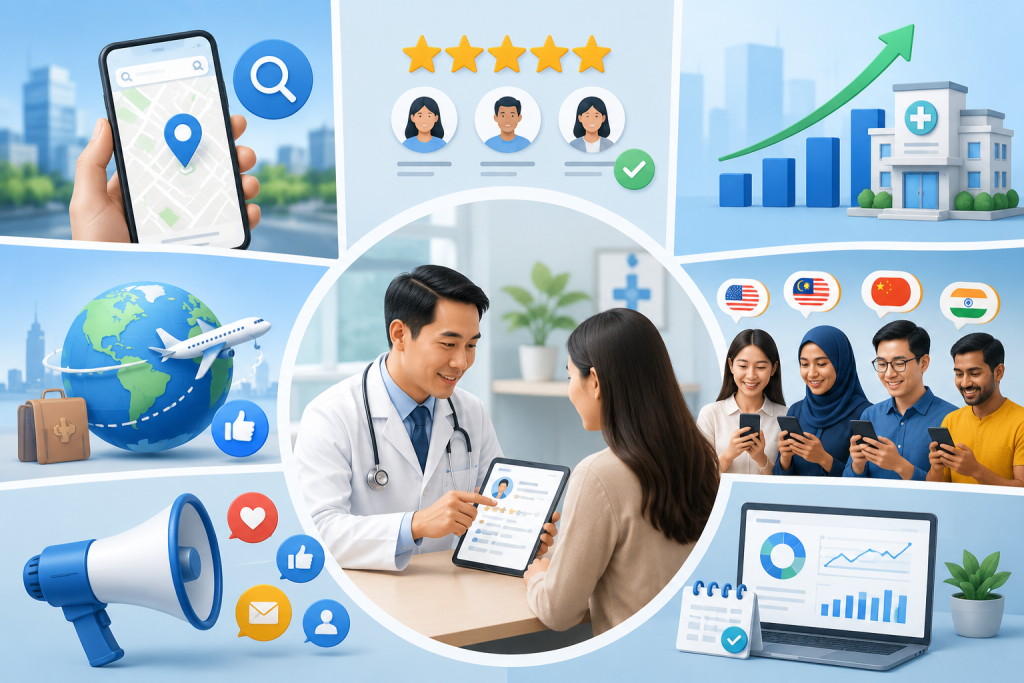
Healthcare buying rarely happens in one click. Mapping your effort to each stage stops you from over-investing in one channel while a gap quietly leaks patients.
|
Stage |
What the patient is doing |
Channel that wins |
What you need ready |
|
Awareness |
Googling a symptom, scrolling social |
SEO, social content, AEO |
Blog articles, educational videos |
|
Consideration |
Comparing clinics, reading reviews |
Local SEO, Google Business Profile, reviews |
Optimised GBP, service pages, testimonials |
|
Decision |
Ready to book, checking price and location |
Google Ads, website, WhatsApp |
Fast site, clear CTA, click-to-call, instant reply |
|
Retention |
Follow-up, repeat visits, referrals |
Email, WhatsApp, reputation |
Recall reminders, review requests |
For a deeper look at how these stages connect, see our breakdown of the digital marketing funnel.
7 Essential Digital Marketing Strategies for Healthcare in Malaysia
1. Search Engine Optimisation (SEO)
SEO is the single most important long-term investment for any healthcare provider. When a patient in Petaling Jaya searches “orthopaedic specialist near me” or “IVF clinic Malaysia,” you want to be on page one. If you are new to the discipline, start with what SEO is and how it works.
Key tactics for healthcare:
- Keyword research. Map the terms patients actually type: condition-based (“back pain treatment KL”), service-based (“teeth whitening Penang”), and location-based (“paediatrician Shah Alam”). Our guide to SEO keyword mapping shows how to group these by intent.
- On-page optimisation. Every treatment or speciality deserves its own dedicated page with a clear title tag, meta description, clean header structure, and relevant content.
- Technical SEO. Your site must load fast, be mobile-responsive, and run on secure HTTPS. Google rewards smooth experiences, measured through Core Web Vitals. See what technical SEO covers for the full checklist.
- Content creation. Informative articles on common conditions, treatment options, and preventive care position your practice as a trusted authority and capture long-tail searches. This is where blogging for SEO and a structured content cluster strategy compound over time.
- E-E-A-T compliance. Google applies extra scrutiny to health content through its Experience, Expertise, Authoritativeness, and Trustworthiness framework. Make sure content is written or reviewed by qualified medical professionals with visible author credentials. Our note on E-E-A-T and topical authority explains why this matters more for medical sites than almost any other niche.
Want it done for you? Our SEO services in Malaysia build a patient-acquisition channel that does not depend on ad spend. Work through the complete SEO checklist to audit where you stand today.
2. Local SEO and Google Business Profile
For clinics, local SEO is arguably more important than general SEO. Most patients search within their own area, and Google’s local pack (the map results) usually sits above organic listings. Start with what local SEO is and the Google local ranking factors that decide who appears.
How to dominate local search:
- Optimise your Google Business Profile. Keep your clinic name, address, phone, hours, and services accurate and complete, and add high-quality photos of the clinic, staff, and facilities. Follow our Google Business Profile optimisation checklist step by step, or hand it to our Google My Business optimisation service.
- Encourage patient reviews. Reviews are a major local ranking factor. Build a simple, repeatable process for asking satisfied patients after a visit, for example a QR code at reception or a follow-up WhatsApp message.
- Keep citations consistent. List your practice with identical NAP details across directories, healthcare portals, and mapping services.
- Create location pages. Target the areas you serve, such as “Family Clinic in Bangsar” or “Aesthetic Clinic Mont Kiara.”
Our local SEO services in Malaysia make sure your practice shows up when nearby patients are actively searching for care.
3. Google Ads (Pay-Per-Click Advertising)
While SEO builds visibility over months, Google Ads delivers patients this week. PPC places your clinic at the very top of results for high-intent keywords, reaching people ready to book now.
Why it works for healthcare:
- High intent. Someone searching “emergency dental clinic open now KL” is not browsing. They need care urgently, and your ad puts you in front of them instantly.
- Precise targeting. You can target by location down to specific postcodes, by device, time of day, and demographics, so the budget reaches the people most likely to become patients.
- Measurable ROI. Every click, call, and booking can be tracked, which lets you calculate exact cost per patient acquisition.
Strong campaigns need careful keyword selection, MMC-compliant ad copy, and landing pages that convert. Use our Google Ads optimisation checklist to tighten performance, and budget realistically with our guide to Google Ads pricing in Malaysia. Deciding between channels? This comparison of Google Ads vs Facebook Ads helps you allocate spend.
4. Social Media Marketing
Facebook, Instagram, and TikTok are where Malaysian patients spend a large share of their online time. For healthcare, social is less about promotion and more about trust and community.
Effective approaches:
- Educational content. Health tips, myth-busting posts, and short explainers position your practitioners as approachable experts.
- Behind-the-scenes content. Show the clinic environment, introduce the team, and share patient success stories with consent. This humanises your practice and eases the anxiety many feel about a visit.
- Short-form video. TikTok and Instagram Reels perform strongly for procedure explainers, common-question answers, and facility tours.
- Paid social. Facebook Ads, Instagram Ads, and TikTok Ads let you target by demographics, interests, and a radius around your clinic. See our full social media advertising options.
- Community management. Reply to comments and messages quickly. Patients often ask questions on social before they commit.
A consistent presence turns followers into patients. To plan a budget, review our breakdown of social media marketing costs in Malaysia.
5. Website Design and User Experience
Your website is your digital front door, and for many patients it is the first impression of your practice. A well-built site can lift conversion rates significantly, while poor UX bleeds patients to competitors. Here is why website design matters for clinics specifically.
What a healthcare website must get right:
- Mobile-first design. With most healthcare searches on a phone, the site has to be fully responsive. See mobile-first design done right.
- Fast loading. If the site takes more than three seconds, you lose patients. Speed ties directly back to Core Web Vitals.
- Clear calls-to-action. Every page should make it effortless to book, call, or get directions. Prominent “Book Now” buttons and click-to-call are essential. Our landing page and conversion design is built around exactly this.
- Service pages. Each treatment or speciality needs its own page with clear descriptions, what to expect, and relevant credentials.
- Trust signals. Display doctor qualifications, accreditations, testimonials, and affiliations with recognised medical bodies.
- Accessibility. Proper contrast, alt text, and keyboard navigation are not optional. Follow website accessibility standards.
Investing in web design and development built for conversions, not just looks, is one of the highest-ROI moves a provider can make. To turn more visitors into booked patients, apply these tactics to increase your website conversion rate.
6. Content Marketing
Content marketing sits at the intersection of SEO, trust, and patient education. Publish accurate, valuable health content consistently and you hit several goals at once.
Content types that work for healthcare:
- Blog articles. In-depth pieces on conditions, treatments, and prevention. A dermatology clinic publishing “A Complete Guide to Acne Treatment Options in Malaysia” helps patients and ranks at the same time.
- Video content. Doctor Q&A sessions, procedure explanations, and consented testimonials build trust across platforms.
- Infographics. Visuals explaining health stats, treatment processes, or preparation steps are shareable and easy to grasp.
- FAQs. Answer common concerns directly on your site. This cuts call volume, improves UX, and helps you win featured snippets.
- Case studies. Anonymised patient journeys that demonstrate outcomes are powerful conversion tools.
The keys are consistency and accuracy. Every medical piece should be reviewed by a qualified practitioner and updated as guidelines change. Structuring it as a content cluster around your core specialities is what builds lasting authority.
7. Online Reputation Management
In healthcare, reputation is everything. One bad review can deter dozens of prospective patients, while a strong body of positive reviews becomes your most powerful asset.
Building and protecting it:
- Request reviews actively. After positive interactions, prompt patients to review on Google, Facebook, and relevant directories.
- Respond to every review. Thank positive reviewers, and address criticism professionally and promptly. Never disclose patient information in a public reply.
- Monitor mentions. Use alerts to track when your practice or doctors are mentioned online.
- Fix root causes. Treat negative feedback as a signal to improve processes and patient experience.
The Malaysia Difference: Channels Most Guides Miss
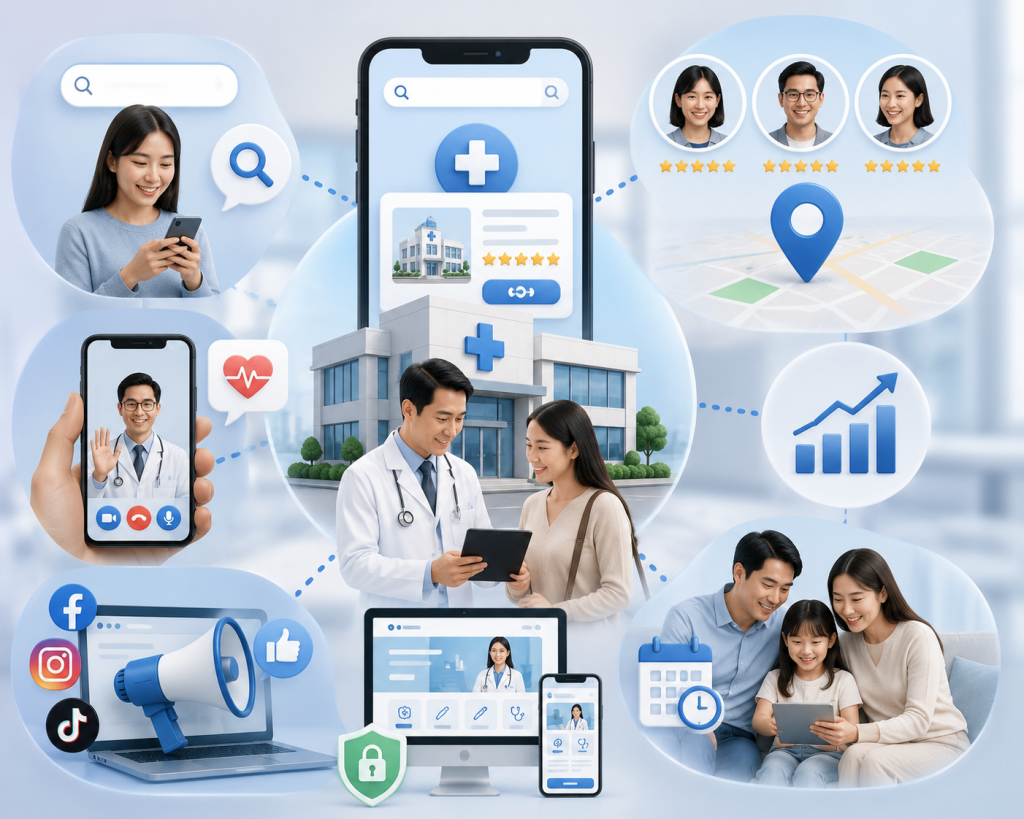
Generic playbooks ignore how Malaysian patients actually behave. Two channels deserve their own spotlight.
WhatsApp as a booking engine. For many clinics, WhatsApp converts better than any web form. Add click-to-WhatsApp buttons on your site and ads, set up quick replies for hours, location, and price, and assign a staff member to respond within minutes. Speed of reply is often the deciding factor between you and the next clinic.
Multilingual reach. Running your most important service and location pages in Bahasa Malaysia and Mandarin, on top of English, widens your reachable market significantly. The same applies to ad copy and social content. This is a low-competition advantage most providers never act on.
Get Found in AI Answers, Not Just Google
A growing share of patients now ask ChatGPT, Gemini, and Google’s AI Overviews questions like “best clinic for knee pain in KL” before they ever click a website. Showing up in those answers is a new discipline called answer engine optimisation, closely related to generative engine optimisation.
The practical moves overlap with good SEO: clear question-and-answer formatting, well-structured FAQ content, accurate and frequently updated medical information, and strong E-E-A-T signals. Providers who learn how to get cited by AI early will own visibility as this shift accelerates through 2026.
Regulatory Compliance: Marketing Healthcare in Malaysia
Healthcare marketing here is not a free-for-all. The Malaysian Medical Council (MMC) and Ministry of Health (MOH) enforce strict rules on how medical services may be advertised.
Key considerations:
- No misleading claims. You cannot guarantee outcomes, misuse before-and-after photos, or make unsubstantiated treatment claims.
- Professional conduct. Advertising must preserve the dignity of the profession. Aggressive promotion, heavy discounting, and sensationalised messaging can breach MMC guidelines.
- Patient privacy. Testimonials, photos, and case studies need explicit written consent and must comply with the Personal Data Protection Act (PDPA).
- Platform rules. Beyond local regulation, Google and Meta enforce their own healthcare advertising policies, including targeting restrictions for certain conditions.
Partnering with a marketer who understands these rules is critical. Non-compliance can mean fines, suspended ad accounts, or disciplinary action from the MMC.
Measuring Success: KPIs for Healthcare Marketing
The biggest edge digital marketing has over traditional channels is measurability. Track these:
|
KPI |
What it measures |
Why it matters |
|
Organic traffic |
Visitors from search engines |
Indicates SEO effectiveness |
|
Local pack impressions |
Visibility in Google Maps results |
Shows local SEO performance |
|
Click-to-call rate |
Calls generated from digital channels |
Direct patient acquisition metric |
|
Appointment bookings |
Online bookings from site and ads |
Primary conversion metric |
|
Cost per acquisition (CPA) |
Marketing spend per new patient |
Measures campaign efficiency |
|
Patient lifetime value (LTV) |
Revenue per patient over time |
Justifies marketing investment |
|
Review volume and rating |
Number and quality of reviews |
Reflects reputation strength |
A data-driven approach lets you double down on what works and cut wasted spend. Layering in conversion rate optimisation ensures your budget produces actual patient growth, not just traffic.
How to Choose the Right Digital Marketing Partner
Not every agency understands healthcare. When evaluating partners, weigh:
- Industry understanding. Do they grasp patient behaviour, the healthcare buyer journey, and the sensitivity medical marketing demands?
- Regulatory knowledge. Can they navigate MMC and MOH guidelines confidently?
- Full-service capability. Healthcare marketing works best when SEO, paid ads, social, web design, and content move as one strategy rather than isolated efforts.
- Proven track record. Look for case studies and demonstrated results in healthcare or similarly regulated fields.
- Transparent reporting. Expect clear, regular reporting on performance and ROI.
- Local market expertise. Malaysia’s multilingual, multicultural market needs an agency fluent in search behaviour across English, Bahasa Malaysia, and Mandarin.
For a wider shortlist and how to vet them, see our overview of digital marketing agencies in Malaysia.
MediaPlus Digital is a Google Partner agency with over a decade of experience helping Malaysian businesses grow through SEO, Google Ads, social media, and performance-driven campaigns. With offices in Malaysia, Singapore, and across the region, the team pairs local expertise with a data-first approach on every campaign.
Getting Started with Healthcare Digital Marketing
You do not need to do everything at once. Start with the foundations:
- Audit your current presence. Google your practice and key services. What shows up? Is your Google Business Profile complete and accurate?
- Fix your website. Make it mobile-friendly, fast, and built around clear booking CTAs.
- Claim and optimise your Google Business Profile. This is the single fastest win for local visibility.
- Start with one or two channels. On a tight budget, begin with local SEO and Google Ads for immediate acquisition, then expand into social and content.
- Track everything. Set up Google Analytics, call tracking, and booking tracking from day one.
The providers who will thrive in Malaysia’s increasingly competitive landscape are those who treat digital marketing not as an expense, but as a core part of patient acquisition.
Ready to grow your healthcare practice online? Get in touch with MediaPlus Digital for a consultation tailored to your practice’s goals and market.