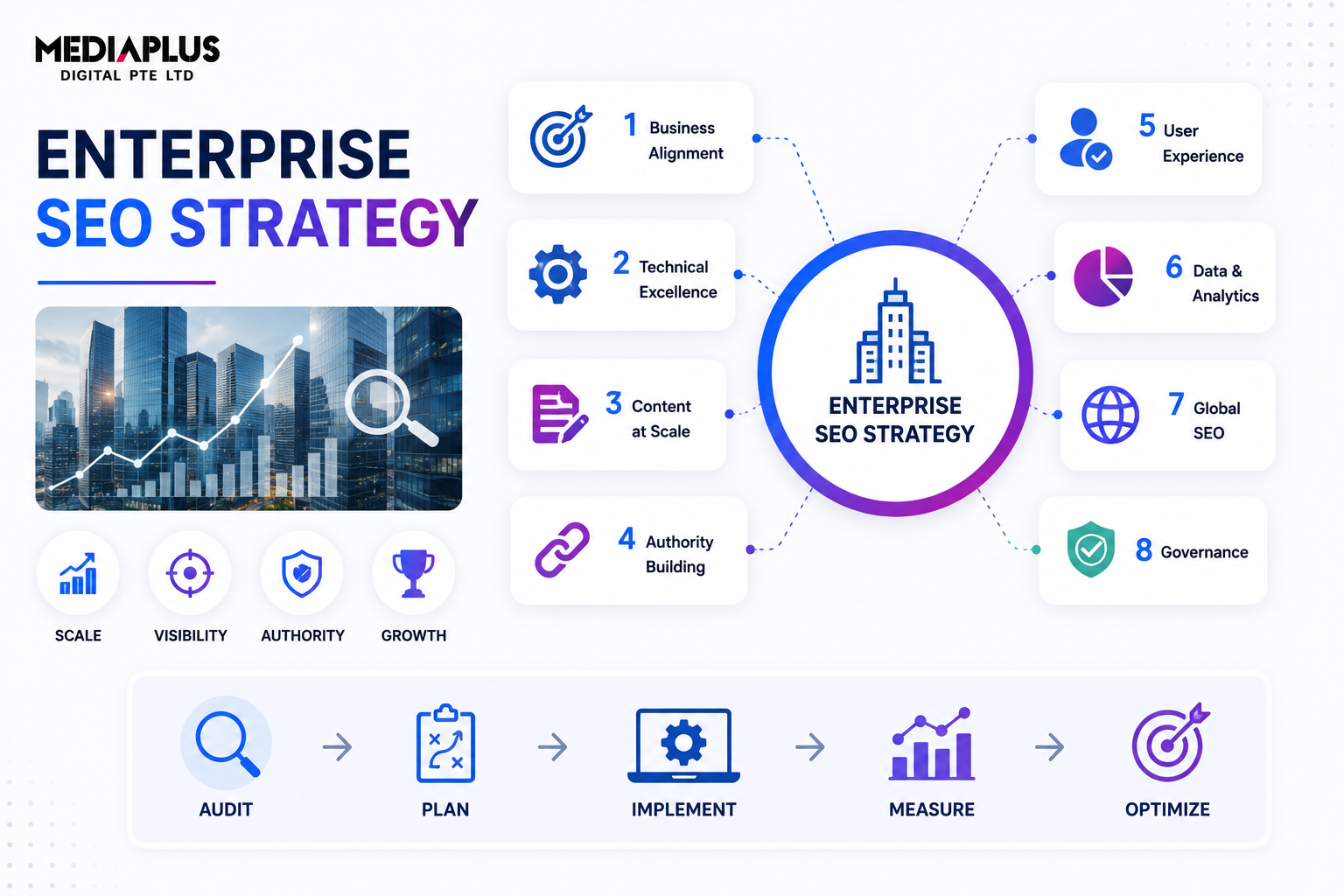
Enterprise SEO is a different game from SME SEO. When your site has hundreds of thousands or millions of pages, several teams, and legacy systems, the hard part is rarely the keyword. It is scale, coordination, and control. An enterprise SEO strategy is how a large organisation grows organic search in a way that is scalable, governed, and tied to revenue, across both Google and the new AI search engines. This guide lays out a practical framework, a 90-day roadmap, and how to measure it.
What makes enterprise SEO different
Standard SEO and enterprise SEO differ on three fronts:
- Scale. Hundreds of pages become hundreds of thousands or millions, which changes how you handle crawling, templates, and content.
- Organisation. Changes need agreement across marketing, IT, content, product, and sometimes legal, not one person clicking publish.
- Measurement. Success is revenue and pipeline attributed to organic, not just a rank tracker.
|
SME SEO |
Enterprise SEO |
|
|
Site size |
Tens to hundreds of pages |
Hundreds of thousands to millions |
|
Main bottleneck |
Effort and budget |
Coordination and governance |
|
Stakeholders |
One or a few |
Marketing, IT, content, product, legal |
|
Biggest risk |
Doing too little |
Changes breaking at scale |
|
Where leverage sits |
Individual pages |
Templates and systems |
The lesson: at enterprise scale, you fix templates and systems, not pages one by one.
The enterprise SEO framework: six pillars
1. Governance and ownership
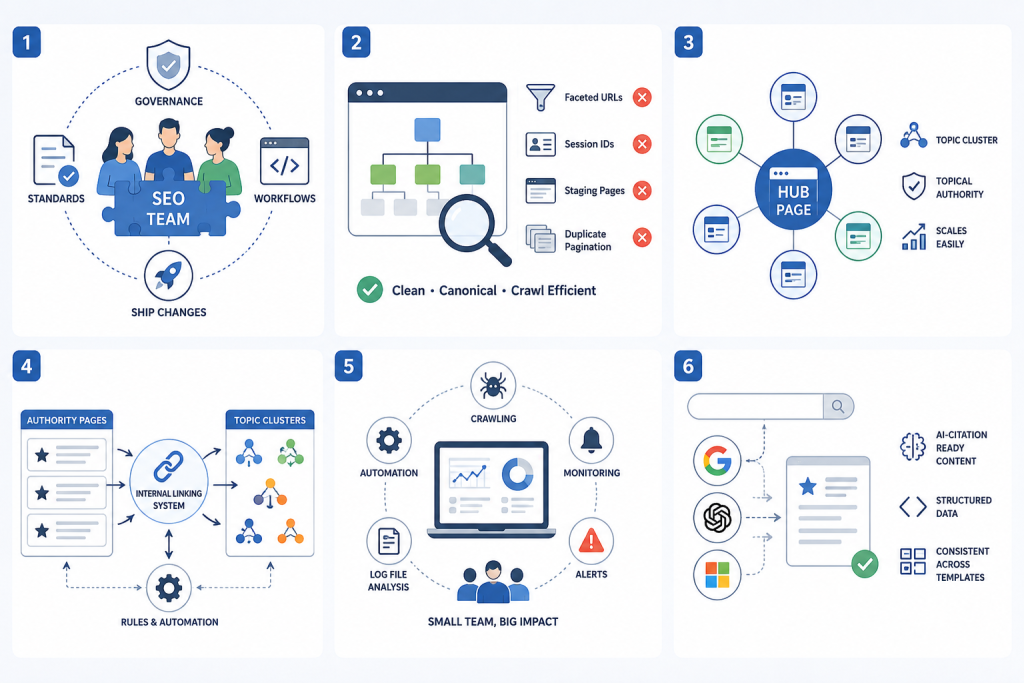
The biggest barrier to enterprise SEO is not technical, it is organisational. Siloed teams with different priorities stall SEO changes. So it starts with governance: clear ownership, SEO standards baked into CMS templates and development workflows, and a way to get changes shipped. A common model is a small central SEO team, roughly 3 to 8 people, that sets standards and enables the wider organisation.
2. Technical foundations at scale
On a large site, technical SEO is about templates and crawl efficiency. The classic trap is crawl waste. A site that thinks it has 4 million pages can expose 40 million crawlable URLs to Google once you add faceted navigation, session IDs, staging pages left indexable, and near-duplicate pagination. If Google crawls 200,000 URLs a day, that junk buries your real pages. Enterprise technical SEO means controlling crawl budget, canonicals, parameters, and schema across page templates, not one page at a time.
3. Topical authority and content architecture
Content is often the largest challenge, because many organisations publish without a clear structure. The fix is a content architecture built around topic clusters: hub pages for core topics, supported by spoke pages, all linked deliberately. This builds topical authority Google understands, and it scales, because new content slots into a system rather than piling up randomly.
4. Internal linking at scale
On a small site you link by hand. On an enterprise site you cannot, so internal linking becomes a system: rules and automation that push authority to priority pages and connect clusters. Done well, it is one of the highest-leverage things you can do at scale.
5. Automation and tooling
At millions of pages, manual audits do not work. Enterprise SEO relies on tooling for crawling, monitoring, log file analysis, and alerting, so issues are caught automatically. Automation is what lets a small central team manage a huge site.
6. AI search and GEO
The search environment has changed. AI chatbots from Google, OpenAI, and Microsoft now handle much of the early-stage informational search that used to drive top-of-funnel traffic. So an enterprise SEO strategy in 2026 has to include generative engine optimisation: structuring content and data so your brand is cited in AI answers, not just ranked in blue links. At scale, that means AI-citation-ready content structure and schema across templates.
A 90-day enterprise SEO roadmap
|
Phase |
Weeks |
Focus |
Outcome |
|
Foundation |
1 to 4 |
Audit, governance, crawl and template review |
A clear picture and a plan everyone agrees on |
|
Quick wins |
5 to 8 |
Fix crawl waste, high-value templates, internal links |
Early ranking and efficiency gains |
|
Scale |
9 to 12 |
Content architecture, automation, GEO rollout |
A repeatable system, not a one-off push |
The point of the roadmap is to prove value fast with quick wins, then build the systems that compound.
Measuring enterprise SEO ROI
At this level, rankings are a means, not the goal. Measure what the business cares about:
- Organic revenue and pipeline attributed to SEO
- Organic traffic and conversions by segment or product line
- Share of voice, including citations in AI answers
- Efficiency gains, like crawl budget spent on valuable pages
Tie SEO to revenue and you keep the investment funded. Report only rankings and you will struggle to justify an enterprise budget.
Frequently asked questions
What is an enterprise SEO strategy?
It is a systematic approach to growing organic search on a large, complex website, coordinating across teams and tying results to revenue. It focuses on templates, governance, and systems rather than optimising pages one by one.
How is enterprise SEO different from normal SEO?
The difference is scale and coordination. Enterprise sites have far more pages, multiple stakeholders, and legacy systems, so the challenges are organisational and technical as much as algorithmic.
How long does enterprise SEO take?
Quick wins can appear within the first one to three months, but the real value comes from building systems that compound over six to twelve months and beyond.
Do enterprise sites need to optimise for AI search?
Yes. AI answers now handle much of the informational search that drove top-of-funnel traffic, so being cited in AI results through GEO is now part of enterprise SEO.
How much does enterprise SEO cost in Malaysia?
It is usually a monthly retainer, often RM3,000 to RM15,000 or more depending on site size, competition, and scope. Enterprise engagements sit at the higher end. We scope each project individually.
Final thoughts
Enterprise SEO is about systems, not pages. The brands that win at scale get the governance right, fix technical foundations across templates, build a real content architecture, automate the monitoring, and adapt to AI search. Do that and organic becomes a reliable, revenue-driving channel rather than a series of one-off fixes.
If you are scaling SEO across a large site, our SEO team works on enterprise strategy, technical SEO, content architecture, and AI search. Talk to MediaPlus Digital and claim a free RM300 SEO audit.