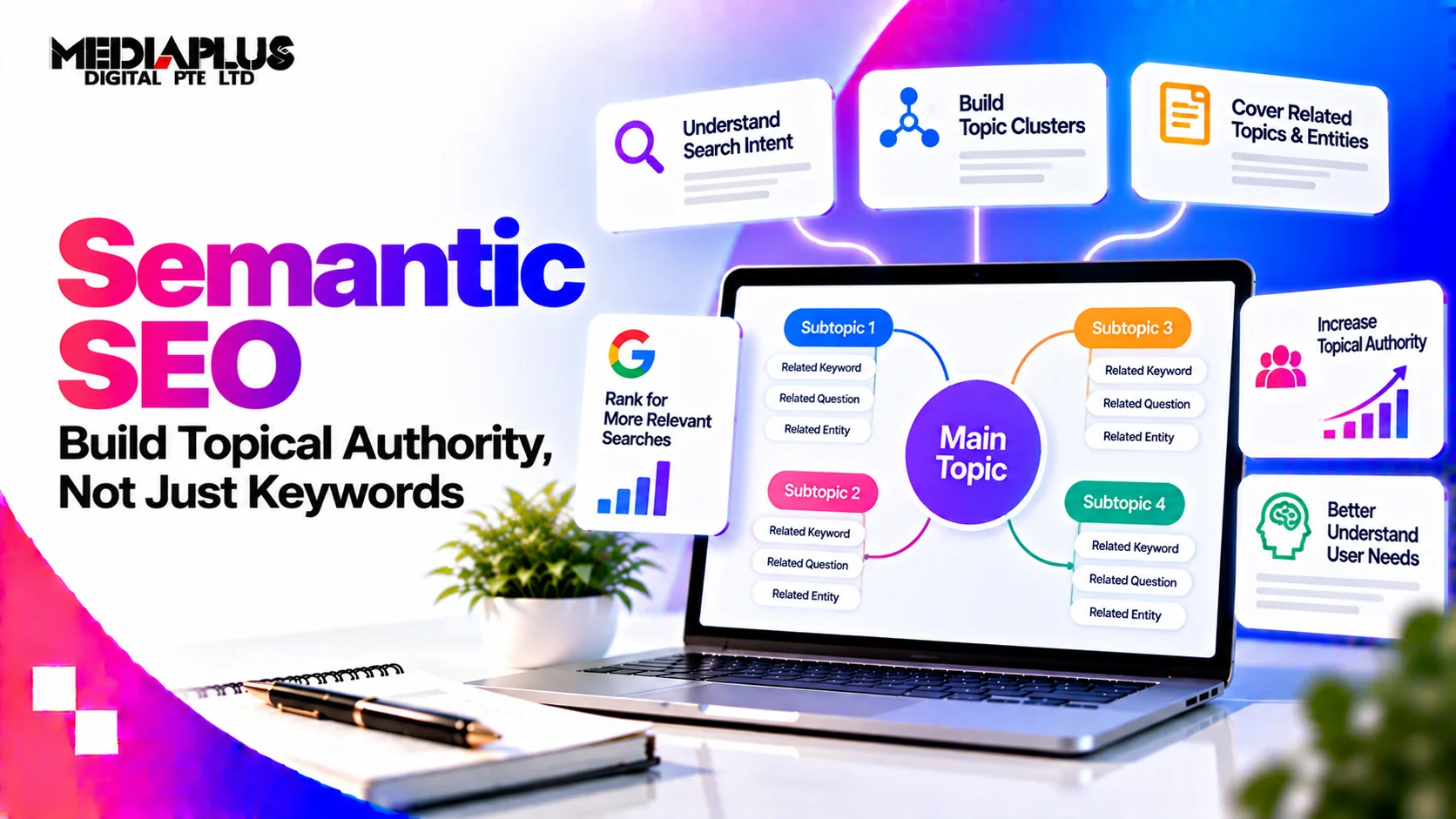
Quick answer: Semantic SEO means organising a site around things and the relationships between them, rather than around strings of text people type. It changes four habits: you plan in clusters instead of single keywords, you link internally by subject rather than by whatever phrase appears, you add structured data only where Google documents a result for it, and you write one page for a family of related questions instead of one page per phrase. This guide shows each with a Malaysian worked example, and separates what Google publishes from the claims about “semantic algorithms” nobody can source.
What semantic SEO actually means, past the jargon
The older model of search was lexical. A page competed for a phrase, and the work was putting that phrase in the title, a heading, the body and some anchor text. One phrase, one page, and three variations meant three pages.
The semantic model treats a query as a question about something in the world. “Aircon not cold enough” and “why is my air conditioner blowing warm air” are not two keywords needing two pages. They are two phrasings of one problem, and a search engine that grasps the problem serves one good page to both.
Where people go wrong is treating this as a writing style. You cannot make a page semantic by adding synonyms, or by padding copy with a tool’s “semantically related keywords”. That is lexical thinking in a new coat. Semantic SEO is an architecture decision: what pages exist, what each is responsible for, and how they connect. If an engagement does not change the four habits above, nothing has happened.
Entities, and why an entity is not a keyword
An entity is a thing that can be identified and told apart from others: a company, a place, a product, a person, a concept. “Kuala Lumpur” is an entity. “kl aircon service near me” is a keyword, a string someone typed.
Entities carry attributes and relationships; strings cannot. Once a search engine knows your business is an organisation of a certain type, in a certain place, offering certain services, it can answer questions you never wrote a page for.
Schema.org is the vocabulary most used to state those facts in machine-readable form, and Google consumes a documented subset of it. But markup does not create authority or make a search engine believe a claim. It makes a claim legible, and whether it is believed depends on corroboration elsewhere, which is why a company’s own “about us” page is weaker evidence than the same facts on a registry, a directory and a news article.
So entity work is mostly unglamorous:
- Decide the canonical business name and use exactly that string everywhere, including third party profiles
- Give each service one page that owns it, so there is a single URL to associate with it
- State the facts a machine cannot infer (address, service area, hours, which services sit where) in markup and visible text, and make them agree across the site and external profiles
See topical authority in SEO for how coverage builds up and E-E-A-T and topical authority for the trust side.
What Google documents, and what it does not
Most writing on the subject cites a “semantic search algorithm” that has never been described publicly. All four of the following were checked on 15 October 2026:
Not documented, and not to be asserted:
- Any named semantic algorithm with a described mechanism. Google has published patents and research and named systems in passing, but there is no specification of how meaning is scored
- A threshold number of pages, words, links or “related entities per page” at which a site becomes topically authoritative. Third party topical authority scores are the tool’s model, not a search engine’s judgement
- Any ranking effect from a particular schema.org type. Google documents structured data as a route to search features, not as a ranking factor
- “LSI keywords.” Latent semantic indexing is real in information retrieval literature, but there is no evidence Google applies it as SEO tools describe
A proposal promising a ranking lift from entity markup promises something the vendor cannot evidence. One promising better coverage of a query family, fewer competing pages and eligibility for documented search features promises something you can check, and being straight about the difference is why a client believes the rest.
Building a topic cluster, with a Malaysian example
A cluster is one page covering a subject broadly plus pages covering parts of it in depth, linked on purpose. The point is not the shape. It is that the structure forces you to decide what each page is responsible for, which is the decision that stops pages competing.
The method
- Name the subject in plain language, not as a keyword: “commercial air conditioning servicing for offices and retail in the Klang Valley”.
- List the questions buyers actually ask, in their words, from enquiry forms, sales calls, WhatsApp messages and the people-also-ask box, not from a keyword tool alone.
- Group questions by the answer they need. Two belong together when one page answers both without padding. This grouping is the real work, and it is judgement, not a tool output.
- Assign one page per group, and write its single job in one sentence. If you cannot, the group is wrong.
- Pick the pillar, the page answering the broadest version and routing to the rest.
- Decide the links before writing. Supporting pages link up to the pillar, the pillar links down to all of them, siblings link sideways only where a reader would want that page next.
The worked example
Subject: commercial aircon servicing, Klang Valley.
Eight pages, eight jobs, no two chasing the same query, and not one title is a keyword with a city bolted on. Geography lives in the pillar and in the pages where location genuinely changes the answer. Separate pages for Petaling Jaya, Shah Alam and Subang Jaya would produce near identical copy splitting its own signals, which is the cannibalisation semantic planning exists to prevent. For the mechanics, see SEO keyword mapping and content cluster strategy.
Internal linking by entity
Most sites link internally by accident. A writer mentions a phrase, notices a page exists, and links. The result is a site whose most linked pages are those whose topics come up most in conversation, which has nothing to do with which pages matter. Linking by entity means deciding at the architecture stage which pages should be connected because their subjects are, then making those links exist.
- Anchor text should name the subject of the destination, not describe the link. “Commercial aircon maintenance schedule” works; “click here” does not
- Vary anchors naturally but keep the subject in them. Three phrasings of one subject is normal writing; the identical phrase repeated is a pattern
- Link from the body, not only a related-posts widget, which is template furniture carrying little context
- The pillar earns the most internal links in its cluster. If a supporting page has more, the structure is inverted and the wrong page will be treated as the main one
- Do not link every mention, and link to live URLs rather than through redirect chains
To see the current state, crawl the site, group every internal link by destination, sort by count and look at the top twenty. If your main commercial pages are not there, your internal linking is not pointing at your business. Our complete SEO audit checklist includes this step and the technical SEO guide covers crawl mechanics.
The structured data that matters, and the structured data that does not
Google documents which types are eligible for which features, and that is the only reliable guide, because a type outside it produces no result however correct the markup. Checked on 15 October 2026 the gallery runs to 25 types, most irrelevant to a service business.
Five or six types cover almost every Malaysian business. Markup beyond that is data modelling, not an SEO deliverable, and should not be sold as one.
Two things are easy to get wrong. Markup must agree with what a human sees on the page, because stating facts the page does not show is a policy problem rather than a clever trick. And Google’s AI features guidance, updated 10 December 2025, says plainly that no special schema.org structured data is needed for those features: if someone is selling “AI schema”, that is the sentence to put in front of them. See AI search readiness and answer engine optimisation.
Writing for a query family rather than one keyword
A query family is the set of differently phrased questions one answer satisfies. Writing for a family means organising the page by those questions, with headings doing the matching work that keyword repetition did badly.
Before
- URL: /aircon-service-kuala-lumpur/
- Title tag: Aircon Service Kuala Lumpur | Best Aircon Service KL | Aircon Servicing
- H1: Aircon Service Kuala Lumpur
- 120 words restating “aircon service Kuala Lumpur” four times
- H2: Our Aircon Service Kuala Lumpur
- H2: Why Choose Our Aircon Service in KL
- H2: Aircon Service KL Pricing
- H2: Contact Us For Aircon Service Kuala Lumpur
Around 600 words, targeting one phrase and its near duplicates, answering no question a buyer has. Three siblings exist for Petaling Jaya, Shah Alam and Puchong with the same text and the place name swapped, so four pages compete.
After
- URL: /commercial-aircon-servicing-klang-valley/
- Title tag: Commercial Aircon Servicing in the Klang Valley
- H1: Commercial air conditioning servicing in the Klang Valley
- Quick answer: what a visit covers, typical frequency, what changes the answer
- H2: What a servicing visit actually includes (task table by system type)
- H2: How often does a commercial system need servicing? (schedule by system type and operating hours)
- H2: What it costs to maintain, and what drives the number (the variables, not one figure)
- H2: Signs your system needs attention before the next visit (checklist)
- H2: What a maintenance contract covers, and how to compare two quotes
- H2: Areas we cover, and why location changes response time but not scope
- H2: Frequently asked questions
- H2: The bottom line
Around 2,400 words. The three city pages are consolidated into this one and redirected to it, and city names appear once, in the coverage section.
Why it works: the page is eligible for dozens of phrasings because each has a heading answering it directly, and it no longer competes with its siblings. It gives a search engine a clear subject rather than a repeated string, and a reader something worth reading, which is what Google’s helpful content guidance asks about. Consolidating also concentrates links previously split four ways. See on-page SEO and blogging for SEO.
How to audit an existing site for topical gaps
- Inventory. Export every indexable URL from the sitemap and a crawl. Record URL, H1, title tag and, in one sentence, the job of the page. Pages where you cannot write that sentence are the first finding.
- Assign each page one query family, in writing. Two pages claiming one family is cannibalisation: decide which wins, consolidate and redirect the other.
- Map the families you have against the families buyers ask about, using enquiry forms, sales calls, chat logs, people-also-ask and the queries already drawing impressions. Families with no page are your gaps.
- Rank gaps by commercial value, not volume. Ten people about to buy beat a thousand who are not, and in a market Malaysia’s size that is the difference between a plan that pays and one that does not.
- Check the cluster links exist, the cheapest fix on the list.
- Check markup against the documented list and fix what the checklist below flags.
- Write the actions in priority order, consolidations first, because they change what everything else is measured against.
The checklist
- Every indexable page has one written sentence stating its job
- Every page has exactly one query family, and no two pages claim the same one
- Near duplicate location pages consolidated or genuinely differentiated
- Buyer question list built from real enquiries, not only a tool
- Gaps ranked by commercial value
- Each cluster has a named pillar, and every supporting page links up to it
- Each pillar links to every supporting page
- Anchor text names the subject of the destination
- Internal links point at live URLs, not redirects
- Top twenty internally linked pages include the main commercial pages
- Organization and BreadcrumbList present, with the canonical business name
- HowTo markup removed
- Any AggregateRating matches reviews visible on that page
- Author and date visible on guides and posts
Frequently asked questions
Is semantic SEO different from normal SEO in 2026?
Not as a separate service. It is how competent SEO has worked for years, and it keeps its own name only because much SEO delivery never caught up and still produces one thin page per keyword. If your site has four near identical city pages for one service, you have a semantic SEO problem whatever you call it.
Do I need a tool to do this?
A crawler, and something to show the queries you already get impressions for, which for most Malaysian businesses means Google Search Console. The grouping judgement, which decides whether the plan works, is not a tool output.
How many pages should a cluster have?
As many as there are distinct jobs, usually five to twelve for a service line. That range is our delivery experience, not research. At thirty you have split families that should have been one page; at two, it is not a cluster.
Will consolidating pages lose the rankings those pages have?
Done properly, with 301 redirects and internal links updated, the combined page usually performs better than any original did, because it stops competing with itself. Without redirects you lose the equity, so that step is not optional. See redesigning without losing rankings.
Does any of this help with AI Overviews and AI assistants?
Indirectly. AI answers are assembled from content that has been crawled and understood, and a site with clear subjects and no internal competition is easier to extract a correct answer from than overlapping thin pages. There is no separate markup for it. See how to get cited by AI and tracking traffic from AI Overviews.
Should I add FAQPage markup to my FAQ sections?
You can, and it fairly describes the page, but expect no rich result: since August 2023 Google shows these only for authoritative government and health sites. The section itself is still worth having, because it is where a query family gets answered.
How long before this shows results?
Consolidations tend to settle within weeks, because they resolve a conflict that already exists. New cluster coverage behaves like any new content and depends on the site’s standing. Anyone giving a date is guessing.
Is this worth doing for a small Malaysian business with a handful of pages?
Yes, and it is cheaper at that size: deciding the job of eight pages and linking them properly takes an afternoon, where the same work on a 400 page site is a project. Our SEO for SMEs guide is sized for that case.
The bottom line
Semantic SEO is not a technique applied to a page. It is a set of decisions about what pages exist and how they relate, and it works for an unremarkable reason: a site where every page has one clear job, where related pages are connected deliberately, and where markup matches both the page and Google’s documented list is easier for a search engine to understand and more useful to read.
The parts you can verify are the parts worth building on. Google documents which structured data types produce which features, and that list is shorter than most agencies imply. It documents that content should be made for people, and that no new files or markup are needed for its AI features. Everything past that is modelling.
If you want this done rather than explained, our SEO services in Malaysia cover the cluster planning, consolidation and internal link architecture described here, and our GEO services in Malaysia cover the AI visibility layer above it. Get in touch for a free review of your page inventory showing where pages compete with each other.