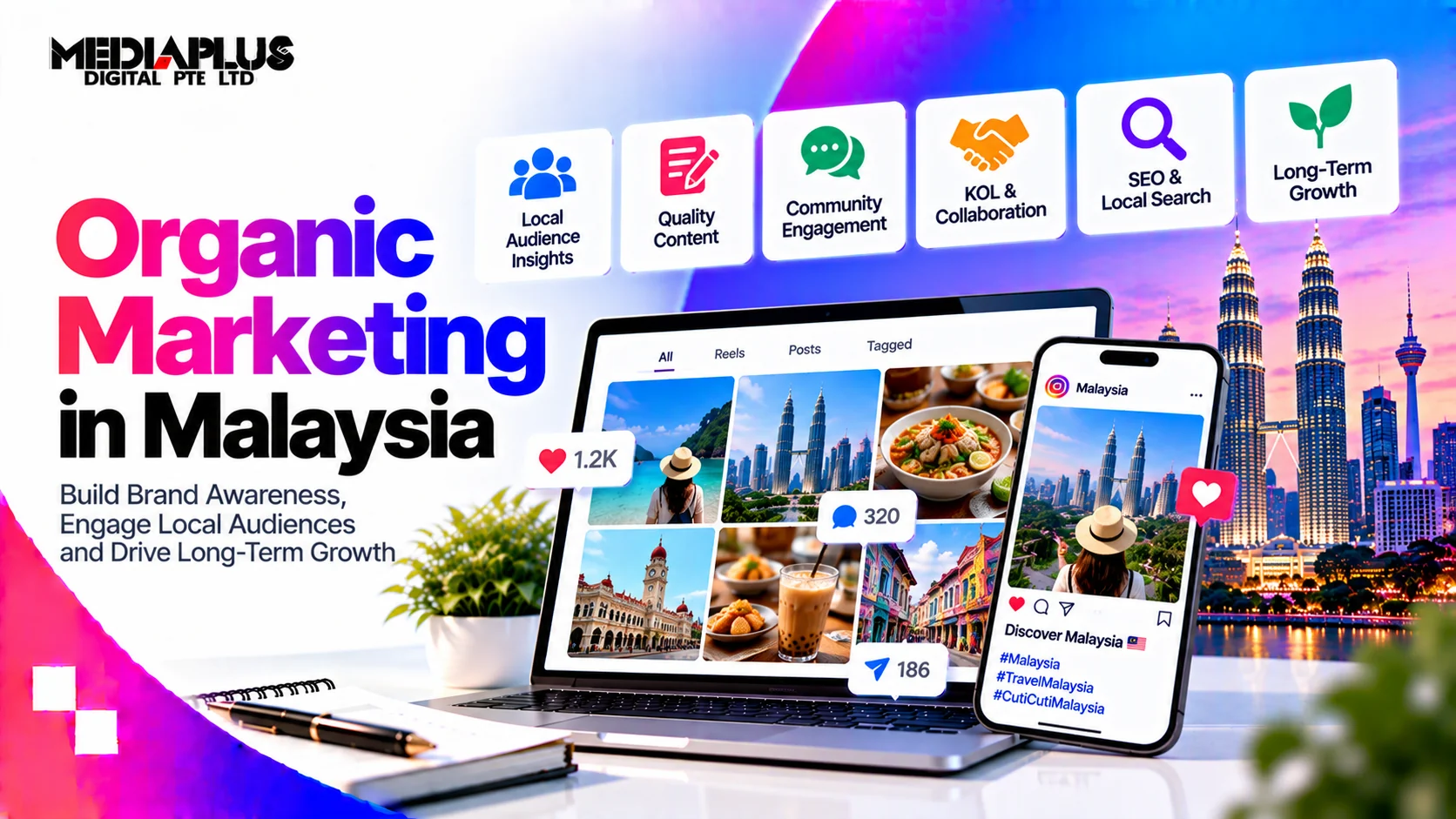
Quick answer: Organic marketing is not free. It trades cash for time, and in Malaysia the realistic bill is somewhere between RM3,000 and RM12,000 a month in money or salaried hours for a small business doing it properly. Only some of it compounds: search, content, your Google Business Profile, your email list and your referral network keep paying after you stop adding to them. Organic social reach does not, because each post starts from zero. First results arrive in weeks for a Google Business Profile, in three to six months for search, and not at all if you publish for three months and stop.
What counts as organic marketing, and what does not
Organic marketing is everything that earns attention without paying a platform for the impression. Search rankings, content, your Google Business Profile, unpaid social posts, email to a list you own, community presence, referrals and WhatsApp conversations with people who already know you.
What it is not: free. The cost moves from the media line to the people line, and people are more expensive than impressions. A business owner spending eight hours a week on content is spending real money, just not money that appears on an invoice. The most common mistake we see in Malaysian SMEs is treating organic work as a zero in the budget and then wondering why it never gets done.
Two other distinctions are worth making early. Organic is not the same as cheap. A single piece of content that ranks can cost more to produce than a month of search ads. And organic is not the same as slow in every channel. A neglected Google Business Profile can produce calls within a fortnight.
The real cost, and how long each channel takes
The table below is the heart of this article. Costs are the Malaysian market range for having the work done properly, whether you pay an agency, hire someone, or do it yourself and value your own hours. These are our own estimates from client work, not published benchmarks.
Read the time column before the cost column. Nothing in the first list produces revenue in the month you start it except a Google Business Profile and WhatsApp, and WhatsApp only converts demand something else created.
On search timelines specifically, Google’s own SEO Starter Guide says that after a change, “some changes might take effect in a few hours, others could take several months,” and advises waiting “a few weeks to assess whether your work had beneficial effects in Google Search results.” Any agency promising rankings in 30 days is selling against its own supplier’s documentation.
Which channels compound and which reset
This is the distinction that decides where an organic budget should go, and most plans get it wrong.
Channels that compound
Work done last year still pays this year.
- Search and content. A page that ranks keeps ranking with light maintenance. The asset is the page, and you own it.
- Google Business Profile reviews. Reviews accumulate. A profile with 180 reviews is permanently harder to beat than one with 12.
- Your email list. Every subscriber is an asset you can mail again at no extra acquisition cost.
- Referral and community standing. Slowest to build, hardest for a competitor to copy.
Channels that reset
Every post starts at zero.
- Organic social reach. Your follower count is not distribution. Platform algorithms decide each post’s reach on that post’s merits, which is why a page with 40,000 followers can reach 900 people. Stop posting for a month and the channel is gone.
- TikTok organic. The most extreme version. Reach is per video, not per account, which is good news when you are starting and bad news when you want predictability.
- WhatsApp broadcasts. They work, but only against a contact list that something else had to build.
The practical consequence: put the compounding money into search, content and your profile, and treat organic social as a cost of looking credible rather than as a lead channel. A Malaysian SME with RM5,000 a month to spend on organic work should not be spending RM3,500 of it on social posts.
Channel by channel, for Malaysia
Search and content
With internet penetration at 98.0 per cent, practically every Malaysian purchase decision involves a search. That makes search the compounding channel with the largest ceiling, and the one with the longest wait. Our guides to what SEO actually involves and SEO for Malaysian SMEs cover the work itself, and our SEO pricing guide for Malaysia carries current retainer ranges.
Content is where most Malaysian SMEs waste money, usually by publishing twenty thin posts instead of six good ones. Six pages that answer a real buying question outperform twenty that restate your service list. Our guides to blogging for SEO and content marketing go into the mechanics.
Google Business Profile
For any business with a physical location or a service area, this is the highest return per hour in organic marketing, and it is routinely neglected. Complete categories, real photographs, correct opening hours over Raya and Chinese New Year, and a steady flow of reviews will move a business into the map pack for local queries within weeks. Work through our Google Business Profile checklist and our guide to local SEO before you spend anything on social.
Organic social, including TikTok
The Malaysian reach figures, from DataReportal’s Digital 2026 Malaysia report published 8 November 2025, set the priorities. Of 36.1 million people, 35.4 million are online and 30.7 million hold social media identities, or 85.0 per cent of the population. Potential advertising reach was YouTube 23.6 million, Facebook 23.0 million, Instagram 16.1 million and LinkedIn 10.0 million. TikTok’s reported adult reach of 30.7 million exceeds the adult population, which means it is a platform estimate rather than a count of people, and should be read as “very large” rather than taken at face value.
What that means in practice:
- Facebook still carries the widest adult audience in Malaysia, including older and non urban buyers. For many categories it remains the most useful organic platform, which surprises people who only read international marketing commentary.
- Instagram skews younger and urban. Good for categories where the product photographs well.
- TikTok has the attention and the discovery, and it demands native vertical video. Repurposed landscape ads perform badly enough to be a waste of the production budget. Our guide to TikTok marketing in Malaysia covers the format properly.
- LinkedIn at 10.0 million is small but concentrated, and it is the only organic channel worth real effort for most business to business firms.
Email, community and WhatsApp
Email is the only audience you own outright, and it is the channel Malaysian SMEs most often skip. It will not produce anything in month one because you have no list, which is exactly why it should start in month one.
Community and referral work does not scale and should not be judged on volume. Four strong referral relationships can outperform a year of social posting, and the enquiries close faster because trust arrived before the quote did.
WhatsApp is where Malaysian enquiries get closed. It converts, but it converts demand another channel created, so it belongs in your organic plan as the closing step rather than as a source. Response speed is the whole game: a reply in five minutes and a reply in five hours are different businesses. Our guide to WhatsApp marketing in Malaysia covers setup and the compliance side.
The language question
Language is a cost decision, not a branding one. English carries most business to business and urban consumer buying, and it is where search volume for commercial terms sits. Bahasa Malaysia carries reach, particularly outside the Klang Valley and strongly in short video. Mandarin matters in specific categories and regions.
For organic work the honest advice is narrower than most agencies will give you: write search content in the language your buyers search in, which for most commercial terms in Malaysia is English, and make social video in the language your audience speaks, which is more often Bahasa Malaysia. Producing everything in three languages triples your content cost for reach you may not need.
Where paid is the better answer
We sell both, so here is the part that matters. Organic is the wrong choice in these situations, and saying otherwise would be selling you a retainer you should not buy.
The honest framing is sequencing, not rivalry. Paid buys demand now and stops when you stop. Organic buys an asset that keeps working and takes two to three quarters to arrive. A business with any runway should run paid to pay the bills while organic is built, which is what most of our Malaysian clients actually do. Our SEO versus PPC comparison goes further into the cost and timeline trade off.
One test settles most arguments: if switching off a channel tomorrow would stop your enquiries tomorrow, that channel is rented. If switching it off would cost you nothing for six months, you own it. A business needs both, and should know which is which.
A realistic twelve month sequence
Month five is where organic programmes die. The work is done, the invoices are paid, and Search Console shows impressions with almost no clicks. That is what progress looks like at month five, and knowing it in advance is most of what gets a business to month nine.
Checklist: before you commit to organic
- You have at least nine months of runway for the channel to return anything
- Analytics and call tracking work, so you can tell organic enquiries from paid ones
- Someone owns the work by name, with hours protected in their week
- Your Google Business Profile is complete before any content is written
- You have chosen six buying questions to answer, not twenty topics to cover
- You know your current non branded search impressions, as a baseline
- WhatsApp enquiries get answered within the hour during business hours
- Email capture exists on the site, with somewhere for those addresses to go
- You have a paid budget covering enquiries for the next two quarters
- You have agreed what you will look at in month five, so nobody panics
Frequently asked questions
How much does organic marketing cost in Malaysia?
For a small business doing it properly, between roughly RM3,000 and RM12,000 a month in money or salaried hours, depending on how much content you produce and whether video is involved. The lower end covers a Google Business Profile, light SEO work and two content pieces a month, nothing more. The upper end covers a full content programme with native video for TikTok. Anything described as free is being paid for in somebody’s unbilled time.
How long before organic marketing produces enquiries?
A Google Business Profile can produce calls in two to six weeks. Search and content take three to six months for first movement and six to twelve months for commercial results, which is consistent with Google’s own guidance that changes can take “several months” to take effect. Organic social produces engagement within weeks and enquiries much later, if at all.
Is organic marketing cheaper than paid advertising?
Per enquiry, eventually yes, and that is the whole case for it. In the first six months it is more expensive, because you are paying to build something that is not yet producing. The crossover for most Malaysian SMEs we work with falls somewhere between month eight and month fourteen. Before that point organic is an investment, not a cheaper option.
Which organic channel should a Malaysian SME start with?
Google Business Profile, almost always, if you have a location or a service area. It costs the least, returns the fastest, and competitors neglect it. Then search and content. Organic social comes third, and only at a volume you can sustain for a year.
Does organic social media still work in Malaysia?
It works for credibility and for supporting other channels. It works poorly as a direct lead source, because reach is decided per post rather than per follower, so your audience size does not guarantee distribution. Treat it as the thing that makes a buyer trust you after another channel found them, and budget it accordingly.
Should we post in English or Bahasa Malaysia?
Search content in the language your buyers search in, which for most commercial terms is English. Social video in the language your audience speaks, which is more often Bahasa Malaysia, particularly outside the Klang Valley. Mandarin where your category calls for it. Do not default to all three, because it triples production cost for reach you may not need.
What happens if we stop organic marketing?
It depends on the channel, which is the argument for knowing which ones compound. Rankings and content decay slowly, over quarters rather than weeks, so a stopped SEO programme keeps paying for a while. Organic social stops almost immediately. Your email list and your reviews stay. If you stop everything, expect six good months and then a decline you will not notice until it is well underway.
Can we do organic marketing in house?
Content and social, often yes, if you protect the hours. Technical SEO and search strategy are harder to do well occasionally, because the work is unforgiving and the feedback loop is months long. The usual arrangement that works is in house for production, outside help for direction and technical work. The arrangement that fails is giving it to whoever has spare time.
The bottom line
Organic marketing is an asset purchase with a long settlement period. It costs real money, most of it in people rather than media, and the channels that justify it are search, content, your Google Business Profile, your email list and your referral network, because those are the ones that still pay after you stop adding to them. Organic social is a credibility cost, not a lead channel.
If you need enquiries this quarter, buy them. If you want enquiries that cost less every year, build the organic side at the same time, and plan for month five to look like failure.
We offer both, which is why we would rather tell you which one your situation calls for. See our SEO services for Malaysia or talk to our team. We will review your current organic position and tell you honestly whether it is worth investing in, at no cost.