Quick answer: Google Ads strategy used to mean picking keywords and writing ads. In 2026 Google’s systems do most of that. What is left, and what now decides whether an account makes money, is a smaller set of decisions: how you define a conversion, how you split the account into campaigns, whether Search or Performance Max gets a given query, which bidding strategy you hand the budget to, and how much of Google’s automation you leave switched on.
Those five decisions are the strategy. Everything else is maintenance.
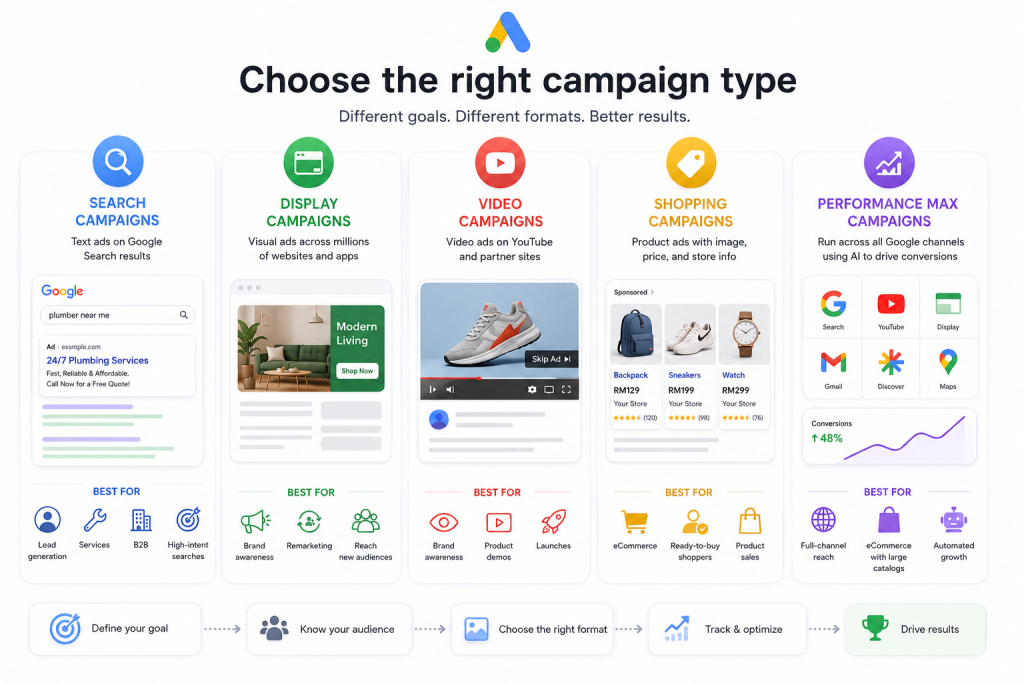
This guide covers the decisions, with each mechanic checked against Google’s own documentation on 20 September 2026. For what clicks cost here, see our Google Ads price in Malaysia guide. For what each campaign type is, see types of Google Ads. This page is about choosing between them.
What changed in 2026, and why old strategy advice fails
Three changes landed this year. Each one breaks a piece of standard advice that still circulates on Malaysian agency blogs.
|
Change |
Date |
What it breaks |
|
AI Max moved out of beta and is on by default in new Search campaigns |
15 April 2026, updated 11 June 2026 |
“Start with tight exact match and expand carefully.” Your campaign is already expanding |
|
Target-based bidding now spends up to target on budget-limited campaigns |
17 August 2026 |
“Set a loose target and let the budget cap protect you.” The cap no longer holds costs down |
|
Target CPA and Target ROAS relabelled as standalone strategies |
June 2026 |
Screenshots and guides written before June show names that no longer match the interface |
AI Max. Google is explicit that AI Max “isn’t a new campaign type but an optimization layer within existing Search campaigns”. It adds three things: broader search term matching, automatic customisation of your headlines and descriptions, and final URL expansion that can send traffic to a different page than the one you chose. Google reports “an average of 7% more conversions or conversion value at a similar CPA/ROAS when using the full feature suite”. New Search campaigns have it switched on unless you turn it off.
Two limits from Google’s documentation are worth planning around. AI Max “won’t be effective if campaigns are limited by budget”, and its search term matching does not function with Manual CPC at all.
The August bidding change. Previously, a campaign limited by budget often delivered well under its target, and plenty of advertisers relied on that. Google’s own example of the new behaviour: “If your campaign’s Target CPA is $10, but your recent actual CPA performance is $5, your campaign now delivers more closely to a $10 actual CPA.” If your targets were set loosely years ago, they are now live instructions rather than ceilings.
One thing that did not change. Dynamic Search Ads were scheduled to sunset in September 2026, and most guides published in the first half of the year say so. Google extended that on 11 June 2026: the DSA sunset and auto-upgrade “will begin in February 2027”. Campaigns using automatically created assets and the campaign-level broad match setting are being auto-upgraded from September 2026.
Decision one: what counts as a conversion
Every automated bidding strategy optimises toward whatever you told it a conversion is. Get this wrong and Google will efficiently buy you the wrong thing, which is worse than buying nothing.
The common Malaysian SME failure is counting a WhatsApp click, a phone-number reveal and a contact-page view as three separate conversions. Smart Bidding then spends the budget finding people who click WhatsApp buttons and never message.
|
Counts as a primary conversion |
Keep as secondary, do not bid on |
|
Submitted enquiry form with a real reply address |
Contact page view |
|
Completed phone call over 60 seconds |
Phone number click |
|
Purchase, with revenue passed back |
Add to cart |
|
Booking confirmed |
Newsletter signup |
|
Qualified WhatsApp conversation, tracked to a reply |
WhatsApp button click |
Set one primary conversion per campaign objective. Mark everything else secondary so it reports without steering the bidding. Where you can pass offline outcomes back, do, because a lead that never closes is not a result.
Budget matters here too: target-based bidding needs roughly 30 conversions a month before it behaves predictably. Below that, use Maximise Clicks or Manual CPC and gather data first.
Decision two: how to split the account
Campaign structure is the main lever you still fully control. Google’s automation works inside campaigns, not across them, so your structure decides where budget can and cannot flow.
Split campaigns when the budget must not mix. Separate campaigns for separate budgets, separate locations with genuinely different economics, and separate product margins. If you would be unhappy for Google to move money from A to B, A and B are different campaigns.
Do not split for tidiness. Fragmenting one RM3,000 budget into eight campaigns gives every campaign too little data to learn from. In a thin auction like Malaysia’s, this is the most common structural mistake we see.
|
Situation |
Structure |
|
One service, one city, RM1,000 to RM3,000 a month |
One Search campaign, two to four ad groups by service theme |
|
Several services, different margins |
One campaign per service line, budget matched to margin |
|
National, with Klang Valley much more competitive |
Split Klang Valley from the rest so the denser auction does not eat the national budget |
|
Ecommerce with a product feed |
Search for non-brand demand, Performance Max for the catalogue, brand kept separate |
|
Any account with meaningful brand search |
Always a separate brand campaign |
That last row matters more than it sounds. Brand clicks are cheap and convert well, so leaving them mixed into a non-brand campaign flatters every number in the account and hides whether paid search is actually finding new customers.
Decision three: Search or Performance Max
These two compete for the same queries inside your own account, and Google publishes the order in which it resolves that. From the match types documentation, accessed 20 September 2026:
- An exact match keyword identical to the query wins.
- Phrase and broad match keywords, including AI Max, rank level with identical Performance Max search themes.
- Below that, AI-based ad group relevance decides.
- Ad Rank breaks any remaining tie.
The practical reading: your Search campaign keeps the queries you have named precisely, and Performance Max takes the rest. That is a reasonable arrangement if your Search keywords are genuinely good, and a quiet budget drain if they are not.
|
Choose |
When |
|
Search only |
Lead generation, limited budget, a service with clear search demand, or no product feed |
|
Search plus Performance Max |
A product feed, strong creative assets, and enough budget that both can gather data |
|
Performance Max only |
Ecommerce with broad catalogue coverage and reliable revenue tracking |
|
Neither yet |
Conversion tracking is not working. Fix that first |
Performance Max reporting improved this year. Channel performance reporting is now a full report rather than a beta, showing a campaign-level summary, a channels-to-goals chart and a channel distribution table. A search terms report exists for Performance Max too, with ad format segmentation splitting Shopping from text ads. Use both before concluding that Performance Max “works”, because a campaign carried entirely by brand traffic looks identical to a campaign that is genuinely finding customers.
Campaign-level controls worth setting: search themes, negative keywords, brand exclusions and final URL expansion. Left at defaults, Performance Max will happily spend your budget on your own brand name.
Decision four: which bidding strategy
Google groups five strategies as Smart Bidding: Target CPA, Target ROAS, Maximise Conversions, Maximise Conversion Value and Enhanced CPC. Alongside those sit Maximise Clicks and Manual CPC, plus visibility strategies like Target Impression Share.
|
Strategy |
Use when |
Do not use when |
|
Manual CPC |
Brand new account, no conversion data, you want full control while learning |
You want AI Max search term matching, which does not work with it |
|
Maximise Clicks |
Gathering first data, or traffic is the genuine goal |
You already have steady conversions |
|
Maximise Conversions |
15 to 30 conversions a month, no reliable cost target yet |
Conversion tracking is unreliable |
|
Target CPA |
Steady conversion volume and a cost per lead you must hold |
Fewer than about 30 conversions a month |
|
Target ROAS |
Ecommerce passing real revenue values back |
Lead generation without values attached to leads |
|
Target Impression Share |
Defending brand terms, or genuine visibility goals |
Anywhere you care about cost per result |
Set targets from your own data, not aspiration. Since the August 2026 change, a Target CPA well above your real cost per lead is an instruction to spend more, not a safety margin. If you are not sure where your target should sit, run Maximise Conversions for a month, read the actual cost per conversion, then set a target slightly below it and move in steps of 10% to 15%.
Give any strategy change two to three weeks before judging it. Every change restarts a learning period.
Decision five: how much automation to leave on
This is the 2026 strategy question, and the honest answer is that it depends on how much you can afford to waste while Google learns.
|
Control |
Leave on when |
Turn off or tighten when |
|
AI Max search term matching |
Budget is comfortable and you read the search terms report fortnightly |
Budget is tight, or your sector attracts irrelevant queries |
|
AI Max text customisation |
Your headlines are generic |
Regulated wording, or a brand voice that must not be rewritten |
|
Final URL expansion |
Your site is well structured and every page converts |
You have thin pages, out-of-stock products, or old campaign landing pages |
|
Broad match |
Paired with Smart Bidding and a maintained negative list |
Running Manual CPC, where Google explicitly advises against it |
|
Automatically created assets |
You want scale and accept some odd combinations |
Legal, medical or financial copy requirements |
Whatever you leave on, the control that makes it safe is the negative keyword list, rebuilt monthly rather than written once. Broader matching means a wider stream of queries, and the search terms report is where you see what you actually bought.
AI Max reporting is genuinely usable now. “AI Max” appears as a match type in the search terms report with a source column showing broad match expansion versus keywordless matching, the keywords report shows total AI Max contribution, and the landing pages report gained a “Selected by” column so you can see when final URL expansion overrode your choice.
What this means in a Malaysian auction
Malaysian auctions are thin. When we measured cost per click across 31 commercial Malaysian keywords in Ahrefs on 19 September 2026, the median sat near RM1.40, with most consumer categories under RM3. Fewer competing bidders changes the strategy in three ways.
Automation has less data to learn from. A Malaysian campaign at RM2,000 a month generates a fraction of the conversions a comparable American account does. Target-based bidding needs volume, so most Malaysian SMEs should stay on Maximise Conversions longer than international guides suggest.
Broad matching is riskier in a small market. With fewer genuinely relevant searches available, broadened matching reaches further from your intent faster. Check search terms more often here, not less.
Cheap clicks make landing pages the real lever. At RM1.40 a click, your cost per enquiry is set almost entirely by conversion rate. Moving a landing page from 2% to 4% halves cost per lead. No bidding strategy does that. This is why conversion rate optimisation and landing page development usually beat bid tuning in this market.
One Malaysia-specific opportunity: Google lists Malaysia among the countries where ads serve inside AI Overviews, in English, on mobile and desktop. Those ads come from existing Search, Shopping and Performance Max campaigns. You cannot target the placement or opt out, and Google states it “doesn’t offer segmented reporting when ads show within Search AI Overviews”. They report as Top Ads. Since Google’s guidance for this surface points toward broad and keywordless matching, an account built entirely on tight exact match is largely absent from it.
Measurement, and the 2026 attribution reset
Four attribution models were retired: first click, linear, time decay and position-based. Only last click and data-driven remain, and data-driven is now the default for most conversion actions. Conversion actions that used a retired model were upgraded automatically.
If you are comparing this year against last, you may be comparing across that switch. Check which model each conversion action uses before drawing conclusions, and before accepting any agency report that shows a sudden improvement.
A workable reporting rhythm:
- Weekly: search terms report, negative keywords, budget pacing.
- Fortnightly: cost per conversion by campaign, AI Max and final URL expansion behaviour.
- Monthly: cost per qualified enquiry including management fee, not just cost per conversion.
- Quarterly: structure review. Are campaigns still aligned to how the business actually makes money?
Report on cost per qualified enquiry. Clicks, impressions and Quality Score are diagnostics. Google says so itself about Quality Score: it “is not a key performance indicator and should not be optimized or aggregated with the rest of your data”.
Strategy mistakes that cost the most
- Bidding on the wrong conversion. Fastest way to waste a budget efficiently.
- Launching new Search campaigns without checking AI Max settings. It is on by default now.
- Setting a Target CPA above real performance. Since August 2026, that is permission to spend more.
- No brand campaign split. Every metric in the account is flattered.
- Fragmenting a small budget. Eight campaigns on RM3,000 learn nothing.
- Performance Max with no brand exclusions. It will buy your own name back.
- Writing a negative keyword list once. Broader matching makes it a monthly job.
- Judging changes inside a week. Learning periods are real.
Frequently asked questions
What is a Google Ads strategy?
In 2026 it is a set of five decisions: what counts as a conversion, how the account is split into campaigns, whether Search or Performance Max serves a given query, which bidding strategy holds the budget, and how much of Google’s automation stays switched on. Keyword selection and ad writing are now largely automated.
Is AI Max on by default?
Yes, in new Search campaigns. Google describes it as an optimisation layer, not a campaign type, covering broader search term matching, headline and description customisation, and final URL expansion. You can turn individual features off. It does not work with Manual CPC, and Google notes it is ineffective on budget-limited campaigns.
What is the best bidding strategy?
Whichever matches your conversion volume. Below roughly 30 conversions a month, use Maximise Clicks or Maximise Conversions. Above it, Target CPA for lead generation or Target ROAS for ecommerce with real revenue values. Set targets from measured performance, never from hope.
Should I use Performance Max or Search?
Search for lead generation with clear demand and limited budget. Both, if you have a product feed and enough budget for each to gather data. Google resolves overlap by giving exact match keywords priority, then ranking phrase and broad match level with matching Performance Max search themes.
Did Google retire Dynamic Search Ads in September 2026?
No. That was the original plan, but on 11 June 2026 Google extended the DSA sunset and auto-upgrade to begin in February 2027. Automatically created assets and the campaign-level broad match setting are being auto-upgraded from September 2026.
How much budget do I need for a strategy to work?
Enough to buy roughly 30 conversions a month if you want target-based bidding. In Malaysia, with a median click around RM1.40 and a 3% landing page conversion rate, that is roughly 1,000 clicks, so about RM1,400 in ad spend. Higher-cost sectors need considerably more.
Do I still need keywords?
Yes, and they still take priority. An exact match keyword identical to the query wins over Performance Max search themes and over broader matching. Keywords are now the part of the account you control precisely, which makes them more useful than ever, not less.
How long before a strategy change shows results?
Two to three weeks for bidding changes, because every change restarts a learning period. Structural changes take a full month. Judge on cost per qualified enquiry across a month, not on a week of clicks.
The bottom line
The strategy work that mattered in 2020, tight match types, manual bids, hand-built keyword lists, has mostly been automated. What replaced it is a smaller set of higher-stakes decisions, and two 2026 changes, AI Max on by default and bidding that now spends fully to target, both push budgets upward unless somebody is deliberately holding them down.
Decide what a conversion really is. Split the account the way the business actually makes money. Choose a bidding strategy that matches your data rather than your ambition. Then read the search terms report often enough to see what the automation is buying.
Want a Google Ads account structured and run against your actual numbers? Request a quote from our Google Ads team, or ask about the free account health check worth RM300. See also SEM services, Google Shopping ads and performance marketing.