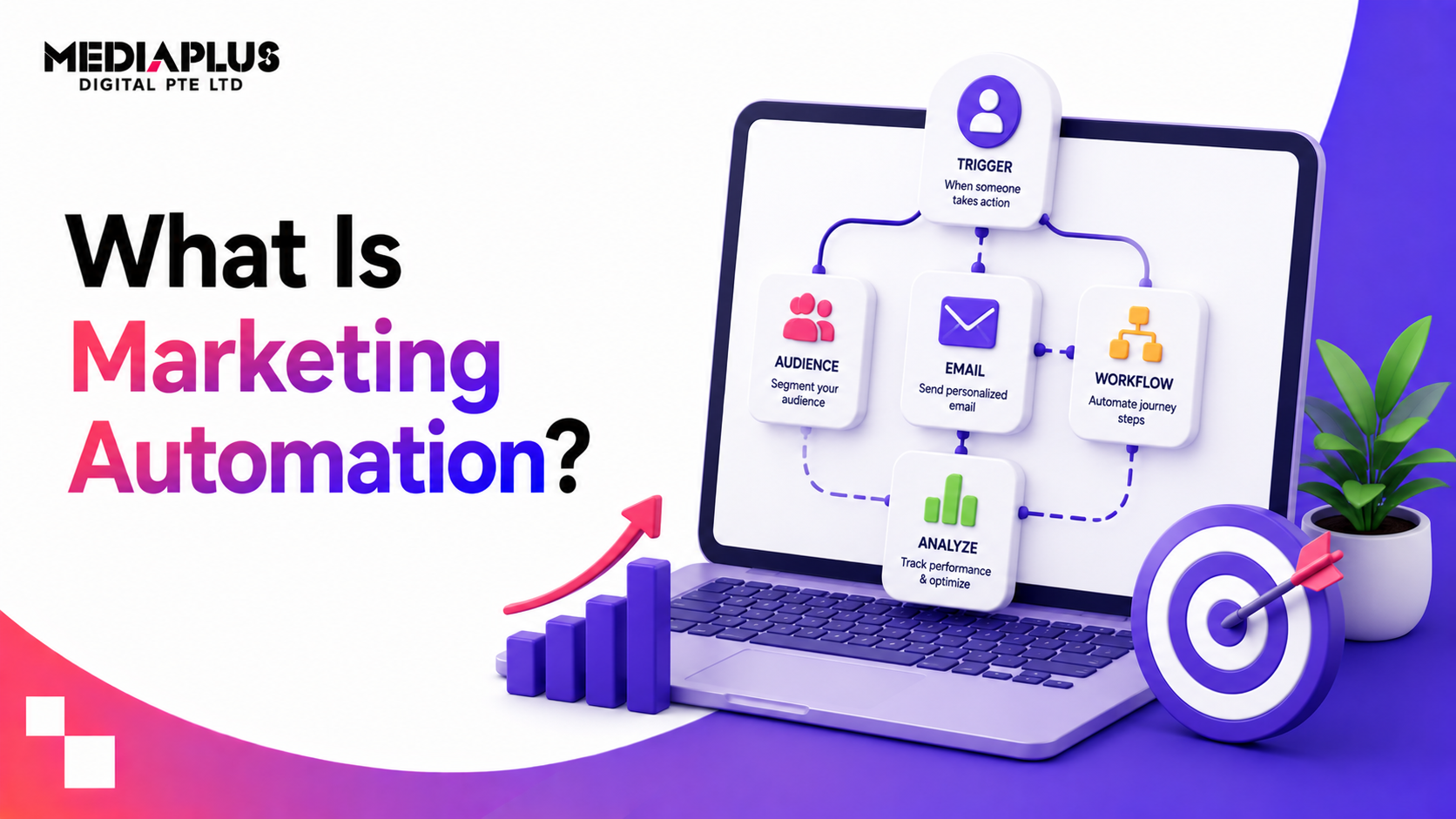
Marketing automation is software that sends the right message or does the right task when a customer does something, without someone on your team having to remember. A form is submitted, and the enquirer gets an instant reply and a salesperson gets an alert. A cart is abandoned, and a reminder goes out the next day. A customer bought three months ago, and a reorder message arrives just as they are running low.
For most Malaysian SMEs, the problem automation solves is not a lack of marketing. It is slow replies, forgotten follow-ups and leads that sit in someone’s personal WhatsApp until they go cold. This page covers what to automate first, how to do it on WhatsApp without breaking Meta’s rules or running up message charges, and what Malaysia’s amended PDPA means for every automated message you send.
What marketing automation is, and what it is not
Every automation has the same three parts:
|
Part |
Meaning |
Example |
|
Trigger |
Something happens |
A lead submits the website form |
|
Condition |
A rule decides what follows |
The lead chose “kitchen renovation” and is in the Klang Valley |
|
Action |
The system does something |
Sends a confirmation, assigns the lead to Aiman, alerts him on WhatsApp |
It is easy to confuse with three nearby things:
- Bulk messaging sends the same message to a list at a time you choose. Automation sends a message to one person when they do something. Bulk blasts are what get WhatsApp numbers restricted.
- A chatbot answers questions in a conversation. It can be part of an automation, but most useful automations need no bot at all. See our page on chatbot development for when a bot is worth building.
- A CRM stores your contacts and deals. Many CRMs include automation, but having a CRM does not mean anything is automated. Our comparison of CRM software for businesses covers which ones do.
Why it matters more in Malaysia than the global guides suggest
Most marketing automation guides are written for markets where email is the main channel. In Malaysia, a large share of enquiries arrive on WhatsApp, buyers expect a reply within minutes, and many SMEs run sales from one shared phone or from salespeople’s personal numbers.
That creates four leaks automation can close:
- Slow first replies. An enquiry at 9.40pm gets answered at 10am the next day, after the buyer has already messaged two competitors.
- No follow-up. A quote is sent, the buyer goes quiet, and nobody chases it.
- Leads lost with staff. When a salesperson leaves, the conversations on their personal phone leave too.
- Nothing after the sale. No review request, no reorder reminder, no referral ask.
None of these needs a complex system. They need the same few actions to happen every time.
The eight automations to set up first
In order. Most businesses get the majority of the benefit from the first four.
|
# |
Automation |
Trigger |
Action |
Why first |
|
1 |
Instant enquiry reply |
Form submitted or new WhatsApp chat |
Confirms receipt, says when someone will reply, asks one qualifying question |
Stops the buyer contacting the next result while they wait |
|
2 |
Lead assignment and alert |
New lead |
Assigns to a salesperson by area or product, alerts them immediately |
Makes someone responsible within minutes |
|
3 |
Unanswered lead escalation |
Lead not contacted within your target time |
Alerts a manager |
Catches the leads that fall through |
|
4 |
Quote follow-up |
Quote sent, no reply in 2 to 3 days |
Sends a short check-in, then a second after a week |
Most lost deals were never chased |
|
5 |
Appointment reminder |
Booking confirmed |
Reminder the day before and on the day, with location |
Cuts no-shows for clinics, salons, site visits |
|
6 |
Abandoned cart reminder |
Checkout started, not completed |
One reminder within 24 hours |
Recovers sales already nearly made |
|
7 |
Post-purchase review request |
Job completed or order delivered |
Asks for a review, with the link |
Builds reviews steadily without asking staff to remember |
|
8 |
Reorder or service reminder |
A set time after purchase |
Reminds the customer it is time to reorder or service |
Repeat revenue for consumables and maintenance |
A note on number 7. Google’s review policy prohibits selectively asking only happy customers for reviews, and prohibits offering anything in return for one. An automated review request must go to every completed customer, not only those who scored you highly in a survey first. Our Google Business Profile optimisation team works within these rules.
A worked blueprint: renovation enquiry to site visit
A Klang Valley renovation company gets about 60 enquiries a month from Google Ads and Facebook. Before automation, leads arrive in a shared inbox and a WhatsApp group, and a quarter are never contacted within a day.
|
Step |
When |
What happens |
Channel |
|
1 |
Form submitted |
Lead created in the CRM with source, project type and area |
Website to CRM |
|
2 |
Within 1 minute |
Confirmation to the lead: “Thanks, we received your kitchen renovation enquiry. A designer will WhatsApp you within 2 working hours. Is this a condo or landed property?” |
WhatsApp template |
|
3 |
Within 1 minute |
Lead assigned to the designer covering that area. Alert sent to the designer’s phone |
CRM and internal alert |
|
4 |
2 working hours, not contacted |
Alert to the sales manager with the lead’s details |
Internal alert |
|
5 |
Designer calls or chats |
Designer marks the lead as contacted and books a site visit |
CRM |
|
6 |
Day before visit |
Reminder to the lead with date, time and designer’s name |
WhatsApp template |
|
7 |
3 days after quote, no reply |
Short check-in from the designer’s account |
WhatsApp or email |
|
8 |
Job completed |
Review request to every completed customer |
WhatsApp or email |
What changes: every lead gets a reply in under a minute, every lead has a named owner, the manager sees the ones being ignored, and no quote goes unchased. The company did not add staff. It removed the steps that depended on someone remembering.
WhatsApp automation: the rules that decide what you can send
WhatsApp is where Malaysian automation either works well or gets a business number restricted. There are two products, and the rules differ.
WhatsApp Business App versus the WhatsApp Business Platform
|
WhatsApp Business App |
WhatsApp Business Platform |
|
|
Who it suits |
A sole trader or small team on one or a few phones |
A team that needs routing, records and integration |
|
Automation available |
Greeting message, away message, quick replies, labels |
Templates, triggers from your website or CRM, routing, bots |
|
Integration |
Very limited |
Connects to CRM, website, ecommerce and ad platforms |
|
Cost |
Free app |
Charged per delivered message by category, usually through a provider |
|
When to move |
When several people share one number, or leads need assigning |
Start with the free app’s greeting and away messages if you have nothing today. Move to the Platform when you need the blueprint above, because the app cannot assign leads, escalate them or connect to your CRM. Our page on the WhatsApp Business API in Malaysia explains the setup and providers.
Opt-in
Meta’s documentation states that you can only send messages to WhatsApp users who have opted in to receiving messages from you. A phone number on an enquiry form is not, by itself, permission to send marketing. Add a clear line to the form (“We will reply on WhatsApp about your enquiry. Tick here to also receive offers and updates.”) and keep a record of who agreed to what.
The customer service window
When a customer messages or calls your business, a 24-hour customer service window opens. Each time they message again, it resets to 24 hours. Inside that window you can reply freely. Outside it, you can only send pre-approved template messages.
This shapes every automation. An instant reply to someone who just messaged you is inside the window. A quote follow-up three days later is outside it and must use an approved template.
What messages cost, and what changed in 2025 and 2026
Meta moved to per-message pricing on 1 July 2025. You are charged for each delivered template message according to its category: marketing, utility, authentication or service. Meta lists Malaysia as its own market on the rate card, with a rate card in ringgit available since 1 April 2026.
Two changes took effect on 1 October 2026, and they matter to anyone who built automation on the assumption that replies are free:
- Utility messages sent inside an open customer service window are now charged. Before October 2026 they were free.
- Service messages are free only up to 1,000 per business phone number per month. Meta charges from the 1,001st service message in a month. The free tier does not roll over.
One window is still free. When someone messages you from a Click to WhatsApp ad and you reply within the customer service window, a free entry point window opens for up to 7 days, during which Meta does not charge for marketing, utility, authentication or service messages.
Practical consequences:
- Do not send a template where a single well-written reply would do.
- Classify templates honestly. A booking confirmation is utility. A promotion is marketing. Mislabelling gets templates rejected or recategorised.
- If Click to WhatsApp ads are a main lead source, plan the follow-up sequence to happen inside the free 7-day window.
- Check current rates on Meta’s pricing page, or with your provider, before forecasting costs. Meta can change rates at the start of a quarter.
PDPA: what every automated message has to respect
Automation means you are collecting, storing and using personal data at scale, often in third-party tools. Malaysia’s Personal Data Protection Act 2010 applies, and the Personal Data Protection (Amendment) Act 2024 raised the stakes.
The amendments that matter for automation
- Higher penalties. The maximum fine for breaching the Personal Data Protection Principles rose to RM1 million, with up to three years’ imprisonment, up from RM300,000 and two years.
- Data processors are directly liable. Software providers and agencies processing your customer data now have their own security obligations under the Act.
- Data breach notification. Data controllers must notify the Personal Data Commissioner of personal data breaches. Most sources date this obligation, along with the requirement to appoint a data protection officer, from 1 June 2025.
- Data portability. Individuals gained a right to have their data transmitted to another controller, subject to conditions.
What that means in practice
|
Obligation |
What to do in your automation |
|
Notice and consent |
State on every form what you will use the data for, and link your privacy notice next to the submit button |
|
Separate marketing consent |
Keep “reply to my enquiry” separate from “send me offers”, and record both |
|
Right to stop direct marketing |
Section 43 of the PDPA lets individuals require you to stop using their data for direct marketing. Every marketing message needs an easy way to opt out, and opt-outs must sync across WhatsApp, email and SMS |
|
Security |
Restrict who can export contacts. Remove former staff access the day they leave |
|
Processor contracts |
Have written terms with your CRM, messaging provider and agency covering how they handle the data |
|
Retention |
Delete leads you will never contact again after a set period |
Our guide to making your website PDPA compliant covers the form and privacy notice side. For legal advice on your specific situation, consult a Malaysian lawyer, because this page is a practical summary rather than legal advice.
Choosing tools without overbuying
The most common mistake is buying a platform before deciding what it should do. Work out your first four automations from the table above, then choose the simplest tool that runs them.
|
Stage |
Typical setup |
Fits when |
|
Starting |
WhatsApp Business App greeting and away messages, a form that emails the team, a shared spreadsheet |
Under about 30 leads a month, one or two people selling |
|
Organised |
A CRM with built-in automation, connected to the website form, plus email automation |
Several salespeople, need for assignment and follow-up reminders |
|
Integrated |
CRM plus WhatsApp Business Platform through a provider, connected to ads and ecommerce |
High lead volume, WhatsApp as the main channel, need for routing and reporting |
Questions to ask any vendor:
- Does it connect to our website form and our ad platforms without custom code?
- Can it assign leads by rule and escalate unanswered ones?
- If WhatsApp is involved, is it an official WhatsApp Business Platform provider, and who holds the account?
- Where is the data stored, and will they sign processor terms?
- If we leave, can we export every contact and conversation?
How to tell whether it is working
|
Measure |
What it tells you |
Good direction |
|
Time to first reply |
Whether the instant reply and assignment work |
Down to minutes |
|
Leads contacted within target time |
Whether escalation catches the gaps |
Up towards every lead |
|
Lead to appointment or quote rate |
Whether faster contact turns into progress |
Up |
|
Quote to sale rate |
Whether follow-up recovers deals |
Up |
|
Opt-outs and blocks |
Whether messages are wanted |
Low and stable |
|
Message cost per sale |
Whether WhatsApp templates are being used efficiently |
Stable or down |
|
Repeat purchase rate |
Whether reminders bring customers back |
Up |
Measure for a month before switching anything on, so you have a baseline. Our guide to qualifying leads from ads and measuring MQLs shows how to tell good leads from noise once the volume rises.
Mistakes that make automation backfire
- Automating a broken process. If nobody knows who owns a lead today, software will not decide for you. Write the process first. Our guide to customer journey maps helps.
- Sending too much. Five messages in three days to someone who asked one question gets your number blocked and reported.
- Sounding like a robot. Write automated messages the way your best salesperson talks, in the language your customer used, and sign them with a real name.
- Pretending a bot is a person. If an automated assistant is answering, say so. Customers forgive automation more readily than deception.
- Ignoring the reply. An instant confirmation that promises a reply in two hours, followed by silence for two days, is worse than no automation.
- No opt-out. A legal risk under the PDPA and a fast way to collect blocks.
Frequently asked questions
What is marketing automation?
Marketing automation is software that carries out marketing and sales tasks automatically when a customer does something, such as submitting a form, abandoning a cart or completing a purchase. Typical actions are sending a confirmation, assigning the lead to a salesperson, reminding someone of an appointment or asking for a review. It replaces steps that depend on someone remembering with steps that happen every time.
What should a small business automate first?
Start with an instant reply to every new enquiry, automatic assignment of each lead to a named person, an alert when a lead has not been contacted within your target time, and a follow-up after a quote goes quiet. These four close the biggest leaks for most Malaysian SMEs: slow replies and leads that are never chased. Add reminders, review requests and reorder messages after.
Can I automate WhatsApp messages in Malaysia?
Yes. The free WhatsApp Business App supports greeting messages, away messages and quick replies. For routing, CRM integration and triggered messages, you need the WhatsApp Business Platform, usually through an official provider. You can only message people who have opted in, and outside the 24-hour customer service window you can only send pre-approved template messages, which Meta charges per delivered message.
How much does WhatsApp automation cost?
Meta charges per delivered template message, by category and country, and Malaysia has its own rate card, available in ringgit since April 2026. Since 1 October 2026, utility messages inside the customer service window are charged, and service messages are free only up to 1,000 per number per month. Providers add their own fees. Check Meta’s current rate card before forecasting, because rates can change each quarter.
Does marketing automation need PDPA consent?
Yes. Under Malaysia’s PDPA you need to tell people how their data will be used and obtain consent, and section 43 gives individuals the right to stop you using their data for direct marketing. The 2024 amendments raised maximum fines to RM1 million and introduced breach notification. Keep enquiry consent and marketing consent separate, record both, and give every marketing message an easy opt-out.
Is marketing automation the same as a chatbot?
No. A chatbot holds a conversation and answers questions. Marketing automation runs actions triggered by what a customer does, such as sending a reminder or assigning a lead. A chatbot can be one part of an automation, for example collecting details before handing over to a person, but most of the useful automations for SMEs need no chatbot at all.
How long does it take to set up?
A first set of automations covering instant replies, lead assignment and escalation can usually be running within a few weeks if the website form, CRM and WhatsApp account are already in place. Most of the time goes on deciding the rules and writing the messages, not on the software. Moving to the WhatsApp Business Platform adds time for account verification and template approval.