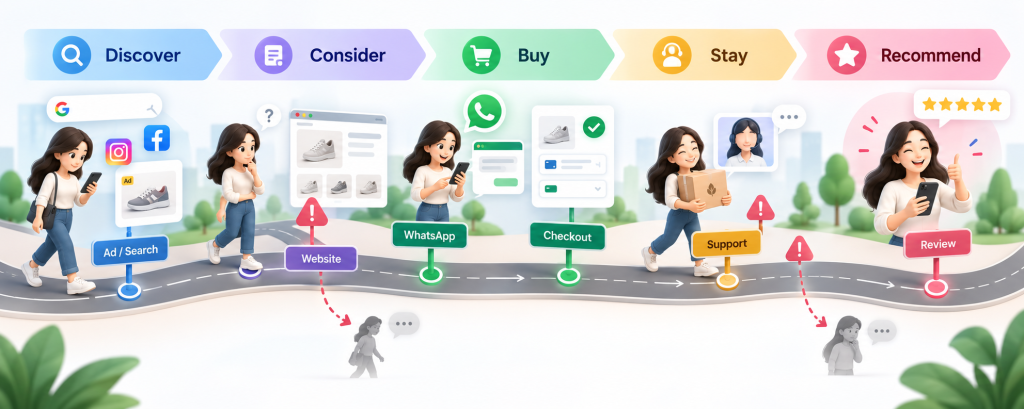
Quick answer: A customer journey map is a visual of every step a customer takes with your brand, from first discovering you to buying and beyond, showing what they do, think, and feel at each stage, and where they hit friction. You build one by researching real customers, defining stages (awareness, consideration, decision, retention, advocacy), plotting touchpoints and pain points, then fixing the moments that lose you sales.
What is a customer journey map?
A customer journey map is a diagram of the whole experience a customer has with your business, laid out stage by stage. For each step it captures:
- What the customer is doing (searching, comparing, contacting you)
- What they are thinking and feeling (curious, confused, hesitant)
- Which touchpoint they are on (an ad, your website, WhatsApp, a salesperson)
- What is going wrong (friction, gaps, unanswered questions)
Its purpose is simple: see your business the way your customer actually experiences it, not the way your org chart assumes.

Why customer journey mapping matters
- It finds where you lose people. Most businesses have one or two moments quietly killing conversions.
- It aligns your team. Marketing, sales, and support see one shared picture.
- It improves conversions. Removing friction lifts results from the traffic you already have.
- It guides where to invest. You fix the moments that matter, not the ones you assume.
- It underpins good customer experience design.
The 5 stages of the customer journey
|
Stage |
What the customer is doing |
Your job |
|
1. Awareness |
Realising they have a problem, discovering you |
Be findable (SEO, social, ads) |
|
2. Consideration |
Researching and comparing options |
Answer questions, prove credibility |
|
3. Decision |
Choosing and buying |
Remove friction, make acting easy |
|
4. Retention |
Using your product or service |
Deliver, support, follow up |
|
5. Advocacy |
Recommending you |
Earn reviews and referrals |
Most businesses over-invest in awareness and under-invest in consideration and decision, which is exactly where mapping tends to reveal the biggest wins.
How to create a customer journey map (7 steps)
1. Set a clear goal
Decide what you want to learn or fix (for example, why enquiries do not become customers).
2. Research real customers
Do not guess. Use interviews, sales and support feedback, reviews, analytics, and heatmaps. Real evidence beats assumption.
3. Build a persona
Map the journey for one specific customer type at a time, different customers travel different paths.
4. List every touchpoint
Everywhere they meet your brand: search results, ads, your website, social, WhatsApp, email, phone, in person, invoices, support.
5. Map actions, thoughts, and feelings per stage
For each stage, capture what they do, what they are thinking, and how they feel. Emotion is where the insight usually is.
6. Identify pain points and gaps
Where do they hesitate, get confused, wait too long, or drop out? Mark every friction point.
7. Fix, then measure
Prioritise the highest-impact fixes, make the changes, and track whether conversions improve. Then repeat, it is an ongoing tool, not a one-off poster.
A simple customer journey map template
For each stage (Awareness, Consideration, Decision, Retention, Advocacy), fill in these rows:
- Customer goal: what they are trying to achieve
- Actions: what they actually do
- Touchpoints: where they interact with you
- Thoughts: what they are asking themselves
- Emotions: how they feel
- Pain points: what goes wrong
- Opportunities: what you will fix or improve
- Owner and metric: who fixes it and how you will measure it
That last row is what separates a useful map from a nice diagram.
Common mistakes to avoid
- Mapping from assumption instead of real customer research.
- Mapping your process, not their experience.
- Ignoring emotions, which is where friction shows up.
- Making it a one-off, journeys change.
- No owner or action, the map ends up on a wall and nothing improves.
Where your website fits
Your website usually appears at almost every stage: discovery, research, comparison, and purchase. That makes it the highest-leverage place to fix friction found in a map. If your map shows people hesitating or dropping out, look at clarity, speed, and calls to action first. See web design mistakes that kill conversions and how to increase your conversion rate.
Frequently asked questions
What is a customer journey map?
A visual of every step a customer takes with your brand, from discovery to purchase and beyond, showing what they do, think, and feel, and where they hit friction.
What are the 5 stages of the customer journey?
Awareness, consideration, decision, retention, and advocacy.
How do you create a customer journey map?
Set a goal, research real customers, pick one persona, list touchpoints, map actions/thoughts/feelings per stage, identify pain points, then fix and measure.
What should a customer journey map include?
Customer goals, actions, touchpoints, thoughts, emotions, pain points, opportunities, and an owner and metric for each fix.
What is the difference between a customer journey map and a sales funnel?
A funnel is your view of how prospects convert, stage by stage. A journey map is the customer’s view of their whole experience, including emotions and post-purchase. See our digital marketing funnel guide.
How often should I update it?
Review it at least yearly, and after any major change to your product, website, or market.
The bottom line
A customer journey map shows your business through your customer’s eyes, and almost always reveals a moment or two quietly costing you sales. Research real customers, map the five stages honestly, mark the friction, then fix the biggest problems and measure. It is one of the cheapest ways to get more from the traffic and leads you already have.
Want a website designed around your customer’s journey? Talk to MediaPlus Digital about web design and conversion optimisation, and claim a free RM300 consultation.