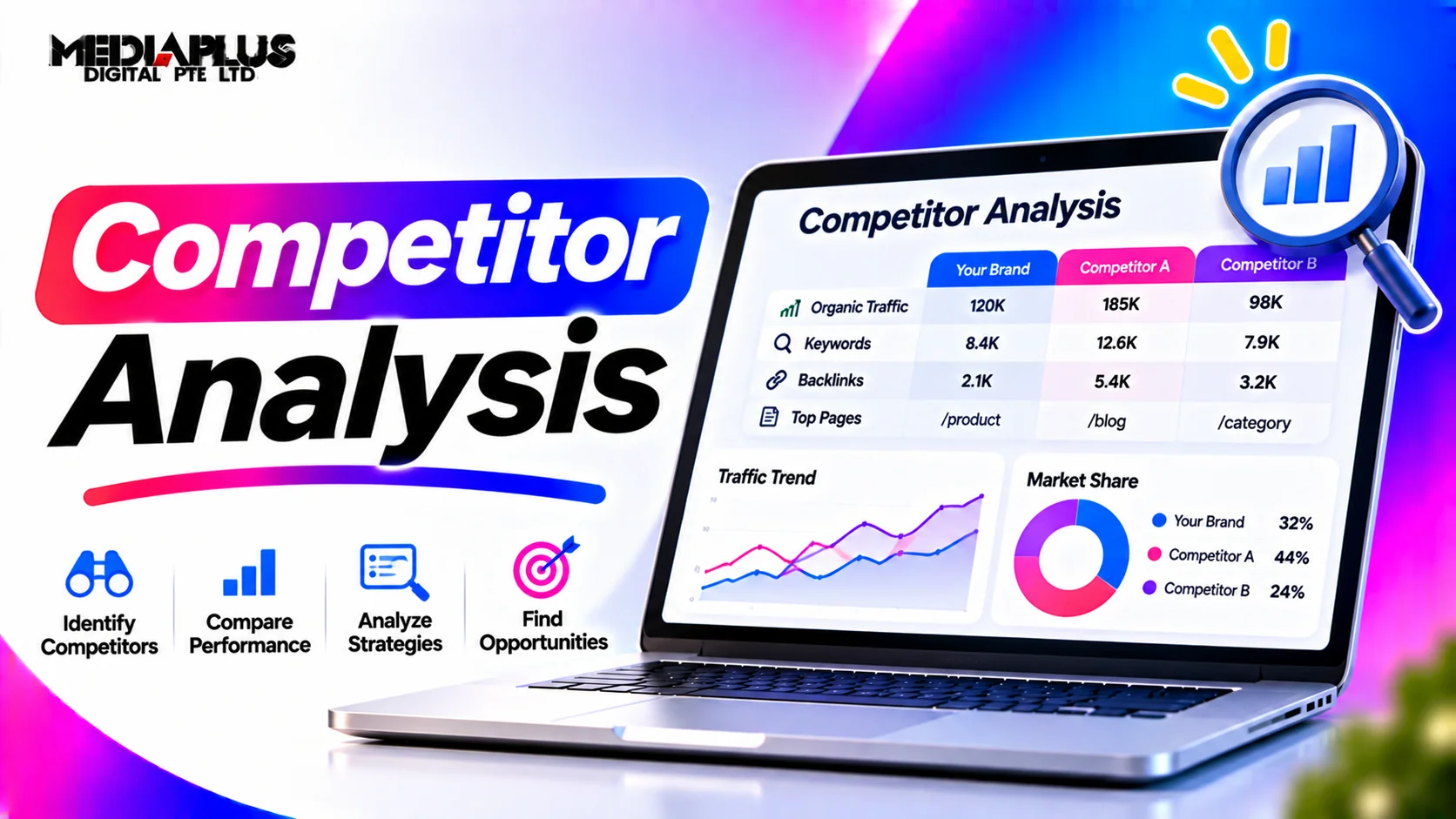
Every competitor you have is publishing their marketing in public. Their ads sit in libraries that Meta and Google make searchable for free. Their best pages are ranking on Google where you can read them. Their customers are telling you what they get wrong in their Google reviews. Most Malaysian businesses never look, and then wonder why a newer rival is getting the enquiries.
This guide is a working method, not a theory. It walks through what to look at, which tools show it (most of them free), and how to turn what you find into a short list of decisions. Set aside half a day for the first round. After that, a monthly check takes about an hour.
What a competitor analysis is for
A competitor analysis answers three practical questions:
- Where are they winning attention that we are not? Keywords they rank for, ads they run, platforms they are active on.
- What are they promising that we are not? Offers, guarantees, prices, turnaround times, proof.
- Where are they weak? Complaints in their reviews, slow replies, thin pages, platforms they ignore.
If an analysis does not end in a change to your ads, pages, offers or budget, it was a reading exercise. Keep that in mind as you go. Every section below ends with the decision it should feed.
The SWOT diagrams and five forces charts you learned in a business course have their place in strategy. This is the part underneath them: the evidence. Once you have it, the bigger strategic questions in our guide to digital marketing strategy become much easier to answer.
Step 1: pick the right competitors
Most businesses list the companies they think of as rivals. That list is usually incomplete, because the competitors that matter online are the ones that show up when your customers search, and some of them you have never heard of.
Build the list from three sources:
|
Source |
How to find them |
What they compete with you for |
|
Business competitors |
The names your sales team hears from customers |
The final decision |
|
Search competitors |
Search your top five service keywords on Google, on mobile, signed out, and note who appears in the ads, the map pack and the top organic results |
Clicks and enquiries |
|
Social and marketplace competitors |
Search your category on TikTok, Instagram, Facebook, Shopee and Lazada |
Attention and impulse purchases |
Pick three to five to analyse properly. Include at least one you would not have named yourself. If a directory or a comparison site keeps appearing on your keywords, include it too. It is taking your clicks even if it does not sell what you sell.
One Malaysian nuance: search competitors can vary by language and state. A dental clinic in Johor Bahru may compete with Singapore clinics on English searches and with local clinics on Malay and Chinese searches. Check the main languages your customers use.
Step 2: see their ads
This is the part most businesses have never done, and it is free.
Meta Ad Library (Facebook and Instagram)
The Meta Ad Library lets anyone search all active ads running across Facebook, Instagram, Messenger and Meta’s partner network. You do not need an account.
- Go to the Meta Ad Library (facebook.com/ads/library).
- Set the country to Malaysia and the ad category to All ads.
- Search the competitor’s Page name.
- Use the filters for platform, media type and active status.
What you can see for each ad: the creative (image, video or carousel), the primary text, the headline, the call to action, the date it started running, the platforms it runs on, and whether there are several versions of the same ad.
What you cannot see: how much they spend, who they target, or how well the ad performs. Spend and reach data is only shown for ads about social issues, elections or politics.
The trick that tells you what works: look at the start dates. An ad that has been running for three months or longer is almost certainly profitable, because businesses rarely keep paying for ads that lose money. New ads tell you what they are testing. Old ads tell you what is working.
Note what you find:
- Which offers keep appearing: free consultation, a discount, a free trial, a bundle
- Which formats dominate: short video, UGC style testimonials, static images, carousels
- Which call to action they use: Send WhatsApp message, Learn more, Book now, Get quote
- Which languages: English only, or Malay and Chinese versions too
- How many ads are active. One business running three ads and another running forty are playing different games
Google Ads Transparency Center
Google’s equivalent is the Ads Transparency Center (adstransparency.google.com). It shows ads from verified advertisers across Google Search, YouTube, Display, Google Play, Maps and Shopping.
- Search the competitor by advertiser name or website.
- Set the region to Malaysia.
- Filter by format (text, image, video) and date range.
For each ad you can see the creative, the format, when it last ran and the regions it was shown in. The advertiser page also shows the legal name and the country it is based in.
For Search ads, the Transparency Center shows the ad text but not the keywords. To see which keywords trigger a competitor’s ads, search the keywords yourself on Google, on mobile, in an incognito window, at different times of day. A paid SEO tool can estimate a competitor’s paid keywords too, though the estimates for Malaysia are rougher than for larger markets.
TikTok
TikTok’s ad library, the Commercial Content Library, only covers ads shown in Europe, so it is of limited use for Malaysian competitors. Two alternatives work better locally:
- TikTok Creative Center shows top performing ads by region and industry, including Malaysia. You will not always find a specific competitor, but you will see what works in their category.
- Search the brand directly on TikTok and look for posts marked as sponsored or promotional, and for Spark Ads that boost creator content.
What this should change
Write down three things after this step: the offer you will test against theirs, the creative format you are underusing, and one claim they make that you can beat with proof. If you run ads already, this is also the moment to check your own account against basic hygiene, which our SEM audit checklist covers.
Step 3: see their keywords and best pages
This step needs an SEO tool. Ahrefs, Semrush and Similarweb all estimate a website’s organic keywords and traffic. Free versions and trials show enough for a first pass. Our comparison of SEO keyword research tools covers the options.
Run each competitor’s domain through the tool and pull four reports.
|
Report |
What it tells you |
What to look for |
|
Organic keywords (filtered to Malaysia) |
The searches that bring them traffic |
Commercial keywords you do not rank for at all |
|
Top pages |
The pages that bring them the most traffic |
Page types you do not have: cost guides, comparison pages, location pages |
|
Content gap or keyword gap |
Keywords several competitors rank for and you do not |
The most important report. Three competitors ranking for a keyword is strong proof of demand |
|
Referring domains |
The websites linking to them |
Directories, associations, media and partners you could also be listed on |
Reading the numbers honestly
Traffic numbers from these tools are estimates, and for Malaysian sites they can be off by a wide margin in either direction. Use them to compare competitors with each other and to spot patterns, not as facts. A competitor showing 2,000 visits a month and another showing 200 are genuinely different. One showing 2,000 and another 1,700 are not.
Read their top pages
The tool tells you which pages win. Reading those pages tells you why. For each competitor’s top three commercial pages, note:
- What question the page answers. A page that ranks for “renovation cost Malaysia” answers a cost question. If your service page only says “contact us for a quote”, it will not compete.
- Length and depth. Not word count for its own sake, but whether it includes prices or price ranges, process steps, FAQs, photos of real projects, and proof.
- Structure. Headings, tables, comparison sections. Copy the useful structure, never the words.
- Freshness. A page that says 2023 at the top in 2026 is an opportunity.
What this should change
Take the keyword gap list and sort it into three groups: keywords for pages you should create, keywords for pages you should improve, and keywords to ignore because they are not your business. Then decide which page each keyword belongs to, so you do not end up with two pages fighting over the same search. Our guide to SEO keyword mapping shows how to do that properly.
Step 4: audit their website as a customer would
Put the tools away and use the competitor’s website on your phone, as a customer would. Time yourself.
|
Check |
What to record |
|
Speed |
Does it load in under three seconds on mobile data? |
|
First screen |
Is it clear within five seconds what they do, where, and for whom? |
|
Contact |
How many taps to WhatsApp, call or a form? |
|
Price signals |
Do they show prices, ranges, packages or nothing? |
|
Proof |
Reviews, case studies, client logos, certifications, before and after photos |
|
Languages |
English only, or Malay and Chinese versions? |
|
Offer |
Free consultation, site visit, trial, quote within 24 hours? |
Two free tools add useful detail. The Wayback Machine (web.archive.org) shows older versions of a page, so you can see how a competitor’s offer or pricing has changed. Browser extensions such as Wappalyzer show what platform a site runs on and which tracking tools are installed, which tells you whether the competitor is likely measuring conversions properly.
If you want a more structured way to look at sites, including your own, our complete SEO audit checklist covers the technical side.
What this should change
List the places where their site makes it easier for a customer to act than yours does. Fewer taps to WhatsApp, a clearer price signal, stronger proof. Those are usually faster to fix than any SEO or ad problem.
Step 5: read their reviews
This is the most underrated step, and the one that produces the best ideas.
Open each competitor’s Google Business Profile and read their three, two and one star reviews. Then read their Shopee or Lazada store reviews if they sell there, and the comments on their most popular social posts.
You are looking for repeated complaints:
- “Took three days to reply to my WhatsApp”
- “Final price was much higher than the quotation”
- “Contractor disappeared after the deposit”
- “Delivery was late for Hari Raya”
- “Staff only spoke English”
Every repeated complaint about a competitor is a promise you can make, as long as you can keep it. If customers in your category keep complaining about hidden costs, a transparent quotation process is a selling point worth putting in your headline and your ads.
Read their five star reviews too. They tell you what customers value enough to mention, which is often not what the business itself advertises.
What this should change
Write one sentence: “Customers in our category are frustrated by , and we can promise .” That sentence is a headline, an ad angle and a sales script.
Step 6: test their response
How quickly and how well a competitor answers an enquiry is often the real reason they win. You can only learn this by trying it, and it should be done fairly: ask genuine questions you would actually want answered, do not waste their sales team’s time with an elaborate fake project, and do not misuse anything you learn.
Send a simple enquiry by WhatsApp and through their website form. Record:
|
Measure |
What to note |
|
Time to first reply |
Minutes, hours or days |
|
Who replies |
A person, a bot, or nobody |
|
Quality |
Did they answer the question or just ask for your phone number? |
|
Follow up |
Did they follow up if you did not reply? |
|
Language |
Did they reply in the language you used? |
Then do the same test on your own business, from a number your team does not recognise. Many owners find this the most uncomfortable and useful part of the whole exercise.
Step 7: track demand over time
Two free signals show whether a competitor is growing.
- Google Trends can compare the search interest in up to five brand names over time and by state. If a newer competitor’s brand searches are climbing while yours are flat, something they are doing is working.
- Social follower counts and posting frequency. Note them each month. Sudden jumps usually mean a paid push or a viral post, which you can then find in the ad libraries.
Turn it into a one page summary
Put everything into one page. A table like this, one row per competitor, is enough:
|
Competitor |
Channels active |
Main offer |
Ad formats running |
Top organic pages |
Review complaints |
Reply speed |
Our opening |
|
Competitor A |
Google Ads, Facebook, SEO |
Free site visit |
Video testimonials, 25 active ads |
Cost guide, location pages |
Late completion |
2 hours |
Publish timelines and guarantee them |
|
Competitor B |
TikTok, Shopee |
Bundle discounts |
UGC creator videos |
Weak website |
Slow delivery |
Next day |
Same day dispatch in Klang Valley |
|
Competitor C |
SEO only |
None stated |
No ads |
Strong blog, 40 articles |
Hard to reach |
No reply |
Win on response speed and paid search |
Below the table, list no more than five actions, each with an owner and a date. Fold them into your marketing plan for the quarter. Our marketing plan template has a place for exactly this kind of input.
How often to repeat it
|
Check |
Frequency |
Time needed |
|
Meta Ad Library and Google Ads Transparency Center |
Monthly |
20 minutes |
|
Competitor reviews |
Monthly |
15 minutes |
|
Keyword gap and top pages |
Quarterly |
1 hour |
|
Full website and response test |
Twice a year |
Half a day |
Set a recurring calendar reminder. The value of competitor analysis comes from noticing changes: a new offer, a new format, a new page that suddenly ranks.
Mistakes to avoid
- Copying instead of learning. Copying a competitor’s ad or page word for word is lazy, often a copyright problem, and makes you look like the cheaper version of them. Take the structure and the insight, then make it yours.
- Treating tool estimates as facts. Traffic and keyword numbers for Malaysian sites are rough. Use them for comparison.
- Only watching the competitors you already know. The search results decide who your competitors are online.
- Analysing without acting. If nothing changes in your ads, pages or offer, the time was wasted.
- Reacting to every move. A competitor launching a discount does not mean you need one. Check whether their ad is still running a month later before you respond.
When to get help
A first round of competitor analysis is very doable in house. It is worth bringing in an agency when you need the paid tools and someone who uses them daily, when you need the findings turned into a keyword and content plan, or when a competitor is clearly outspending you and you need to decide where to fight and where not to.
Our SEO services start with this kind of competitive keyword analysis, and our SEO consultant service suits businesses that want the analysis and a plan their own team will carry out. On the paid side, Google Ads management and social media ads both include monitoring what competitors are running and adjusting your offers and creative in response.
Frequently asked questions
How can I see my competitors’ Facebook and Instagram ads?
Use the Meta Ad Library at facebook.com/ads/library. Set the country to Malaysia and the category to All ads, then search the competitor’s Page name. You will see every active ad, its creative and text, its start date and the platforms it runs on. Spend and targeting are not shown except for political and social issue ads.
How can I see my competitors’ Google Ads?
Use the Google Ads Transparency Center at adstransparency.google.com. Search by advertiser name or website and set the region to Malaysia. You can see the ad creatives across Search, YouTube and Display, and when they last ran. The keywords they bid on are not shown, so search your main keywords yourself on mobile to see which ads appear.
Can I see how much a competitor spends on ads?
Not directly. Meta only publishes spend for political and social issue ads, and Google does not publish spend in the Transparency Center. Paid SEO tools estimate Google Ads spend, but estimates for Malaysia are rough. The number of active ads and how long they have run is a more reliable signal of commitment.
What are the best free tools for competitor analysis?
Meta Ad Library, Google Ads Transparency Center, TikTok Creative Center, Google Trends, the Wayback Machine, and simply searching Google on mobile. Free trials or limited free versions of Ahrefs, Semrush or Similarweb cover keywords and top pages for a first pass.
How do I find out which keywords my competitors rank for?
Run their domain through an SEO tool such as Ahrefs or Semrush, set the country to Malaysia, and look at the organic keywords and top pages reports. A content gap report, comparing several competitors with your site, shows keywords they share that you are missing.
How often should I do a competitor analysis?
Check competitor ads and reviews monthly, keywords and top pages quarterly, and do a full website and response test twice a year. The useful insights come from changes over time, so a regular light check is worth more than one big report.
Is it legal to look at competitors’ ads and websites?
Yes. Ad libraries are published by Meta and Google specifically for transparency, and websites, rankings and public reviews are public. What you must not do is copy their creative or text, misuse their trademarks in your ads, or mislead their staff in ways that could cause harm.