SEO keyword mapping is one of those foundational practices that quietly separates high-performing websites from sites that struggle to grow. It is not about finding more keywords. It is about using the right keywords in the right places, with clear intent and structure.
When keyword mapping is done well, every page on your site has a purpose. Search engines understand your content hierarchy. Users find what they are looking for faster. Rankings become more stable instead of fluctuating with every algorithm update.
This guide breaks down what SEO keyword mapping is, why it matters, and how to implement it step by step.
What Is SEO Keyword Mapping?
SEO keyword mapping is the process of assigning target keywords to specific pages on your website based on search intent, topic relevance, and site structure.
Instead of letting multiple pages compete for the same keyword, keyword mapping ensures that:
-
Each important keyword has one clear target page
-
Each page supports a distinct search intent
-
Content is organised into logical topic clusters
In simple terms, keyword mapping answers one question clearly:
Which page should rank for which keyword, and why?
A keyword map is usually documented in a spreadsheet that includes:
-
Primary keyword
-
Secondary or variation keywords
-
Search volume
-
Keyword difficulty
-
Search intent
-
Target URL
-
Page status (to create, to optimise, updated)
This document becomes the backbone of your SEO strategy.
Why SEO Keyword Mapping Matters
Many SEO problems are not technical issues. They are structure problems.
Without keyword mapping, websites often suffer from:
-
Keyword cannibalisation, where multiple pages compete for the same term
-
Weak internal linking
-
Unclear content priorities
-
Pages ranking briefly, then dropping
A proper keyword mapping process helps you:
1. Align Content With Search Intent
When keywords are mapped intentionally, informational keywords lead to guides and blog posts, while commercial keywords lead to service or product pages. This alignment improves rankings and reduces bounce rate.
2. Prevent Keyword Cannibalisation
Google struggles when several pages target the same keyword with similar intent. Keyword mapping eliminates overlap and clarifies authority signals.
3. Build Strong Topic Clusters
Mapping supports a pillar and cluster structure, where:
-
Pillar pages target broad, high-value keywords
-
Cluster pages target long-tail variations and subtopics
-
Internal links reinforce topical authority
4. Identify Content Gaps
Any keyword without a mapped URL is a signal that new content is needed. This turns keyword research into a clear content roadmap.
How to Do SEO Keyword Mapping Step by Step
Step 1: Identify Core Topics and Pillar Pages
Start with your main business or content themes. These become your pillar topics.
For example:
-
SEO services
-
Local SEO
-
Ecommerce SEO
-
Content marketing
-
Technical SEO
Each pillar page should target one broad keyword with strong commercial or informational value.
Step 2: Conduct Keyword Research
For each pillar topic, research:
-
Main keywords with solid search volume
-
Long-tail variations
-
Related questions
-
Commercial and informational modifiers
Use tools like keyword planners, competitor analysis, and SERP reviews to validate intent, not just volume.
Step 3: Group Keywords by Intent and Topic
Keywords that share the same intent should live on the same page.
For example:
-
“SEO keyword mapping”
-
“keyword mapping SEO”
-
“how to do keyword mapping”
These belong to one page, not three.
Separate keywords when intent changes. A “how to” keyword should not be forced onto a service page.
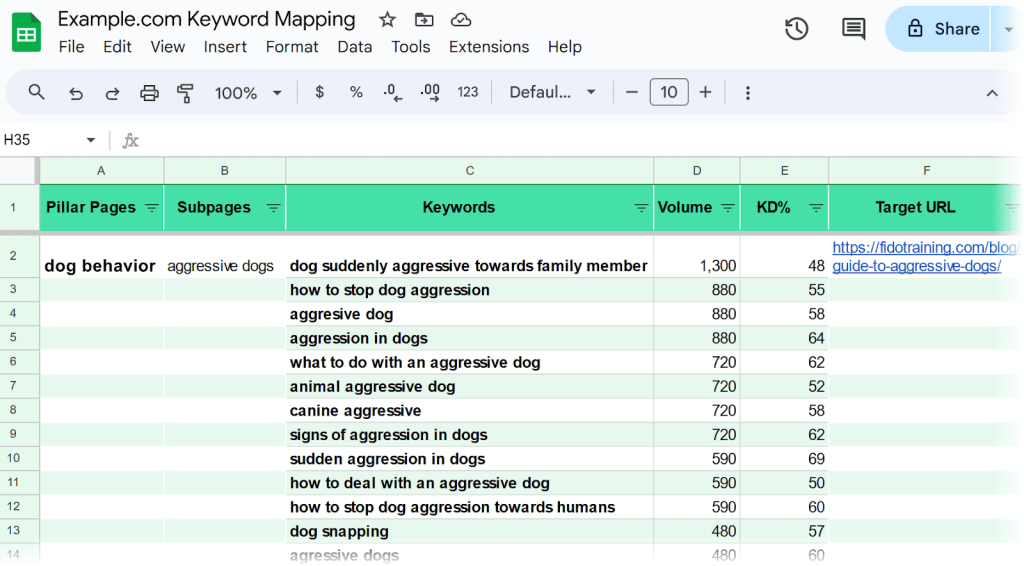
Step 4: Assign Keywords to URLs
For each keyword group:
-
Assign an existing URL if one matches intent
-
Mark pages as “to optimise” if content exists but is weak
-
Mark pages as “to create” if no suitable page exists
Each keyword group should map to one URL only.
Step 5: Optimise and Track
Once mapping is complete:
-
Optimise existing pages first
-
Create missing pages strategically
-
Update internal links using mapped anchor text
-
Track rankings and revisit the map quarterly
Keyword mapping is not static. It evolves with your business and search behaviour.
Common Keyword Mapping Mistakes
-
Mapping one keyword to multiple URLs
-
Creating new pages without checking existing coverage
-
Ignoring search intent in favour of volume
-
Treating keyword mapping as a one-time task
Good keyword maps are reviewed regularly, especially after major content additions or site changes.
Keyword Mapping in the Age of AI Search
Search engines are increasingly driven by context, semantics, and entity understanding. This makes keyword mapping more important, not less.
Modern keyword mapping should consider:
-
Semantic keyword relationships
-
Topical depth, not just exact matches
-
User journeys across multiple pages
-
Internal linking patterns that reinforce expertise
This is where AI-assisted workflows are becoming valuable, especially for larger websites with hundreds of pages.
Turning Keyword Mapping Into Real SEO Growth
A keyword map on its own does not generate traffic. Execution does.
For many businesses, keyword mapping becomes far more effective when combined with structured SEO implementation and ongoing optimisation. This is where working with experienced specialists can make a measurable difference.
At MediaPlus Malaysia, keyword mapping is treated as a strategic layer within a broader SEO service, not a standalone document. Their approach focuses on aligning keyword maps with site architecture, content quality, and conversion intent so pages rank and perform commercially.
For larger sites or competitive industries, MediaPlus Malaysia also integrates AI SEO service workflows to scale keyword clustering, detect cannibalisation early, and identify semantic gaps that traditional methods often miss. This allows businesses to build content ecosystems that are resilient to algorithm changes and aligned with how modern search engines interpret relevance.
When keyword mapping, on-page optimisation, and AI-driven insights work together, SEO stops being reactive and becomes predictable.
Final Thoughts
SEO keyword mapping is not about controlling every keyword. It is about creating clarity.
Clear structure leads to better crawling.
Clear intent leads to better rankings.
Clear mapping leads to sustainable growth.
If your website feels bloated, inconsistent, or stuck despite ongoing content creation, keyword mapping is often the missing link. When done properly and supported by the right SEO strategy, it becomes one of the highest-ROI activities in organic search.