Quick answer: B2B (business-to-business) digital marketing targets other companies and decision-makers, with longer sales cycles, logic-driven messaging, and channels like LinkedIn, SEO, and email. B2C (business-to-consumer) marketing targets individual shoppers, with shorter cycles, emotion-driven messaging, and channels like social media, influencers, and paid ads. Same tools, different audiences, cycles, and messages.
B2B vs B2C: the core difference
- B2B sells to businesses: the buyer is a professional (or a buying committee) making a considered, often expensive decision for their company.
- B2C sells to consumers: the buyer is an individual making a faster, often more emotional decision for themselves.
Everything else, the message, the channels, the sales cycle, follows from who is on the other side.
Side-by-side comparison
|
B2B digital marketing |
B2C digital marketing |
|
|
Audience |
Businesses, decision-makers |
Individual consumers |
|
Sales cycle |
Long (weeks to months) |
Short (minutes to days) |
|
Decision driver |
Logic, ROI, trust |
Emotion, desire, convenience |
|
Deal size |
Larger, fewer |
Smaller, many |
|
Messaging |
Value, expertise, proof |
Benefits, feelings, lifestyle |
|
Top channels |
LinkedIn, SEO, email, content, webinars |
Social, influencers, paid ads, video |
|
Buyers |
Often a committee |
Usually one person |
Messaging: logic vs emotion
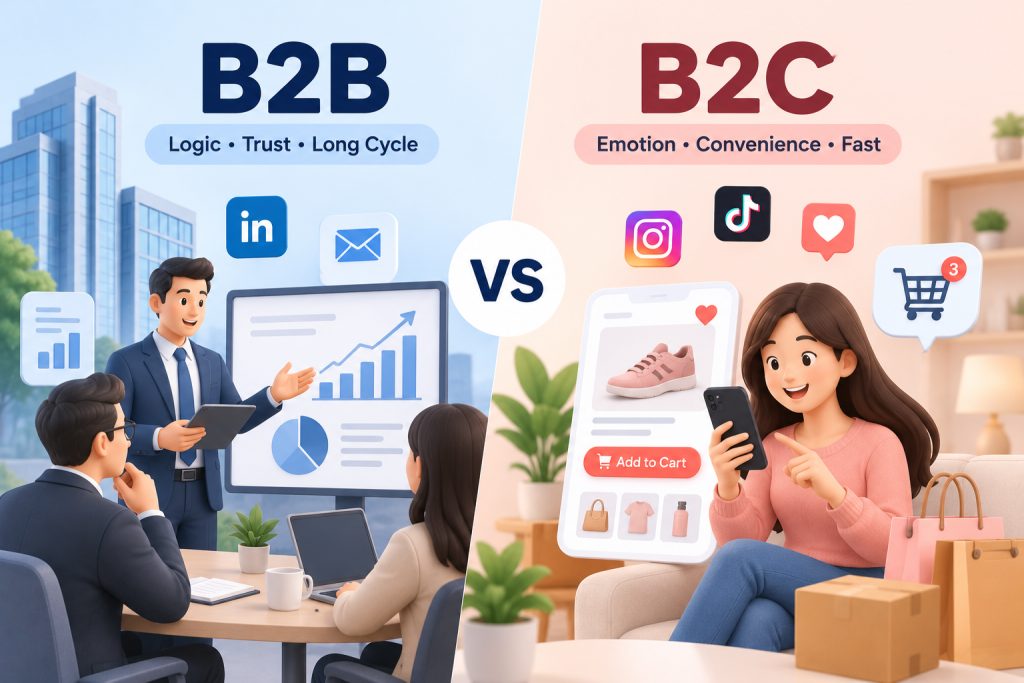
B2B buyers need to justify a decision to their company, so content leads with value, ROI, case studies, and expertise. Trust and credibility win. B2C buyers decide for themselves, often quickly, so messaging leads with benefits, emotion, and lifestyle. Desire and convenience win. Both need clarity and trust; they just weight logic and emotion differently.
Channels that work best
- B2B: LinkedIn, SEO and content marketing, email nurturing, webinars, and account-based marketing. See B2B digital marketing.
- B2C: Instagram, TikTok, and Facebook, influencers, paid social and search, and video. See social media marketing. Many channels overlap (both use SEO, email, and paid ads); the strategy and tone differ.
The sales cycle
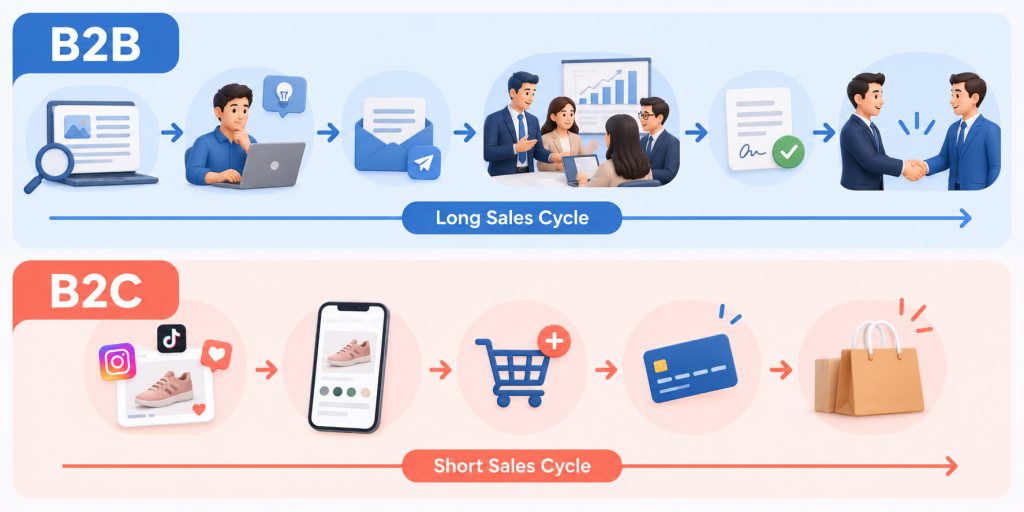
B2B cycles are long: prospects research, compare, and involve several stakeholders, so marketing nurtures over time with content and email. B2C cycles are short: a shopper can see an ad and buy the same day, so marketing focuses on quick, compelling paths to purchase.
Which approach do you need?
If you sell to businesses, lead with expertise, proof, and nurturing over a longer cycle. If you sell to consumers, lead with emotion, benefits, and a fast, frictionless path to buy. Many businesses do both (D2C plus wholesale) and run two tailored strategies.
Frequently asked questions
What is the difference between B2B and B2C digital marketing?
B2B targets businesses with logic-driven messaging and long sales cycles; B2C targets consumers with emotion-driven messaging and short cycles. The audience, channels, and tone differ.
Which channels are best for B2B?
LinkedIn, SEO and content, email nurturing, webinars, and account-based marketing.
Which channels are best for B2C?
Social media, influencers, paid social and search, and video.
Is SEO useful for both B2B and B2C?
Yes. Both benefit from SEO; the keywords and content intent differ (research and comparison terms for B2B, product and lifestyle terms for B2C).
Can a business do both B2B and B2C?
Yes, many do. It usually means running two distinct strategies with different messaging and channels for each audience.
The bottom line
B2B and B2C digital marketing use the same toolkit for different people. B2B nurtures business decision-makers with logic, proof, and patience; B2C wins consumers with emotion, benefits, and speed. Know which one you are (or run both properly), and shape your channels and message around your actual buyer.
Want a digital marketing strategy built for your audience? Talk to MediaPlus Digital about digital marketing, and claim a free RM300 consultation.