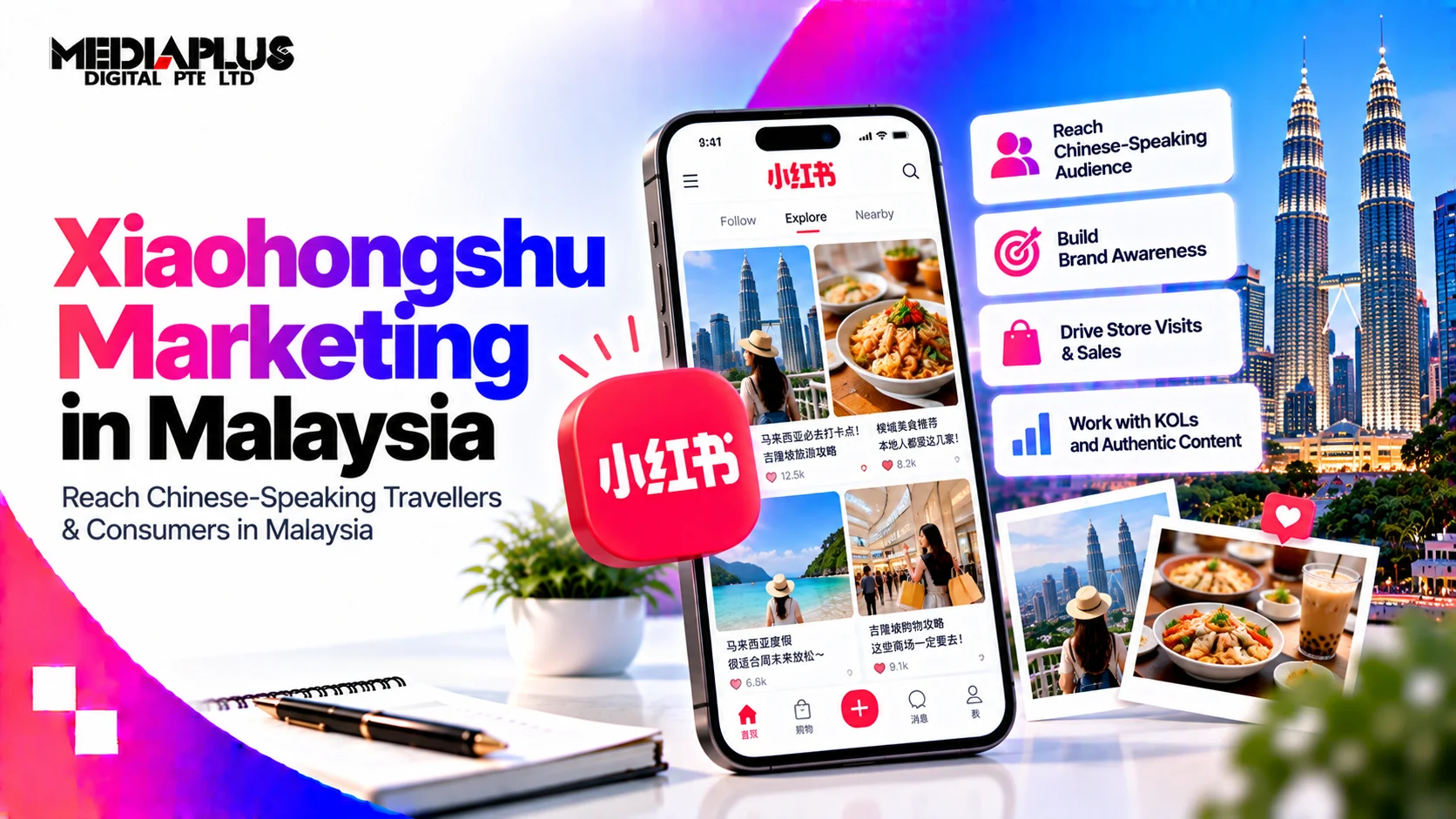
Quick answer: Xiaohongshu is a search-and-review platform before it is a social feed, and in Malaysia it reaches a specific slice of the market: Mandarin-reading, mostly female, mostly urban, mostly under 35. Published figures for the Malaysian base disagree. The Star reported more than 2.5 million Malaysian users in December 2024, citing platform data from February 2023, while Marketing-Interactive put Malaysia and Singapore together at 4.3 million in June 2025. Nobody publishes an audited current number, so plan against the shape of the audience rather than its size. There is no English-language self-serve advertising portal for Malaysian businesses: the official ad platform, Juguang, renders in Simplified Chinese only. In practice a Malaysian company reaches the platform through its own Chinese-language account, through paid notes by local creators, or through an agency holding a cross-border ad account. If your product is not visual, not researched before purchase, and not interesting to a Chinese-speaking buyer, this is the wrong platform and no budget fixes that.
New to the platform? Start with our explainer on what Xiaohongshu is. This page is about whether to spend on it here.
How many Malaysians are on Xiaohongshu? The figures do not agree
This is the first thing every client asks, and the first place most agency decks quietly invent a number.
The 2.5 million figure is the most quotable one for Malaysia, but it describes February 2023 and was published almost two years later, so treat it as a floor rather than a current count. The 4.3 million figure is more recent but covers two countries, and anyone who tells you “about 3 million in Malaysia” has split it by guesswork without saying so. Silver Mouse carries both 1.5 million and 2.5 million without reconciling them, which tells you how loosely these numbers circulate.
The shape is not disputed. The Star’s framing is the useful one: 2.5 million registered users would be roughly 36.7 percent of Malaysia’s ethnic Chinese population of 6.8 million. This is not a mass-market platform the way TikTok is, where measured reach is 30.7 million adults. For the full comparison, see our breakdown of social media platforms in Malaysia.
Who the Malaysian audience actually is
The demographic picture is more consistent than the user count, which makes it more useful. Marketing-Interactive’s June 2025 piece reports 63 percent of Malaysian users aged 16 to 34, majority female, predominantly Chinese and single. Universiti Tunku Abdul Rahman research cited by The Star in December 2024 describes the base as predominantly young women aged 18 to 35, and Silver Mouse’s figure of over 80 percent female aged 20 to 35 points the same way.
The planning profile is narrow and clear:
- Chinese Malaysian, reading and searching in Mandarin
- Female skew strong enough that male-targeted categories are an uphill fight
- Age roughly 18 to 35, concentrated in Klang Valley, Penang, Johor Bahru and Kuching
- Single or early-household, with discretionary spend
- In research mode, not browsing mode
That last point changes strategy. The Star quoted a Malaysian student, Emily Ng: “The reviews feel genuine. I trust it more than what I see on Instagram ads.” Deserved or not, that trust is why people open the app. They are looking something up.
The language requirement, and why it decides everything
The majority of content on the platform is in Chinese. Marketing-Interactive names this as the thing that alienates non-Chinese speakers and keeps the audience small next to mainstream platforms.
For a Malaysian brand this is a staffing decision, not a translation task.
English posting is possible and will reach some users, but it fights the platform’s search behaviour. People search in Chinese, the notes that surface are in Chinese, and your note competes against native-language notes written by daily users. English-only posting here is technically visible and practically invisible.
In practice:
- You need someone who writes Simplified Chinese natively and reads the platform’s conventions, not someone who translates your English captions
- Comment replies also have to be in Chinese, and reply speed matters because comments are where purchase questions land
- Your product names, ingredients, sizes and prices need Chinese equivalents that match how buyers search, not literal translations
- Bahasa Malaysia has almost no role on this platform, which is the opposite of your Facebook strategy
If you cannot staff Chinese-language content and moderation, either through a hire, a freelancer or an agency, stop here. The platform will not work for you, and the honest recommendation is to put that budget into Instagram advertising in Malaysia or TikTok marketing in Malaysia where you can operate in languages you actually have.
How notes and search work on the platform
Content on Xiaohongshu is posted as “notes”: an image carousel or short video with a text body, hashtags and a comment thread. Notes behave less like feed posts and more like answers.
The mechanics worth understanding before you brief anyone:
- Search is the main distribution channel. Users type a category plus a city, a brand plus “review”, or a problem plus “recommendation”, and matching notes keep surfacing for months. A note is closer to a blog post with a shelf life than to a story that disappears.
- The title and first line carry the keyword. Notes that rank name the query plainly. This is keyword work, and it rewards the same discipline as search optimisation on your site.
- The cover image is the click decision. Text on the cover is normal and expected here, the opposite of good practice on Instagram. A cover with a readable claim outperforms a clean lifestyle shot.
- Comments are part of the content. Buyers read the thread for the objections and your answers. An unanswered “how much” under a six-month-old note is lost revenue.
- Saves matter more than likes. A saved note is one someone intends to act on.
- Clusters compound. A run of twelve related notes often works where one-off posting never does.
That pattern is search behaviour inside an app. The planning approach we use for social media marketing in Malaysia applies, but the format is dictated by the platform rather than by your brand guidelines.
KOC content beats polished brand advertising here
Marketing-Interactive’s recommendation is blunt: work with KOCs, meaning ordinary users, because the platform runs on peer-to-peer validation rather than paid influencer reach.
The distinction matters commercially.
The content that works reads as a real person’s honest account, including the thing they did not like. A note that praises everything is read as an ad and ignored. Our page on user-generated content covers the production side.
Two Malaysian specifics. Disclosure applies: Malaysian rules on identifying paid content do not stop at the border of a Chinese app, and the platform has its own rules on undisclosed commercial notes. And do not re-use Instagram creative, because the aspect ratio, cover-text convention and tone are all different.
What a Malaysian company needs to set up an account
A brand presence starts with a verified business account, which the platform calls 专业号. The requirements for a Malaysian entity, as described by agency sources and not by any English-language official documentation we could find:
- A business registration document. BWB Agency’s Juguang guide of 13 October 2026 states a Chinese business licence is not required and a foreign one can be used. We could not confirm this against official documentation in English.
- Certified Chinese translation of that document where it is not already in Chinese
- A trademark registration certificate, Chinese or international, for brand-name verification
- Passport or identity document of the responsible person, plus an authorisation letter
- A Chinese mobile number for verification, the step that catches most Malaysian applicants out
- A verification fee, reported by third-party agencies at around USD 300 for international entities as at 2026
Budget weeks, not days: this is a documentation exercise in Chinese, not a ten-minute sign-up.
Can a Malaysian business buy ads? The honest answer
We checked the official ad platform on 15 October 2026. Juguang, at ad.xiaohongshu.com, serves a page titled 小红书聚光 with no English interface and no English onboarding path. There is no English-language self-serve advertising portal for Malaysian advertisers.
Beyond that, the public sources contradict each other and we are not going to pretend otherwise. Zenweb states Juguang verifies advertisers against China business registration and bills in yuan, and that an SSM-registered company reaches it through a cross-border agency account, a China entity, or paid creator notes. BWB Agency, in October 2026, states a foreign business licence is sufficient for a verified brand account, while noting that paid advertising, the in-app store and payment processing require a registered business in China.
The consistent part: an unverified Malaysian SME cannot simply enter a card and start a campaign. Three routes are available:
We are not quoting platform ad costs, because the figures circulating in Malaysian guides are agency planning estimates rather than published rate cards. For budgeting a social programme overall, see social media marketing cost in Malaysia.
Honest fit: which Malaysian categories work and which do not
This is the section most Xiaohongshu articles leave out, because it costs the writer a sale.
Where it works
Marketing-Interactive’s June 2025 piece names the high-engagement categories for Malaysia and Singapore as beauty, personal care and fashion; travel and tech; indulgences such as snacks, ice cream and alcohol; and experiential occasions such as concert tickets, spa days and trips. On top of that, from what we see in Malaysian search behaviour on the platform: skincare and aesthetics clinics; fashion, accessories and jewellery; cafes and dessert shops; travel, hotels and staycations, the use case The Star’s December 2024 article was built around; interiors and renovation; baby and children’s products; confinement and postnatal care; education and overseas study consultancy; and property, specifically show units.
Where it does not
- B2B and industrial. Your buyer is not researching bearings on a lifestyle app, and our page on LinkedIn advertising in Malaysia is the better answer.
- Anything aimed primarily at Malay or Indian Malaysian consumers. The audience composition makes it a poor use of budget.
- Low-consideration, price-led purchases. If nobody researches it, notes do not help.
- Regulated categories where you cannot control the claim. Malaysian health and medical advertising approval requirements will not be satisfied by a Chinese-language creator note.
- Services sold on proximity alone. Local search and Google Business Profile serve you better.
- Brands with no Chinese-language capability. The most common disqualifier.
A realistic first 90 days
If the fit section did not rule you out, this is the sequence we would actually run.
Weeks 1 to 3: setup and listening
- Gather the verification documents and start the account application
- Have your Chinese-language writer search your category in the app and record the queries people use and the notes that rank
- Build a list of 20 to 30 real Chinese queries your buyer would type
- Identify 15 to 25 Malaysian KOCs with engaged comment threads, not just followers
Weeks 4 to 8: publish and seed
- Publish 12 to 16 of your own notes mapped one to one against those queries
- Brief and seed 8 to 12 KOC notes, product plus modest fee, disclosure required
- Answer every comment within 24 hours, in Chinese
Weeks 9 to 12: read the result
- Review saves, search impressions, comments and enquiries, keep what earned saves, kill the rest
- Decide whether to add paid reach through a cross-border account or stay organic
- If nothing has earned saves by week 12 with Chinese content properly executed, the category is not there and the right call is to stop
What to measure, and what to ignore
The platform hands a Malaysian advertiser no clean conversion tracking, so you will have to ask. Add “Xiaohongshu” to the enquiry source field on your contact form. Our note on social media versus your website explains why the destination still has to do the converting.
The five mistakes that waste the budget
- Translating English captions. Reads as foreign, ranks for nothing.
- Posting weekly and expecting compounding. Clusters work, single notes do not.
- One large KOL instead of twenty KOCs. One expensive note is one roll of the dice.
- Leaving comments unanswered. The thread is the sales conversation.
- Judging it on followers in month two. Search-led platforms pay out slowly, then keep paying.
Frequently asked questions
How many Malaysians use Xiaohongshu in 2026?
No audited current figure is published. The Star reported more than 2.5 million Malaysian users on 8 December 2024, citing platform data as of February 2023, and called Malaysia the second largest market outside China after Taiwan. Marketing-Interactive reported 4.3 million across Malaysia and Singapore combined on 20 June 2025, and Silver Mouse has cited 1.5 million. The figures are not reconcilable, so we present each as what its source says. For planning, the base is in the low millions at most and sits inside one language community, which makes it a targeted channel rather than a mass one.
Can a Malaysian company advertise on Xiaohongshu without a China entity?
Not through a self-serve English portal, because none exists: we checked ad.xiaohongshu.com on 15 October 2026 and Juguang renders in Simplified Chinese only. Sources disagree on entity requirements, with Zenweb saying Juguang verifies against China business registration and bills in yuan, and BWB Agency saying a foreign business licence suffices for a verified brand account. Not in dispute: paid creator notes, billed in ringgit directly to Malaysian creators, need no China entity. That is why most Malaysian brands start there.
Do we have to post in Chinese?
In practice, yes. Marketing-Interactive notes the majority of platform content is in Chinese, which is what keeps non-Chinese-speaking users away. Search happens in Chinese, so English notes compete poorly. If you cannot staff Chinese-language writing and comment moderation, the platform is not a fit and the budget belongs elsewhere.
Is Xiaohongshu bigger than TikTok in Malaysia?
No, and not close. TikTok’s measured advertising reach in Malaysia is 30.7 million adults aged 18 and above, per DataReportal’s Digital 2026: Malaysia report, published 8 November 2025 with data collected October 2025. The highest published Malaysian figure for Xiaohongshu is in the low millions. The case for Xiaohongshu is audience quality and purchase intent, not size.
What does it cost to get started?
We do not publish platform rate cards, because the figures circulating are agency estimates rather than published rates. Plan for three things: the verification fee, reported by third-party agencies at around USD 300 for international entities as at 2026; a Chinese-language content resource; and whatever you pay creators per note. The content resource is the real cost, and it is ongoing.
How long before it works?
Expect three months before you can read the result honestly, and six before notes compound through search. Notes keep surfacing long after publication, which is the attraction, but it also means early months look flat. If you need leads next month, run social media advertising on Meta or TikTok and treat Xiaohongshu as the slower build alongside it.
Should we sell in-app?
Most Malaysian brands cannot, because agency sources consistently tie in-app store access and payment processing to a registered business in China. For Malaysian selling, drive to your own site or WhatsApp. If in-app commerce is the goal, read our page on social commerce and weigh the effort against selling on TikTok in Malaysia, which is open to Malaysian sellers today.
How do we pick an agency for this?
Ask three questions. Who writes the Chinese, and can you meet them. How many Malaysian KOC relationships do they hold, by name and category. Do they hold a cross-border ad account or resell someone else’s. An agency that cannot answer the first is subcontracting the only part that matters. Our guide on how to choose a social media agency in Malaysia covers the rest.
The bottom line
Xiaohongshu in Malaysia is a precise instrument, not a broad one. It reaches a Mandarin-reading, mostly young, mostly female, mostly urban audience that arrives in research mode and trusts what it reads there. For beauty, food, travel, interiors, education and family categories aimed at that buyer, it can produce enquiries that cost less and convert better than paid social. For everyone else, including most B2B and anything aimed primarily at Malay or Indian Malaysian consumers, it is a distraction with an expensive setup bill.
The decision comes down to one question that has nothing to do with the platform: can you produce and maintain Chinese-language content, properly, every week, for at least six months. If yes, the audience is there. If no, spend the money where you can execute.
For a straight answer on whether your category has demand, we will look at the actual Malaysian search behaviour and tell you either way. Our social media advertising team in Malaysia can scope it alongside your Meta and TikTok activity. Get in touch and ask for a free social audit, and we will include a Xiaohongshu fit assessment.