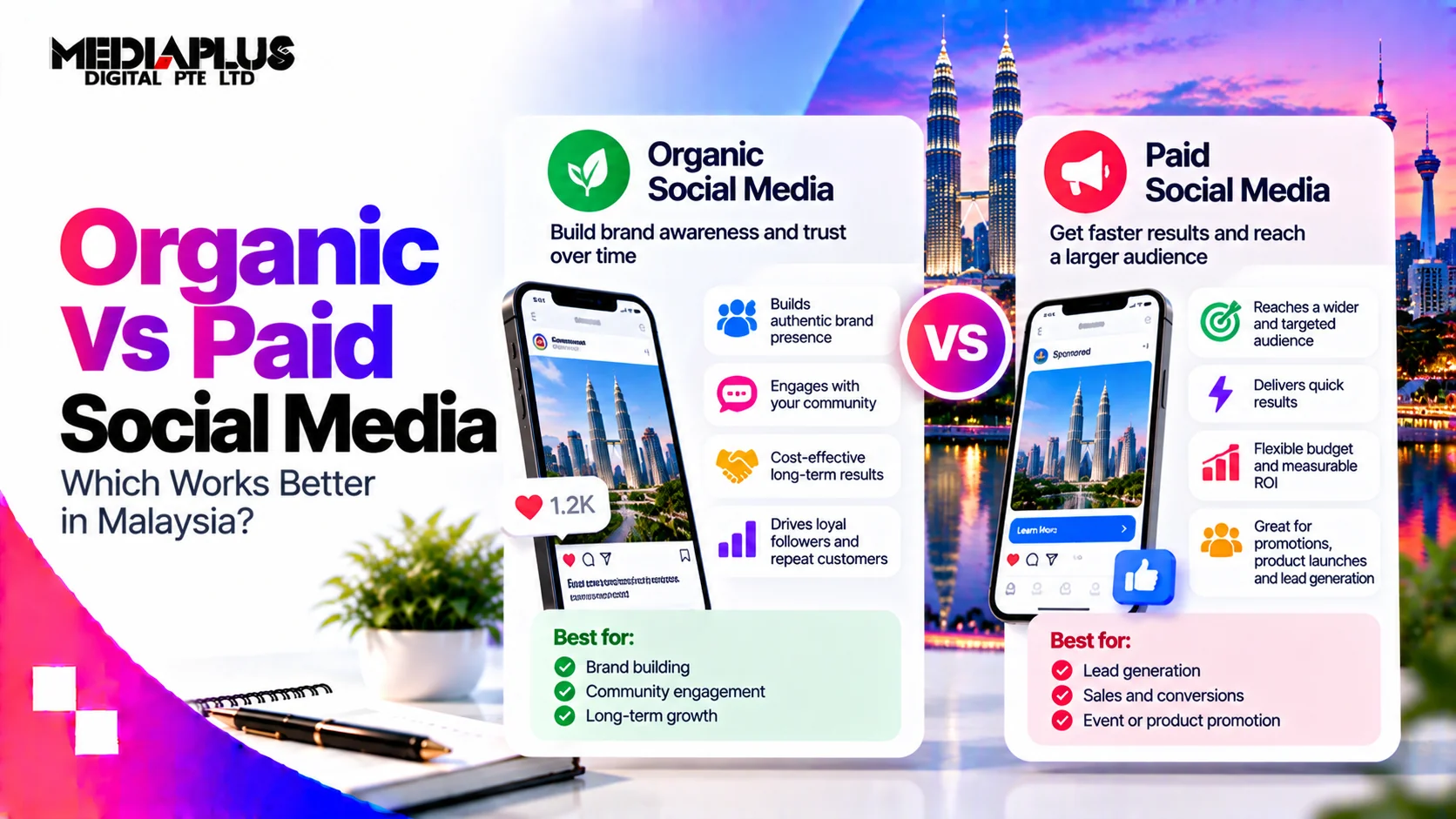
Quick answer: This is not a question of which one is better. Organic social buys you proof, trust and content you own, paid social buys you reach and timing, and in Malaysia neither works properly without the other. Organic is cheap in money and expensive in time, usually 20 to 40 hours a month for one platform done properly. Paid is the opposite: it works in days rather than months, but the cost never stops. Organic reach on the big Malaysian platforms is now low single digits as a share of followers, so if your plan depends on a post reaching your audience for free, it will not. Treat organic as the thing that makes paid cheaper, and paid as the thing that makes organic visible. The split that works for most Malaysian SMEs is roughly 30 percent of effort on organic and 70 percent of budget on paid once you have something proven to promote.
Stop asking which is better
Organic and paid do different jobs and fail in different ways.
Organic social is content you publish without paying for distribution. It compounds, it builds proof a buyer can scroll through, and it costs staff time rather than media spend. It cannot be switched on: if you need enquiries this month, organic will not deliver them.
Paid social is distribution you buy. It reaches people who have never heard of you, it can be targeted and measured, and it stops the day you stop paying. It cannot build credibility on its own, and Malaysian buyers do check the account before enquiring.
The failure modes are worth naming, because most clients arrive with one:
- Posting daily for a year, no budget, wondering why there are no leads
- Spending RM5,000 a month on Meta ads with a page that last posted in 2024
- Running both, with no idea which one produced the enquiries
What each actually costs
Money
Organic looks free and is not. The costs are real, they are just on the payroll line rather than the media line.
For the auction side, the ranges on our Facebook ads cost in Malaysia page give you planning numbers: CPM roughly RM8 to RM25, cost per click RM0.40 to RM3.00, cost per lead RM8 to RM80 and above by category. Around RM1,500 a month is the practical floor for the algorithm to gather useful data on one platform. Below that you are paying to learn nothing. For fee structures, see social media marketing cost in Malaysia.
Time
This is the cost nobody budgets, and it is the reason most Malaysian organic programmes quietly die around month four. These are our planning figures for one platform run properly, not published research.
Paid takes roughly 8 to 15 hours a month per platform once the account is built: creative refresh, audience testing, budget shifts, reporting. Less time, more money. That trade is the whole decision.
A second platform does not double the organic hours, but it does not stay flat either. Expect another 60 percent unless you are genuinely reusing the same vertical video, which most brands claim and few do.
How long each takes to work
The practical consequence: paid is the right answer to a revenue problem this quarter, and organic is the right answer to a cost-per-acquisition problem next year. Businesses that need both, which is most of them, have to fund both.
What organic reach actually looks like on each Malaysian platform
Separate two things. Audience size is published and verifiable. Organic reach as a share of that audience is not, at least not for Malaysia, so we have been explicit about which is which.
The audience figures are from DataReportal’s Digital 2026: Malaysia report by Simon Kemp, published 8 November 2025 with data collected October 2025. They are advertising reach as reported by each platform’s own ad tools, and they match our social media platforms in Malaysia page.
The engagement benchmarks are from Socialinsider’s 2026 Social Media Benchmarks, published 16 January 2026 from 70 million posts covering January 2024 to December 2025. They are global brand averages, not Malaysian, because no Malaysian equivalent is published. The organic reach column is our planning range, an agency estimate.
The pattern across that table: organic reach is a function of platform age and video. Newer platforms and video formats still give content away. Mature feed platforms do not. If your organic plan is static posts on Facebook, you are planning for an audience that is not being shown your posts.
Where paid is the only sensible option
Some jobs organic cannot do, at any volume of posting.
- A launch date. A new outlet, a product drop, a Raya or year-end promotion. Organic reach cannot be scheduled.
- Reaching strangers. Organic reaches your followers and, on video platforms, a slice of strangers you cannot choose. Paid reaches a defined audience on demand.
- Retargeting. Someone viewed a product and left. There is no organic mechanism to reach them again, and this is usually the highest-return paid activity a Malaysian ecommerce business runs.
- Testing a message quickly. Four headlines against a defined audience answers in a week. Organic would take a quarter and the result would be confounded.
- Geographic precision. A clinic in Johor Bahru or a showroom in Penang needs a radius, not a national feed.
- Form fills and lead volume. Instant forms on Meta and TikTok have no organic equivalent.
- A dead account. With 400 followers, organic has no audience to reach. Paid is the only way to start, and that is fine. Build the content while the ads run.
Where to run it depends on the audience: Facebook ads for breadth and lead forms, Instagram ads for visual categories under 35, TikTok ads for volume and commerce, and LinkedIn ads for B2B.
How the two feed each other
This is the part that justifies running both, and it is mostly ignored.
- Organic is your creative testing lab. Post ten pieces, see which three earn saves and comments, then put budget behind those. On TikTok this is formalised through Spark Ads, which run your organic post as an ad and keep the engagement signals attached.
- Paid fills the organic funnel. Ad viewers who follow your account become an audience you no longer pay to reach.
- Organic is the trust check before the enquiry. A buyer who clicks your ad will open your profile and your website, and both have to look alive. Our note on social media versus your website covers the destination side.
- Organic comments are your ad copy. The objection raised in a comment is the one to answer in the next ad.
- Paid data sharpens organic. Campaign audience insights tell you which age bands and placements respond, which organic analytics will not.
- Organic lowers paid costs over time. Creative gets better when you have ten months of organic signal telling you what lands. Judge it on return on ad spend rather than reach.
The sequence we recommend: build enough organic content to look credible, run paid to generate enquiries now, feed the organic winners into paid, feed the paid learnings into organic.
Budget split by business stage
Percentages are of total social media effort, where organic is measured in staff hours costed honestly and paid includes both media spend and management.
Two rules that override the table. Never run paid on a platform where your account looks abandoned, because you are paying to send people somewhere that damages you. And never run organic only because the budget is tight, because 30 hours of staff time a month is more expensive than RM1,500 of ad spend, it just does not arrive as an invoice.
When to stop posting organically on a platform
Giving up on a platform is a legitimate decision, and holding on to five dying accounts is worse than running two well. The signals that it is time:
- Six months of consistent posting at a real cadence, twelve or more posts a month, with no growth in reach or engagement
- Reach falling while your posting quality and frequency hold steady
- Engagement that comes only from staff, suppliers and bots
- The audience data shows your buyer is not there. X at 4.81 million and shrinking is the clearest Malaysian example
- Comments and messages arriving but never converting, which means the platform’s audience is browsing, not buying
- The time cost exceeds what the same hours would earn on another platform or on your website
Before you quit, check three things. Is the content format right for the platform, meaning vertical video where the platform rewards video. Is the cadence real, because four posts a month is not a test. Have you ever answered the comments.
If all three are yes and the numbers are still flat, stop. Leave the account up with a pinned post, correct contact details and a link, so it still serves anyone who searches for you, and move the hours. A dormant but tidy profile costs nothing. A neglected active one costs trust.
A short decision checklist
Answer these before you set the split.
- Do you need enquiries within 60 days? If yes, paid is not optional.
- Can you sustain 25 or more hours a month on content for at least six months? If no, do not plan an organic-led strategy.
- Does your category get researched before purchase? If yes, organic proof matters more.
- Can you produce short vertical video? If no, your organic reach ceiling is low on every platform that matters.
- Is your audience findable by paid targeting? Narrow B2B and Chinese-speaking segments are harder.
- Do you have at least RM1,500 a month of media spend for one platform? Below that, test rather than run.
- Is your website or WhatsApp ready to convert the traffic? If not, fix that before either.
- Can you tell which channel produced each enquiry? If not, you will not learn anything from either.
Frequently asked questions
Is organic social media dead in Malaysia?
No, but free distribution on mature feed platforms largely is. Socialinsider’s 2026 benchmarks, published 16 January 2026, put global engagement rate per follower at 0.15 percent on Facebook and 0.48 percent on Instagram. TikTok at 2.60 percent still gives content away, and YouTube search keeps paying out for years. So organic is alive on video and search platforms and close to dead on static feed posts. The job organic does has shifted from reach to proof.
What is a realistic budget split for a Malaysian SME?
For an established SME that needs leads, roughly 30 percent of effort on organic and 70 percent of budget on paid. Pre-launch flips it, because you need content before you have anything worth promoting. B2B flips it too, because LinkedIn organic from real profiles outperforms most paid B2B activity in Malaysia. Cost the organic hours honestly or the split is fiction.
How much should I spend on paid social to start?
Around RM1,500 a month in media spend on one platform is the practical floor for the algorithm to gather useful data, as set out on our Facebook ads cost in Malaysia page. Split across three platforms, the same amount teaches you nothing. Pick one, run it for three months, then add another.
Which platform gives the best organic reach in Malaysia?
TikTok, on measured audience and on how readily it shows content to non-followers. DataReportal’s Digital 2026: Malaysia report puts TikTok’s Malaysian advertising reach at 30.7 million adults aged 18 and above, the largest of any platform. The caution in that same data is volatility: Malaysian reach fell 4.3 percent between July and October 2025 even while growing 7.4 percent over the year. For B2B, LinkedIn organic from personal profiles beats everything else.
Do I need to post organically if I am running ads?
Yes, and this is the mistake we see most. Malaysian buyers click an ad, then check the account and the website. A page whose last post is two years old reads as a closed business. You do not need daily posting. You need enough recent, real content that the profile passes inspection, which is usually four to eight posts a month.
Can organic social replace paid entirely?
Only in narrow cases: a strong personal brand, a creator-led business, or a B2B founder posting consistently on LinkedIn. For a retailer, a clinic, a restaurant or anything with a launch date, no. The reach is not controllable and the timing is not yours.
How do I tell which one is actually working?
Ask every enquiry where they found you and record it, because platform attribution will not do this for you honestly. Then compare cost per qualified enquiry, counting staff hours on the organic side at a real hourly rate. Most Malaysian businesses discover paid is cheaper per enquiry in month three and organic is cheaper by month twelve.
Should I pay to boost my organic posts?
Boosting is the weakest form of paid social, because it optimises for engagement rather than a business outcome. Promote a proven organic post properly through the ads manager with a conversion objective instead. On TikTok, use Spark Ads so the organic engagement signals carry over. Our guide on TikTok marketing in Malaysia covers that mechanic.
The bottom line
Organic buys proof and costs time. Paid buys reach and costs money, continuously. The Malaysian audience data says the platforms worth your attention are TikTok, YouTube, Facebook and Instagram for consumer businesses and LinkedIn for B2B, and the engagement benchmarks say free distribution on mature feeds is close to gone.
So run both, but for different reasons. Organic exists to make your brand credible and to find out which creative works. Paid exists to put that creative in front of people on a schedule you control. For most Malaysian SMEs that means about 30 percent of effort on organic and 70 percent of budget on paid, with the balance shifting towards organic if you are B2B or pre-launch, and towards paid if you are scaling ecommerce.
If you are not sure where your own split should sit, we will look at your current accounts, your category and your Malaysian audience data, and give you a number with the reasoning behind it. Our social media advertising team in Malaysia runs the paid side, and we will tell you plainly if your organic foundation needs fixing first. Get in touch for a free social audit. If you are still choosing a partner, our guide on how to choose a social media agency in Malaysia sets out what to ask.