A growing share of your buyers now ask ChatGPT, Google AI Overviews, Perplexity or Gemini before they ever open your website. If those systems cannot read your pages, understand who you are, or trust your answers, you simply do not appear in the reply. An AI friendly website is one built so machines can crawl it, extract clean answers from it, and cite it with confidence. This guide shows the exact build, from HTML and schema down to your robots.txt and a sample llms.txt.
What “AI friendly” actually means in 2026
Traditional SEO asks one question: will this page rank in a list of blue links? AI friendly design asks a harder one: can an answer engine lift a correct, self-contained statement from this page and attribute it to your brand? The two overlap, but they are not the same job.
Three shifts make this urgent for businesses right now:
- Zero-click answers. Google AI Overviews and AI Mode answer the question on the results page. If your content is the source behind that answer, you win visibility and a citation. If not, the click never happens and the position 3 ranking you fought for earns nothing.
- Conversational discovery. A buyer in Kuala Lumpur asks ChatGPT “which POS system works for a mamak franchise with SST invoicing?” The model names a handful of vendors. Being one of those named vendors is the new page one.
- Answer engines read differently from humans. They do not scroll, admire your hero animation, or click your accordion. They parse structure. Clean structure gets extracted. Messy structure gets skipped.
This is the discipline we cover in depth under Generative Engine Optimisation and Answer Engine Optimisation. If you want the strategic difference spelled out, our GEO vs SEO breakdown covers where they diverge.
How AI crawlers and answer engines actually consume a page
There are two separate jobs happening, run by two separate types of bot, and confusing them is the most expensive mistake we see.
- Training crawlers (GPTBot, Google-Extended, ClaudeBot, CCBot, Applebot-Extended) fetch your content to help train or ground the underlying model. This shapes what the model “knows” about you in general.
- Search / retrieval crawlers (OAI-SearchBot and ChatGPT-User for OpenAI, PerplexityBot, Claude-SearchBot, Googlebot for AI Overviews) fetch pages at query time to build a live, cited answer. This is what puts a clickable link to your site inside the response.
The critical technical fact: most of these crawlers read raw HTML and do not execute JavaScript. Content that only appears after a client-side render, sits inside a tab or accordion that loads on click, or is injected by a script, is frequently invisible to them. If your React or heavily scripted site shows an almost empty page when JavaScript is disabled, an answer engine sees that empty page too. Server-side rendering or static HTML for your core content is not optional here.
Traditional SEO signal vs AI-friendly signal
Everything you already do for SEO still counts. AI friendliness adds a layer on top of it. This table shows where the emphasis shifts.
|
Goal |
Traditional SEO signal |
AI-friendly signal |
|
Getting found |
Keyword in title, backlinks, rankings |
Entity clarity, brand mentions across the web (linked and unlinked) |
|
Content shape |
Long, comprehensive page that keeps users scrolling |
Self-contained answers, one idea per section, direct answer first |
|
Structure |
H1/H2 for readability and snippets |
H1/H2/H3 as a machine-readable outline; definitions, lists, tables |
|
Trust |
Domain authority, review stars |
Named authors, citations, first-hand experience, consistent facts |
|
Access |
Allow Googlebot, submit sitemap |
Decide access per AI bot; consider an llms.txt |
|
Rendering |
Google renders JavaScript (mostly) |
Assume no JavaScript; ship content in raw HTML |
|
Winning |
Rank in the ten blue links |
Be the cited source inside the generated answer |
On-page structure that gets extracted
This is where most of your wins live, and it is fully within your control. Write and mark up every important page so a machine can lift a clean answer without guessing.
Lead with the answer (BLUF)
Put the direct answer in the first 40 to 80 words under a heading, then expand. Answer engines favour “bottom line up front” writing because they can quote it whole. Compare these two openings for a question like “What is SST in Malaysia?”:
- Weak: “There has been much discussion lately about how businesses handle tax, and in this article we will explore…”
- Strong: “SST (Sales and Service Tax) is Malaysia’s consumption tax, charged at 5% to 10% on sales and 8% on most taxable services as of 2026. It replaced GST in 2018.”
Use headings as real questions
Phrase H2s and H3s the way a person would ask them: “How much does a website cost in Malaysia?” rather than “Pricing”. The heading becomes the query match, and the paragraph directly beneath becomes the extractable answer.
Give definitions their own line
State the term, then define it plainly in one sentence, in the pattern “X is Y that does Z.” Models extract clean definitions extremely reliably.
Use lists and tables for anything comparative
Steps, specifications, pros and cons, pricing tiers, and comparisons should be real <ul>, <ol> and <table> markup, not sentences pretending to be lists. Structured elements are the easiest thing for an engine to reuse without distortion.
Keep sections self-contained
Each section should make sense if it is the only part quoted. Avoid “as we mentioned above” references that break when a section is lifted out of context. Our guide on how to get cited by AI goes deeper on these writing patterns.
Structured data that helps AI understand you
Honest framing first: Google has stated that no special schema is required for its generative features, and content that ranks well already tends to appear in AI Overviews. So treat schema as reinforcement, not a magic switch. That said, valid JSON-LD removes ambiguity about entities, relationships and facts, and it powers rich results that still matter. Prioritise these types:
- Organization (or LocalBusiness for a Malaysian storefront): your name, logo, sameAs links to social and directory profiles, address, and area served. This anchors your brand as a known entity.
- Article with a real author and datePublished / dateModified: ties content to a named expert.
- FAQPage: pairs questions with answers in a format built for extraction.
- HowTo: for step-by-step processes.
- Product with price, availability and reviews for ecommerce and service listings.
- BreadcrumbList: clarifies where a page sits in your site.
A minimal FAQ snippet looks like this:
<script type=”application/ld+json”>
{
“@context”: “https://schema.org”,
“@type”: “FAQPage”,
“mainEntity”: [{
“@type”: “Question”,
“name”: “What is an AI friendly website?”,
“acceptedAnswer”: {
“@type”: “Answer”,
“text”: “An AI friendly website is built so AI systems can crawl it,
understand it, and cite it: clean semantic HTML, structured data,
answer-first content, fast load times, and open access for AI
search crawlers.”
}
},{
“@type”: “Question”,
“name”: “Does an llms.txt file help my site get cited?”,
“acceptedAnswer”: {
“@type”: “Answer”,
“text”: “It may help some assistants find your key pages, but Google
has said it is not required. Treat it as a low-cost addition,
not a ranking factor.”
}
}]
}
</script>
Keep the visible page and the schema in agreement. Marking up an answer that is not on the page is a quality violation and erodes trust.
The llms.txt convention, with a sample
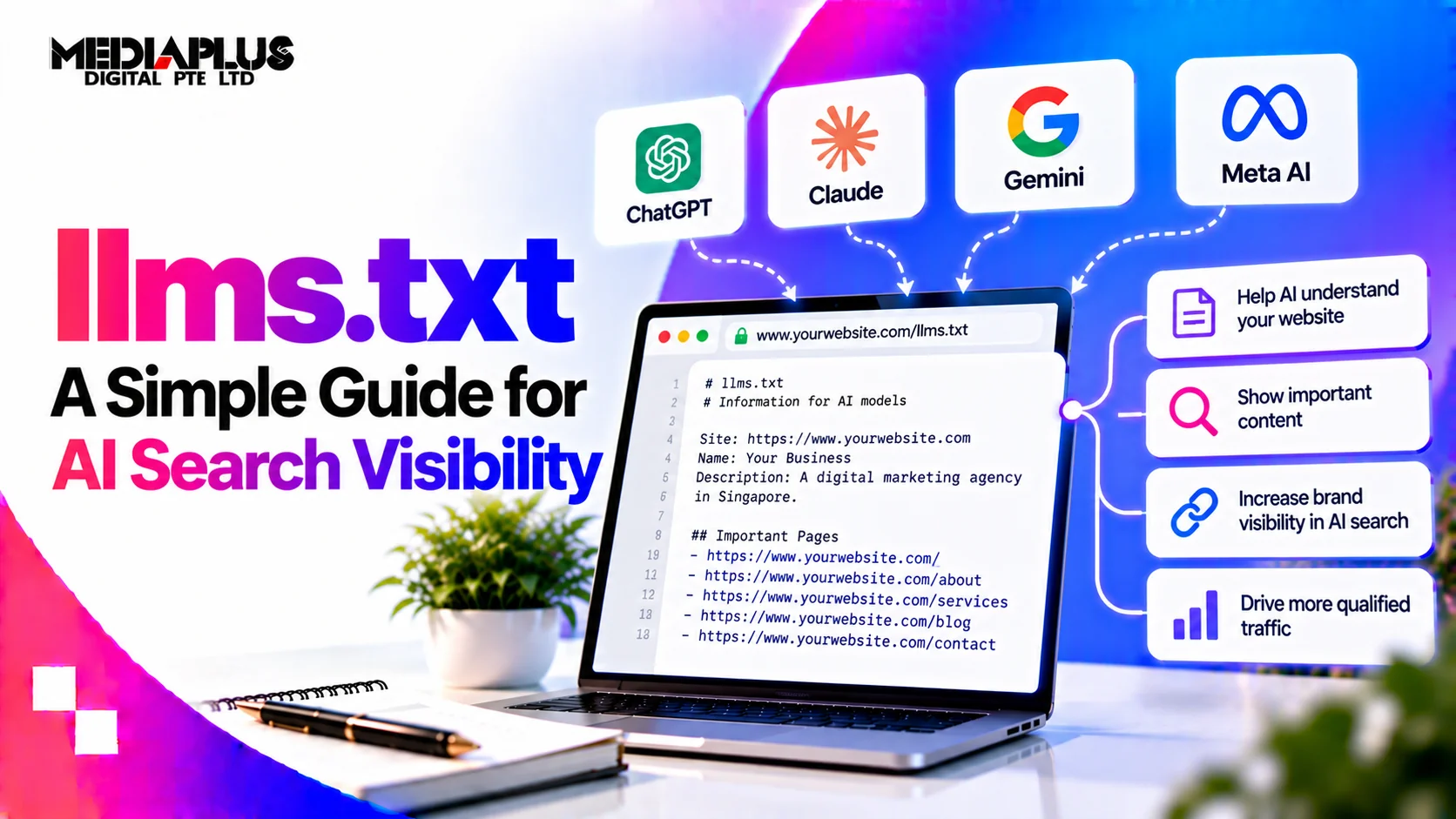
llms.txt is a proposed standard: a plain Markdown file at your domain root (yourdomain.com.my/llms.txt) that gives AI systems a clean, curated map of your most important pages, in priority order, without navigation clutter or scripts. Think of it as a sitemap written for a reader rather than a parser.
Set expectations honestly. Adoption is uneven and Google has publicly said it does not use llms.txt for AI Overviews or AI Mode. There is no confirmed evidence it changes how ChatGPT cites you. It costs almost nothing to publish, so we treat it as a sensible hygiene file, not a growth lever. Do not block real crawlers and expect this file to compensate.
A sample for a Malaysian agency:
# MediaPlus Digital Malaysia
> Web design, SEO and GEO agency based in Malaysia, helping local
> businesses get found in search and cited by AI answer engines.
## Core services
– [GEO services](https://mediaplusdigital.com.my/geo-services-malaysia/): Get cited by ChatGPT, AI Overviews and Perplexity.
– [SEO services](https://mediaplusdigital.com.my/seo-services-malaysia/): Rank in Google Malaysia.
– [Web design & development](https://mediaplusdigital.com.my/web-design-development-malaysia/): Fast, AI-readable websites.
## Key guides
– [What is GEO](https://mediaplusdigital.com.my/what-is-generative-engine-optimisation/)
– [Answer Engine Optimisation](https://mediaplusdigital.com.my/answer-engine-optimisation-aeo/)
– [How to get cited by AI](https://mediaplusdigital.com.my/how-to-get-cited-by-ai/)
## Contact
– Location: Malaysia
– Quote requests: https://mediaplusdigital.com.my/contact/
robots.txt and AI-bot access: the real decision
This is a business decision, not a default. Blocking a search crawler means no citation. Blocking a training crawler means the model learns nothing about you generally, but your live answers can still cite you if the search crawler is allowed. Decide deliberately.
|
Bot |
Run by |
Job |
Common choice |
|
OAI-SearchBot, ChatGPT-User |
OpenAI |
Live search & citations in ChatGPT |
Allow |
|
PerplexityBot |
Perplexity |
Live search & citations |
Allow |
|
Googlebot |
|
Search + AI Overviews |
Allow (never block) |
|
GPTBot |
OpenAI |
Model training |
Your call |
|
Google-Extended |
|
Gemini / Vertex training |
Your call (does not affect Search) |
|
ClaudeBot |
Anthropic |
Model training |
Your call |
|
CCBot |
Common Crawl |
Open dataset used by many models |
Block to limit broad training reuse |
For most Malaysian businesses that want maximum AI visibility, the sensible posture is: allow every search / retrieval crawler, and allow the major training crawlers too, since being in the models’ general knowledge helps you get named. A more protective posture, for publishers and original-research sites, allows search bots but blocks training and Common Crawl. Example of that protective robots.txt:
# Allow live AI search so you can be cited
User-agent: OAI-SearchBot
Allow: /
User-agent: ChatGPT-User
Allow: /
User-agent: PerplexityBot
Allow: /
# Block training crawlers
User-agent: GPTBot
Disallow: /
User-agent: Google-Extended
Disallow: /
User-agent: CCBot
Disallow: /
# Never block Google’s core crawler
User-agent: Googlebot
Allow: /
Sitemap: https://mediaplusdigital.com.my/sitemap.xml
The single most common failure. Sites get accidentally blocked at the CDN, not in robots.txt. Cloudflare and similar services now offer one-click AI bot blocking, and many Malaysian sites have it switched on without realising it kills every AI citation. Check your CDN’s bot-management settings, then confirm with your server logs that OAI-SearchBot and PerplexityBot actually reach your pages. robots.txt is only a polite request; real blocking happens at the server or CDN.
E-E-A-T and entity signals
Answer engines are cautious about who they quote. They lean toward sources that show experience, expertise, authoritativeness and trust. Make those signals machine-visible:
- Real, named authors with a bio, credentials and a linked profile, marked up as the author in Article schema. Anonymous content is easy to discount.
- First-hand experience. Original data, local case studies, real photos, specific numbers. Google explicitly favours content that shows in-depth experience over recycled summaries.
- Consistent facts across the web. Your name, address and phone (NAP) should match on your site, Google Business Profile, and Malaysian directories. Inconsistency confuses entity resolution.
- Citations and outbound links to authoritative sources. Fact density, with statistics and named references, correlates with being quoted.
- Unlinked brand mentions. Being talked about on Reddit, forums, industry sites and local media matters, even without a link. Our note on E-E-A-T and topical authority expands on building this.
Technical performance and clean HTML
A page that is slow or renders only via JavaScript is a page that gets skipped. The fundamentals:
- Ship core content in raw HTML. Server-side render or statically generate anything you want cited. Test by loading the page with JavaScript disabled; if the content vanishes, so does your AI visibility.
- Use semantic elements: <article>, <section>, <nav>, <h1> through <h3>, proper <table> and list tags. Semantics give machines the outline for free.
- One H1 per page, then a logical H2/H3 hierarchy. No skipped levels, no headings used just to make text bigger.
- Descriptive alt text on images and captions on data visuals, since multimodal models read them.
- Core Web Vitals in the green: LCP under 2.5 seconds, INP under 200 milliseconds, CLS under 0.1. Speed helps crawl budget and user experience together. Our Core Web Vitals guide has the fixes.
This is the same foundation behind SEO friendly web design, extended for machine reading. If you are planning a rebuild, our view on the future of web design with AI is worth a read first.
The Malaysia market angle
Competing in AI answers locally has its own moves:
- Local entity signals. A .com.my domain, a complete Google Business Profile, and listings on Malaysian directories all reinforce that you are a Malaysian entity serving Malaysian queries.
- Name local specifics. Reference SST, Ringgit pricing context, PDPA, state and city names (KL, Selangor, Penang, Johor Bahru), and local regulations. These concrete entities help a model match you to a Malaysian question.
- Language. If you serve Bahasa Malaysia speakers, publish genuine BM content, not just an auto-translated shell. Answer engines respond to real localisation.
- Local proof. Case studies with Malaysian clients and locally relevant numbers make you the obvious source when someone asks an answer engine for a recommendation “in Malaysia”.
Measuring AI visibility
You cannot manage what you do not watch. Track these:
- Referral traffic from AI sources in Google Analytics 4: filter for referrers like chatgpt.com, perplexity.ai and gemini.google.com. Our guide on tracking traffic from AI Overviews walks through the setup.
- Server log hits from AI crawlers. Confirm OAI-SearchBot, PerplexityBot and Googlebot are fetching, and check for accidental blocks.
- Prompt testing. Ask ChatGPT, Gemini, Perplexity and Google AI Mode the real questions your buyers ask, and record whether you appear and how you are described. Repeat monthly.
- AI citation trackers. Dedicated tools monitor brand mentions across assistants over time. Understand what surfaces you appear in via our note on Google AI Mode.
Common mistakes we see
- Content hidden behind JavaScript, tabs or accordions that never render in raw HTML.
- AI bots blocked at the CDN by accident, then wondering why citations never come.
- Treating llms.txt or a special schema as a shortcut while ignoring crawlability and content quality.
- Anonymous, source-free content that gives an engine no reason to trust it.
- Burying the answer under three paragraphs of throat-clearing intro.
- Schema that describes things not visible on the page.
- Chasing AI optimisation while neglecting the SEO fundamentals that AI answers still rest on.
Implementation checklist
- Core content renders in raw HTML with JavaScript disabled
- Semantic HTML: one H1, logical H2/H3, real lists and tables
- Every key page leads with a direct, self-contained answer
- Headings phrased as the questions buyers actually ask
- Definitions written as “X is Y that does Z”
- Comparisons and steps in genuine table and list markup
- JSON-LD: Organization/LocalBusiness, Article with named author, FAQPage, HowTo, Product, BreadcrumbList where relevant
- Schema matches the visible page exactly
- robots.txt reviewed: search/retrieval bots allowed, training bots decided deliberately
- CDN bot-blocking checked so AI search crawlers are not silently blocked
- Server logs confirm OAI-SearchBot, PerplexityBot and Googlebot are fetching
- llms.txt published as hygiene (with realistic expectations)
- Named authors with bios and credentials, plus first-hand experience and citations
- NAP consistent across site, Google Business Profile and Malaysian directories
- Core Web Vitals green: LCP < 2.5s, INP < 200ms, CLS < 0.1
- Local signals present: .com.my, SST/Ringgit/PDPA context, city names, BM content where relevant
- AI referral tracking and monthly prompt testing in place
Want your site cited by AI, not skipped?
MediaPlus Digital helps Malaysian businesses build websites that answer engines can read and trust. Start with our GEO services to earn AI citations, or our SEO services for the ranking foundation underneath them.
Free one-time website and SEO health-check worth RM300 for new enquiries: we audit your crawlability, AI-bot access, schema and Core Web Vitals, then show you exactly what to fix. Request a Quote.
Frequently asked questions
What is an AI friendly website?
An AI friendly website is built so AI systems can crawl it, understand it, and cite it. In practice that means clean semantic HTML, structured data, answer-first content, fast load times, clear entity signals, and open access for AI search crawlers.
Is AI friendly the same as SEO friendly?
They overlap heavily but are not identical. SEO aims to rank in the list of links. AI friendliness aims to be the extractable, cited source inside a generated answer. Good SEO is the foundation; AI friendliness adds structure, entity clarity and crawler access on top.
Does llms.txt actually help?
It may help some assistants find your key pages, but Google has said it does not use llms.txt for AI Overviews or AI Mode, and there is no confirmed evidence it changes ChatGPT citations. It is cheap to publish, so treat it as hygiene rather than a ranking factor.
Should I block GPTBot and other AI crawlers?
Decide per bot. Blocking a search crawler like OAI-SearchBot or PerplexityBot means no citations. Blocking a training crawler like GPTBot or CCBot only keeps you out of model training, which most businesses chasing visibility choose to allow. Never block Googlebot.
Why is my content invisible to ChatGPT and Perplexity?
The usual causes are content that only renders via JavaScript, AI bots blocked at your CDN, or thin, source-free pages an engine has no reason to trust. Check raw HTML rendering and your bot-management settings first.
What schema should I add for AI search?
Organization or LocalBusiness, Article with a named author, FAQPage, HowTo, Product, and BreadcrumbList cover most needs. Schema is reinforcement, not required by Google for AI features, and it must always match the visible page.
How do I get cited by AI in Malaysia specifically?
Combine the technical build with local entity signals: a .com.my domain, a complete Google Business Profile, references to SST, Ringgit and PDPA, city names, genuine Bahasa Malaysia content where relevant, and case studies with Malaysian clients.
How do I measure AI visibility?
Track AI referral traffic in GA4, check server logs for AI crawler hits, run monthly prompt tests across ChatGPT, Gemini, Perplexity and AI Mode to see if and how you appear, and use an AI citation tracker for trends.
Do Core Web Vitals matter for AI search?
Yes. Fast, stable pages get crawled more efficiently and read cleanly. Aim for LCP under 2.5 seconds, INP under 200 milliseconds, and CLS under 0.1.
Is GEO replacing SEO?
No. GEO is an additive layer. Content that already ranks well in organic search tends to appear in AI answers, so strong SEO remains the base you build AI friendliness on top of.