For small and medium enterprises (SMEs) in Malaysia, getting found on Google is harder than it looks. Bigger brands outspend you on ads, and new competitors launch every month. But search engine optimization (SEO) is the one channel where a small business can outrank a large one, because Google rewards relevance and usefulness, not just budget.
SEO for SMEs is about earning steady, free traffic from people who are already searching for what you sell, whether that is “aircon servicing Petaling Jaya,” “halal catering KL,” or “accounting firm for SME Malaysia.” Done properly, it turns your website into a lead source that works while you sleep.
This guide walks through exactly how SEO works for Malaysian SMEs, what to prioritise when budgets are tight, and the steps you can start this week.
Why SEO matters for SMEs in Malaysia
SEO is one of the most cost-effective marketing channels available to a small business, and it suits the Malaysian market for a few specific reasons:
- Search-first buyers. Malaysians research on Google and Google Maps before they call, especially on mobile. If you are not on page one for your service plus your town, you are invisible at the moment of intent.
- It levels the field. A focused SME can outrank a national brand for local and long-tail searches the big players ignore.
- Compounding returns. Unlike Google Ads, which stop the moment you stop paying, a page that ranks keeps pulling in leads for months or years.
- Trust. Ranking high signals credibility. Most users never scroll past the first five results.
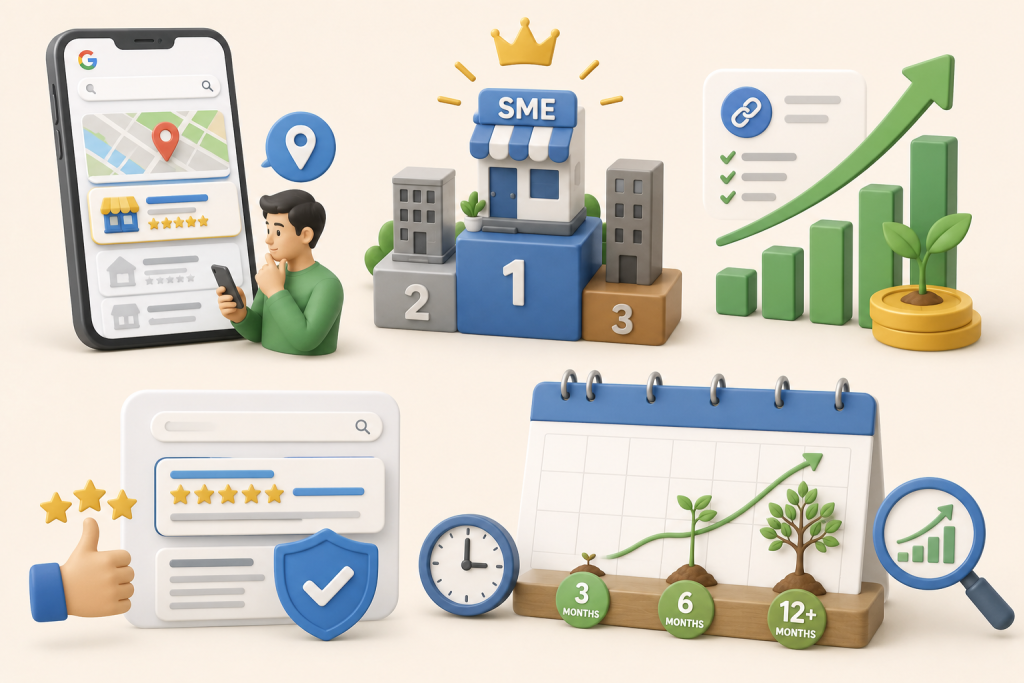
A realistic note: SEO is not instant. For most Malaysian SMEs, meaningful movement takes three to six months, depending on competition and the current state of your site. It is a compounding asset, not a switch.
What SEO actually involves
SEO works on four pillars, and an SME needs all four working together:
|
Pillar |
What it covers |
Why it matters for SMEs |
|
Technical SEO |
Site speed, mobile usability, indexing, site structure |
Most Malaysian traffic is mobile; a slow or broken site loses rankings and leads |
|
On-page SEO |
Titles, headings, content, internal links |
Tells Google what each page is about |
|
Content |
Service pages, location pages, blog guides |
Earns rankings, answers buyer questions, attracts links |
|
Off-page SEO |
Backlinks, local citations, reviews |
Builds authority and trust |
The sections below give you an executable plan for each.
1. Build a fast, mobile-first website
Your website is the foundation. In Malaysia, where most searches happen on phones, Google judges your site by the mobile experience first.
Checklist:
- Loads in under 3 seconds on 4G (test in Google PageSpeed Insights)
- Mobile-friendly layout with tappable buttons and readable text
- A clear menu and an obvious call to action (WhatsApp, call, enquiry form)
- HTTPS (secure padlock) enabled
- Every service has its own dedicated page (not one page listing all services)
If your current site is slow or hard to edit, a rebuild often pays for itself in rankings and conversions. See Web Design & Development in Malaysia (https://mediaplusdigital.com.my/web-design-development-malaysia/).
2. Do keyword research around how Malaysians search
Keyword research uncovers the exact phrases your customers type. For SMEs, the goal is to find terms with real demand but realistic competition, then map one main keyword to each page.
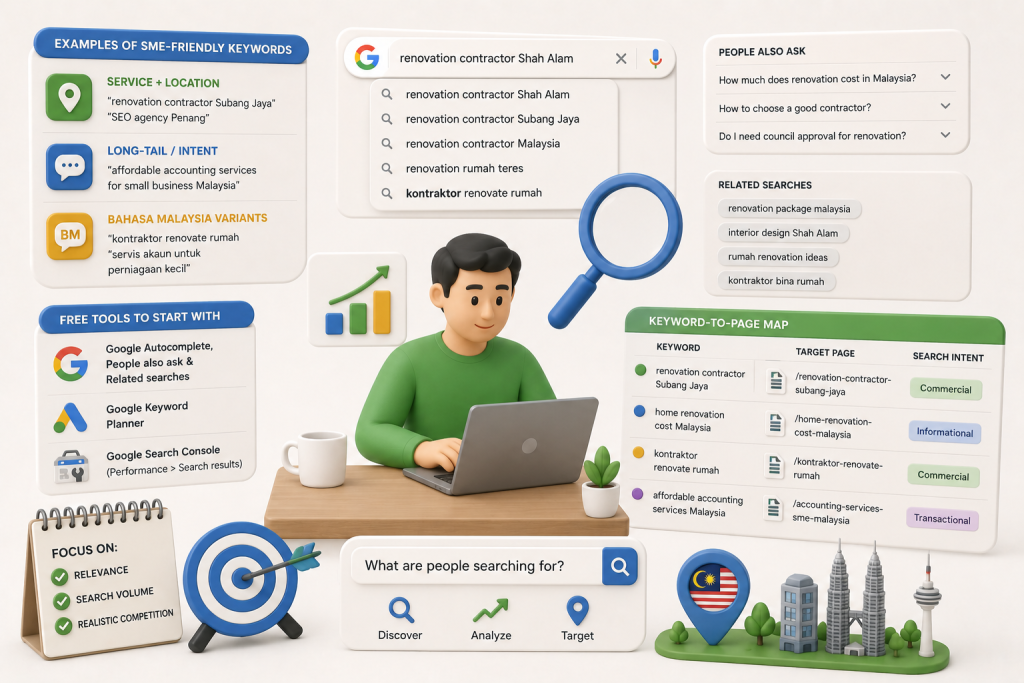
Examples of SME-friendly keyword types:
- Service + location: “renovation contractor Subang Jaya,” “SEO agency Penang”
- Long-tail / intent: “affordable accounting services for small business Malaysia”
- Bahasa Malaysia variants: many buyers search in Malay (for example “kontraktor renovate rumah”), so include local-language terms where they fit
Free tools to start with:
- Google autocomplete and the “People also ask” / “Related searches” boxes
- Google Keyword Planner (inside a free Google Ads account)
- Google Search Console (shows the queries you already get impressions for)
Build a simple keyword-to-page map so no two pages compete for the same term.
3. Optimise on-page SEO
On-page SEO makes each page easy for Google to understand. For every important page, set:
|
Element |
Best practice |
|
Page title |
Include the main keyword and your location, under ~60 characters |
|
Meta description |
A compelling 1-2 line summary with the keyword and a reason to click |
|
URL / slug |
Short and descriptive, e.g. /aircon-service-pj/ |
|
H1 and headings |
One H1 with the keyword; H2s for sub-topics |
|
Image alt text |
Describe the image using natural keywords |
|
Internal links |
Link related pages to each other to spread authority |
Use keywords naturally. Stuffing them hurts more than it helps.
4. Create content that answers buyer questions
Content is what earns rankings beyond your core service pages. Search engines favour content that shows real experience, expertise, authority and trust (E-E-A-T).
High-value content types for SMEs:
- Service pages for each offering, written for a specific audience and location
- Location pages if you serve multiple areas (e.g. one for KL, one for Johor Bahru)
- Guides and how-tos that answer the questions buyers ask before purchasing
- Case studies showing real results for local clients, which build trust and convert
One genuinely useful guide a month beats ten thin posts. Helpful content also earns backlinks naturally.
5. Focus on local SEO (the biggest win for most SMEs)
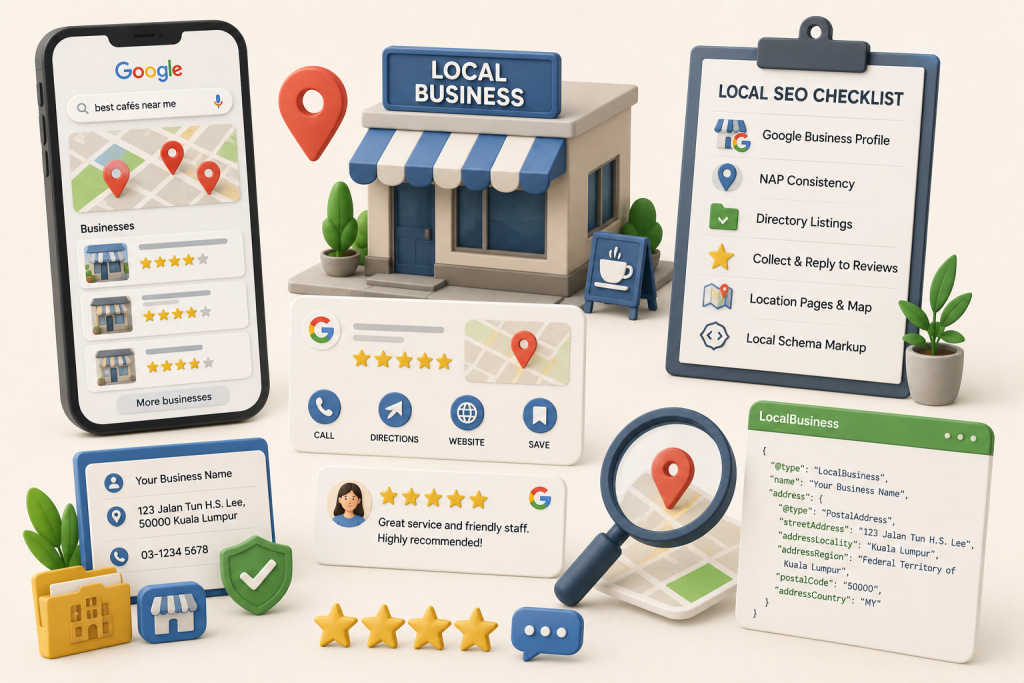
For any SME serving a physical area, local SEO is usually the fastest route to leads. It is what puts you in the Google Map Pack, the block of three businesses with the map at the top of local searches.
Local SEO checklist:
- Claim and complete your Google Business Profile with correct category, hours, service area, photos and a keyword-rich description
- Keep NAP consistent (Name, Address, Phone) across your website, GBP and every directory
- List in Malaysian directories and platforms relevant to your niche
- Collect Google reviews steadily and reply to every one; reviews strongly influence Map Pack ranking
- Add location pages and embed a Google Map on your contact page
- Use local schema markup so Google reads your address and business details cleanly
For most local SMEs, a well-optimised Google Business Profile plus a handful of strong reviews moves the needle faster than anything else.
6. Build backlinks and local authority
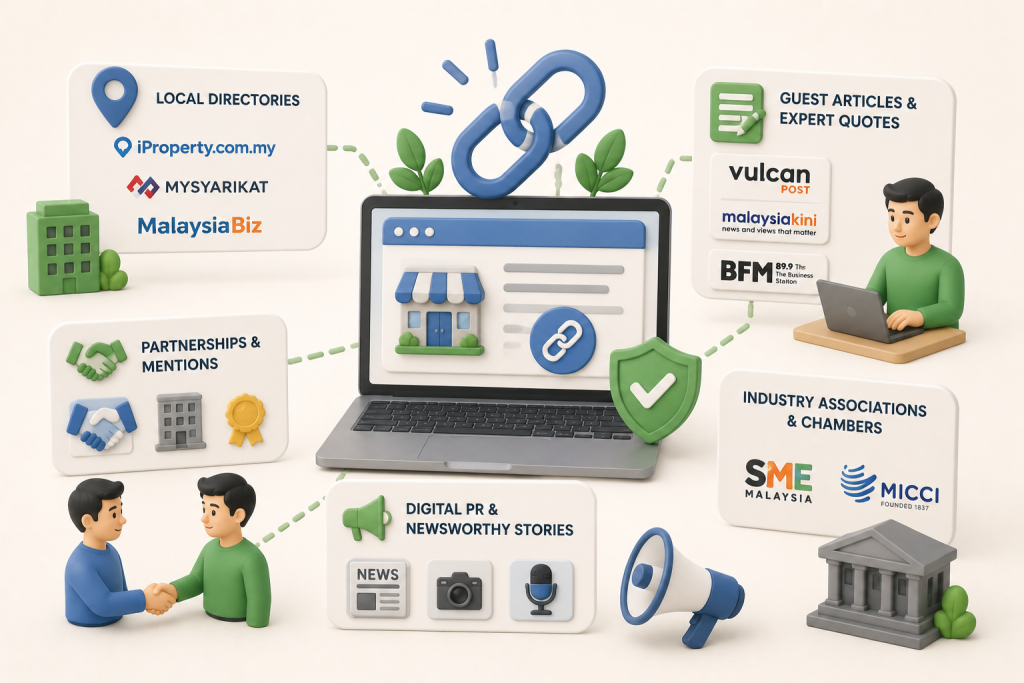
Backlinks (links from other sites to yours) tell Google your business is credible. Quality beats quantity, especially for SMEs.
Realistic, white-hat ways to earn links in Malaysia:
- Local business directories and industry associations
- Guest articles or expert quotes on Malaysian blogs and news sites
- Partnerships, sponsorships and supplier or client mentions
- Digital PR around something newsworthy your business does
Avoid bought link packages and link farms. A few relevant local links are worth more than hundreds of spammy ones.
7. Track performance and improve
SEO needs ongoing monitoring. Two free tools cover most SMEs:
- Google Search Console for keyword rankings, clicks, impressions and indexing issues
- Google Analytics 4 for traffic, behaviour and conversions
What to review monthly:
- Which keywords are gaining or losing position
- Which pages drive enquiries (do more of what works)
- Technical errors flagged in Search Console
- New keyword opportunities from the queries you already rank for on page two
Use the data to decide what to optimise next, rather than guessing.
Common SEO challenges for Malaysian SMEs
|
Challenge |
How to handle it |
|
Limited budget |
Prioritise local SEO and your top 3 money pages first |
|
No in-house expertise |
Start with Google Business Profile and on-page basics, or outsource |
|
Competing with big brands |
Win long-tail and local searches they ignore |
|
Slow results |
Treat SEO as a 6-12 month investment, not a quick fix |
|
Algorithm changes |
Focus on genuinely useful content; it survives updates |
Because of these constraints, many SMEs partner with an agency to move faster without hiring a full in-house team.
SEO services for SMEs
If you would rather focus on running your business, a digital marketing partner can run SEO end to end. MediaPlus Digital Malaysia (https://mediaplusdigital.com.my/) helps small and medium businesses grow their organic visibility with services built for SME budgets and goals:
- SEO Services (including AI SEO) (https://mediaplusdigital.com.my/seo-services-malaysia/): keyword research, on-page and technical optimisation, local SEO and content built to rank and convert.
- Digital Marketing (https://mediaplusdigital.com.my/digital-marketing-agency-services-malaysia/): integrated plans that combine SEO, content and paid campaigns.
- Web Design & Development (https://mediaplusdigital.com.my/web-design-development-malaysia/): fast, mobile-first sites engineered for strong SEO and conversions.
- Google Ads Management (https://mediaplusdigital.com.my/google-ads-services-malaysia/): paid campaigns that drive leads while your SEO builds momentum.
New SMEs can claim a free RM300 SEO audit to see exactly where your site stands and what to fix first. Request a quote (https://mediaplusdigital.com.my/contact-us/) to get started.
Frequently asked questions
How long does SEO take to work for an SME in Malaysia?
Most SMEs see meaningful movement in three to six months, with stronger results building over 6 to 12 months. Local SEO via Google Business Profile can show results faster.
How much does SEO cost for a small business in Malaysia?
It depends on your industry, competition and goals. SEO scales to most SME budgets, and prioritising local SEO and your top money pages keeps early costs low. Request a quote for a plan matched to your business.
Can I do SEO myself, or do I need an agency?
You can handle the basics yourself: claim your Google Business Profile, fix on-page titles and write helpful content. An agency helps when you want faster results, technical fixes or content at scale without hiring in-house.
Is local SEO or content marketing more important for SMEs?
For most SMEs serving a physical area, local SEO delivers leads fastest. Content marketing then compounds those results over time. The two work best together.
What is the first thing an SME should do to improve SEO?
Claim and fully optimise your Google Business Profile, then make sure your website is fast and mobile-friendly. Those two steps deliver the quickest wins.
Final thoughts
SEO is one of the most powerful and cost-effective ways for Malaysian SMEs to grow. By making your site fast and local, targeting the keywords your customers actually use, and publishing content that answers their questions, you can attract steady leads and compete with far bigger brands.
It takes consistency and a clear strategy, but the payoff is a website that brings in customers month after month. With the right plan, and support from a partner like MediaPlus Digital Malaysia when you need it, your SME can rank well and grow sustainably in 2026 and beyond.