B2C digital marketing is how brands reach individual consumers online and turn attention into a purchase. It covers the channels people use every day, from search and social to email and influencers, and it moves fast because consumer decisions are quick and often emotional.
This guide explains what B2C digital marketing is, how it differs from B2B, the channels that actually work, and the mobile-first trends shaping Malaysia specifically. If you want the wider context first, What Is Digital Marketing sets the foundation.
What is B2C digital marketing?
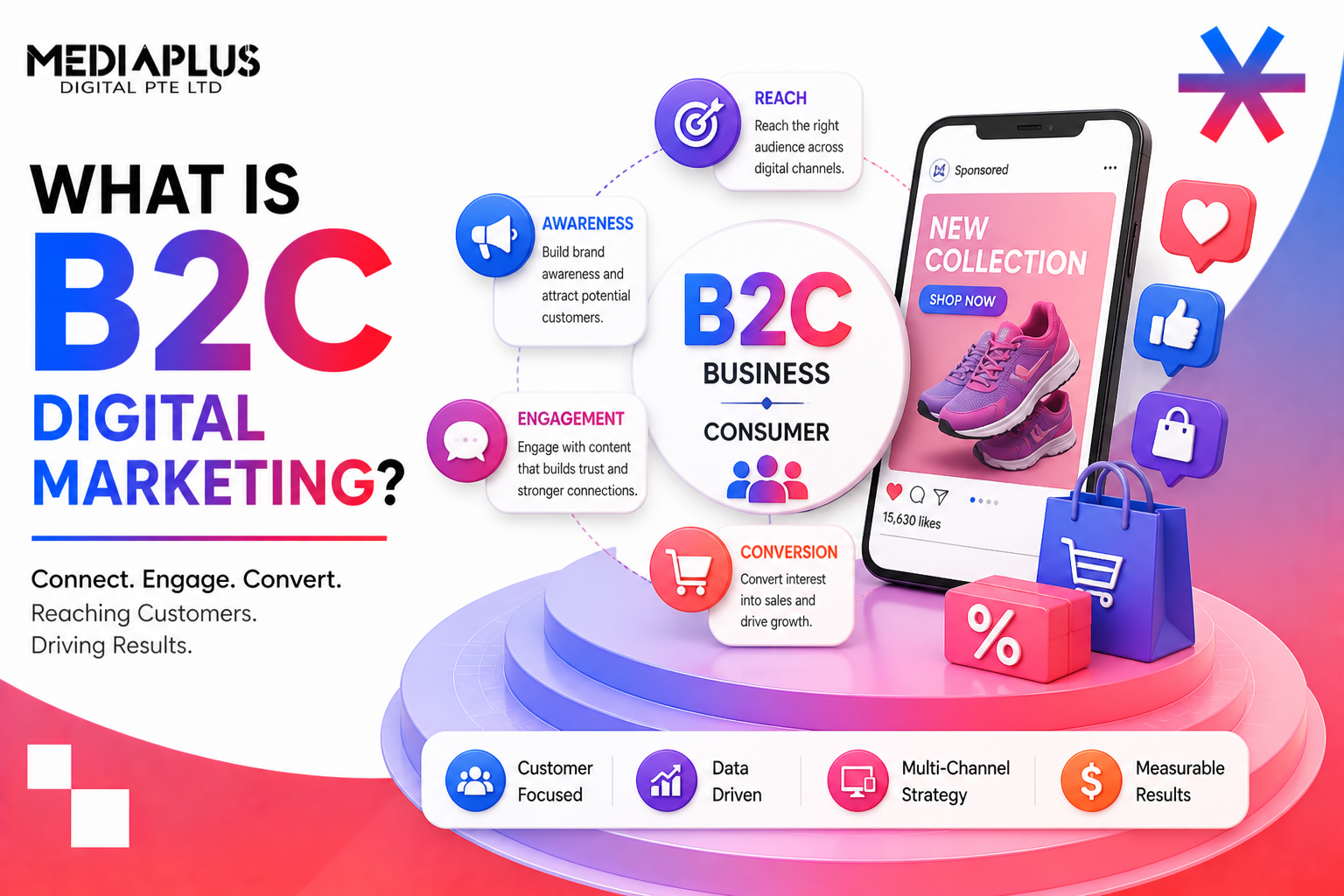
B2C, or business-to-consumer, digital marketing is the set of online tactics a business uses to sell products or services directly to individual consumers rather than to other businesses. The goal is to reach a person, spark interest, and drive a purchase, often in a single short journey.
The defining traits of B2C are:
- An individual buyer making a personal decision, not a committee
- A short, often impulsive sales cycle measured in minutes or days
- Emotional, benefit-led messaging rather than technical justification
- High-volume, lower-value transactions compared with B2B
- Consumer channels like Instagram, TikTok, search, and email
A quick clarification many guides skip: B2C is not the same as D2C. D2C (direct-to-consumer) means a manufacturer sells straight to consumers with no retailer in between. B2C is the broader category that includes selling through marketplaces and retailers too.
B2C versus B2B digital marketing
The two are often compared because the contrast makes each clearer.
|
Factor |
B2C |
B2B |
|
Buyer |
Individual consumer |
Organisation, multiple stakeholders |
|
Sales cycle |
Short, often impulsive |
Long, considered |
|
Motivation |
Emotional, personal |
Logic, ROI, efficiency |
|
Tone |
Casual, brand personality |
Formal, expertise-led |
|
Top channels |
Instagram, TikTok, search, influencers |
LinkedIn, email, webinars |
|
Transaction |
High volume, lower value |
Lower volume, higher value |
For a fuller side-by-side, including how strategy and budget differ, see B2B vs B2C Digital Marketing.
The core B2C digital marketing channels
Most successful B2C brands combine several of the following rather than relying on one.
1. SEO and content
When a consumer wants something, they search. Ranking for those searches captures demand at the moment of intent, and unlike ads, organic visibility keeps working after the spend stops. For online stores, this is especially powerful, as covered in Ecommerce SEO Services in Malaysia.
2. Social media marketing
Instagram, Facebook, and TikTok are where B2C brands build personality and reach. The combination of organic content and paid targeting makes social the centre of most consumer strategies. Our Social Media Ads in Malaysia page covers the paid side.
3. Paid search and shopping ads
Google Ads and Shopping campaigns put products in front of buyers who are actively searching, with results you can measure to the ringgit. See Google Ads Services in Malaysia.
4. Influencer and user-generated content
Consumers trust people more than brands. Influencer partnerships and authentic user-generated content have become central to B2C, especially among younger Malaysian audiences.
5. Email and SMS
Email and mobile messaging drive repeat purchases, recover abandoned carts, and reward loyalty. They are among the highest-return channels in B2C because they reach customers you already have.
6. Social and mobile commerce
Increasingly, the purchase happens inside the app. TikTok Shop, Instagram shopping, and live commerce let consumers discover and buy in one place. For Malaysia this is no longer a side channel. See How to Sell on TikTok in Malaysia and Instagram Ecommerce Strategy.
B2C digital marketing in Malaysia: the trends that matter
This is where global guides fall short, because they ignore how Malaysian consumers actually behave. The local picture is distinctly mobile-first and social.
- Mobile is the default. Mobile commerce in Malaysia has grown sharply, with smartphones accounting for the large majority of online retail activity. Sites and campaigns that are not built mobile-first lose buyers immediately.
- Social commerce is booming. Malaysia’s social commerce market was worth roughly US$400 million in 2023 and is projected to grow toward US$976 million by 2028 (Ken Research), with TikTok Shop and live selling leading the way.
- E-commerce keeps expanding. The Malaysian B2C e-commerce market was estimated at around US$14.8 billion in 2025 and is forecast to keep growing through the end of the decade, with B2C making up the large majority of total e-commerce value.
- E-wallets dominate checkout. Digital wallets are the leading payment method in Malaysia, so a smooth e-wallet checkout directly affects conversion. Friction at payment is lost revenue.
- UGC and values-driven content rise. Younger consumers respond to authentic content from real users and to brands that take a clear stance, though that approach carries reputational risk and needs to be genuine.
The practical takeaway for a Malaysian B2C brand: lead with mobile-first design, social and live commerce, e-wallet-ready checkout, and influencer or UGC content. That combination matches local behaviour far better than a generic global playbook.
How to build a B2C digital marketing strategy
- Know your customer. Define who they are, what they want, and where they spend time online.
- Set measurable goals. Sales, sign-ups, or repeat purchases, with numbers attached.
- Choose channels by fit, not fashion. Match channels to where your customers actually are.
- Make mobile and checkout frictionless, including e-wallet options.
- Create content that earns attention, including short video and UGC.
- Measure and optimise the metrics that map to revenue, not vanity numbers.
To understand how these stages connect from first touch to purchase, read Digital Marketing Funnel Explained. If turning visitors into customers is the priority, What Is Lead Generation is a useful next step.
Channel comparison at a glance
|
Channel |
Best for |
Speed of results |
|
SEO and content |
Capturing search demand, long-term |
Slower, compounding |
|
Social media |
Awareness and brand personality |
Medium |
|
Paid search and shopping |
Active buyers, measurable sales |
Fast |
|
Influencer and UGC |
Trust and reach with younger buyers |
Medium |
|
Email and SMS |
Repeat purchase and retention |
Fast |
|
Social and mobile commerce |
In-app discovery to purchase |
Fast |
FAQ
What is B2C digital marketing?
It is the use of online channels such as search, social media, email, paid ads, and influencers to market and sell products or services directly to individual consumers.
What is the difference between B2C and B2B marketing?
B2C targets individual consumers with short, emotion-driven purchases, while B2B targets organisations with longer, logic-driven sales involving multiple decision-makers.
What is the difference between B2C and D2C?
B2C is the broad category of selling to consumers, including through retailers and marketplaces. D2C specifically means a brand or manufacturer sells straight to consumers with no middleman.
Which B2C channels work best in Malaysia?
A mobile-first mix of social media, social and live commerce (including TikTok Shop), SEO, paid search, and influencer or UGC content suits Malaysian consumer behaviour well.
Why is B2C digital marketing important?
Consumers research and buy online, increasingly on mobile. Without a strong digital presence, a B2C brand is invisible at the exact moment people are deciding what to buy.
Reach consumers where they actually buy
B2C digital marketing rewards brands that meet consumers on mobile, on social, and at the moment of intent, with a checkout that does not get in the way.
MediaPlus Digital builds mobile-first, conversion-focused campaigns through full-service digital marketing in Malaysia, spanning SEO, paid media, and social commerce. Contact us to plan your B2C strategy.