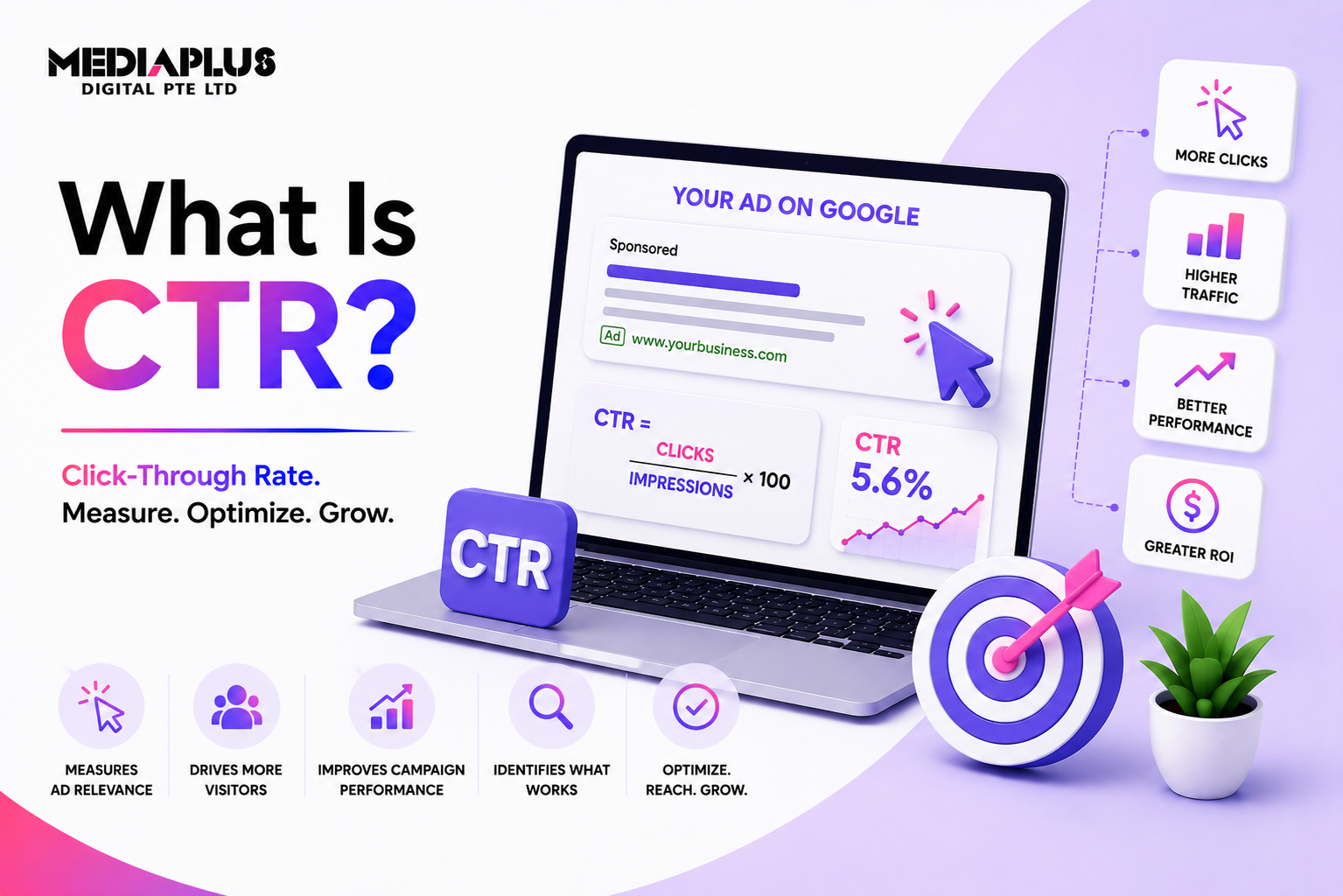
What is CTR?
CTR, or click-through rate, is the percentage of people who click something after seeing it. You calculate it by dividing clicks by impressions and multiplying by 100. If your ad or search result is shown 1,000 times and gets 30 clicks, your CTR is 3%. It is one of the most useful signals in digital marketing, because it tells you whether what people see is compelling enough to act on.
CTR shows up across search ads, organic search results, social ads, and email. A high CTR means your message and audience are well matched; a low one means something (the headline, the offer, the targeting) is not landing.
How to calculate CTR
The formula is simple:
CTR = (Clicks / Impressions) x 100
- 50 clicks from 2,000 impressions = 2.5% CTR.
- 12 clicks from 400 impressions = 3% CTR.
Impressions mean how many times your ad, listing, or email was shown or delivered; clicks mean how many times people clicked through.
Why CTR matters
- In Google Ads, CTR feeds your Quality Score. A higher, more relevant CTR can lower your cost per click and improve ad position.
- In SEO, a higher CTR from search results brings more traffic for the same ranking, and can support your rankings over time.
- In email and social, CTR shows whether your content and calls to action are working.
- As a diagnostic, CTR quickly flags weak headlines, poor targeting, or a mismatch between promise and page.
CTR is a means, not the end. A high CTR that does not convert is a warning, not a win, so always read it alongside conversions.
What is a good CTR?
It depends on the channel and industry, so treat these as rough guides:
- Google Search ads: a CTR of 2% to 5% is common; strong campaigns go higher.
- Google Display ads: much lower, often well under 1%, because they interrupt rather than answer intent.
- Organic search: varies hugely by position, since the top results take most clicks.
- Email: a few percent is typical for the click rate.
The honest benchmark is your own trend: is your CTR improving as you optimise?
How to improve your CTR
- Match the message to the intent. Say what the searcher or audience actually wants.
- Write compelling headlines, with a clear benefit and, for ads, the keyword.
- Use a strong call to action that tells people what to do next.
- Add ad extensions or rich results (sitelinks, reviews, FAQ schema) to take up more space and stand out.
- Tighten your targeting, so the right people see your message.
- Test continuously, comparing headlines and copy to see what wins.
Frequently asked questions
What is CTR in simple terms?
CTR (click-through rate) is the percentage of people who click after seeing your ad, search result, or email. It is clicks divided by impressions, times 100.
What is a good CTR?
For Google Search ads, 2% to 5% is common. Display ads are much lower. There is no single “good” number; the best benchmark is whether your CTR improves as you optimise, and whether those clicks convert.
How do I calculate CTR?
Divide clicks by impressions and multiply by 100. For example, 30 clicks from 1,000 impressions is a 3% CTR.
Does CTR affect SEO?
Indirectly. A higher CTR from search results brings more traffic for the same ranking and can be a positive signal, but content quality and relevance matter more.
Is a high CTR always good?
Not on its own. A high CTR that does not lead to conversions can mean your ad promises something the page does not deliver. Always read CTR alongside conversion rate.
The bottom line
CTR is a fast, honest read on whether your ads, listings, or emails are compelling enough to earn a click. Track it, improve it with better headlines, targeting, and calls to action, but always tie it back to conversions, because clicks only matter if they turn into customers.
Want ads and pages that earn the click and the sale? Talk to MediaPlus Digital about Google Ads and SEO, and claim a free RM300 audit.