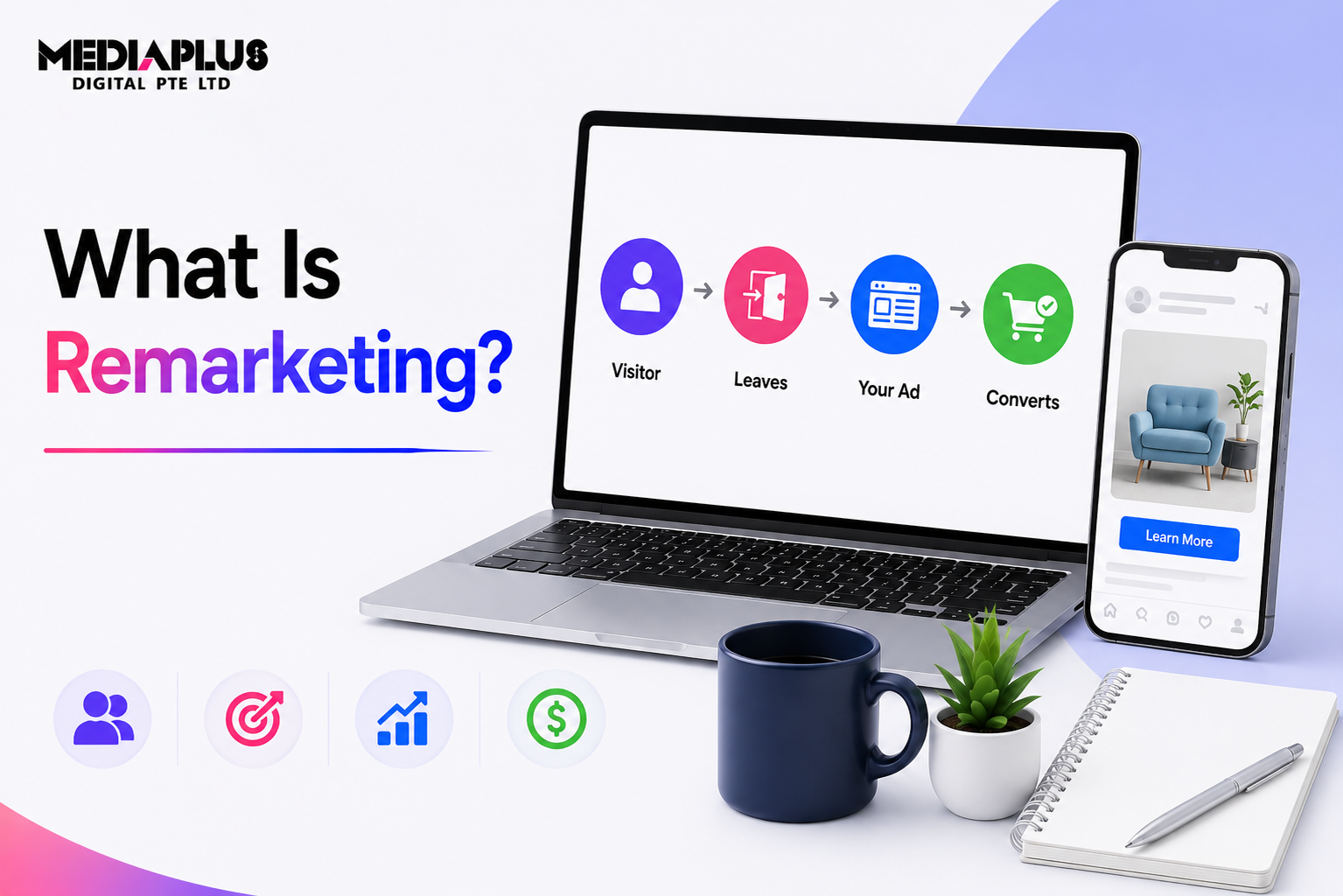
Quick answer: Remarketing (also called retargeting) is showing ads or messages to people who have already interacted with your business, such as visiting your website, watching a video, or adding to cart without buying. It works because warm audiences convert far more cheaply than cold ones. A good remarketing strategy segments people by how close they came to buying, matches the message to that stage, caps frequency so you do not annoy them, and excludes people who already converted.
What is remarketing?
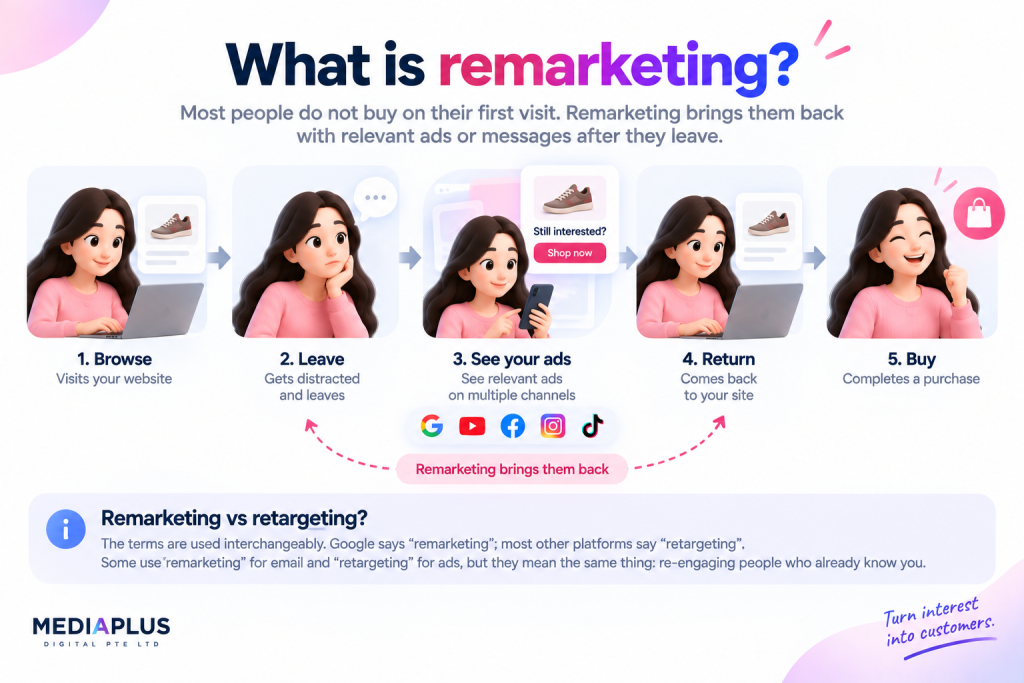
Most people do not buy on their first visit. They browse, compare, get distracted, and leave. Remarketing brings them back by showing relevant ads or messages after they have left, on Google, YouTube, Facebook, Instagram, TikTok, or by email and WhatsApp.
Remarketing vs retargeting: the terms are used interchangeably. Google traditionally says “remarketing”; most other platforms say “retargeting”. Some marketers use “remarketing” for email and “retargeting” for ads, but in practice they mean the same idea: re-engaging people who already know you.
How remarketing works
- Someone interacts with you: visits a page, watches a video, engages on social, or adds to cart.
- A tag or pixel records the interaction (for example the Google tag or Meta Pixel), or you upload a customer list.
- They are added to an audience based on what they did.
- You show them tailored ads or messages as they browse elsewhere.
- They return and convert.
Remarketing depends on proper tracking and consent. Set up your tags correctly, and see how to set up GA4.
Types of remarketing
|
Type |
Where it runs |
Best for |
|
Display remarketing |
Websites and apps across the Google Display Network |
Broad re-engagement, brand recall |
|
Search remarketing (RLSA) |
Google search results |
Bidding harder when past visitors search again |
|
Social remarketing |
Facebook, Instagram, TikTok |
Visual reminders, offers, social proof |
|
Video remarketing |
YouTube |
People who watched your videos or visited your channel |
|
Dynamic remarketing |
Google and Meta |
Ecommerce: showing the exact products people viewed |
|
Email and WhatsApp remarketing |
Inbox and chat |
Abandoned carts, lapsed customers, follow-ups |
|
Customer list remarketing |
Google, Meta |
Upselling or re-engaging existing customers |
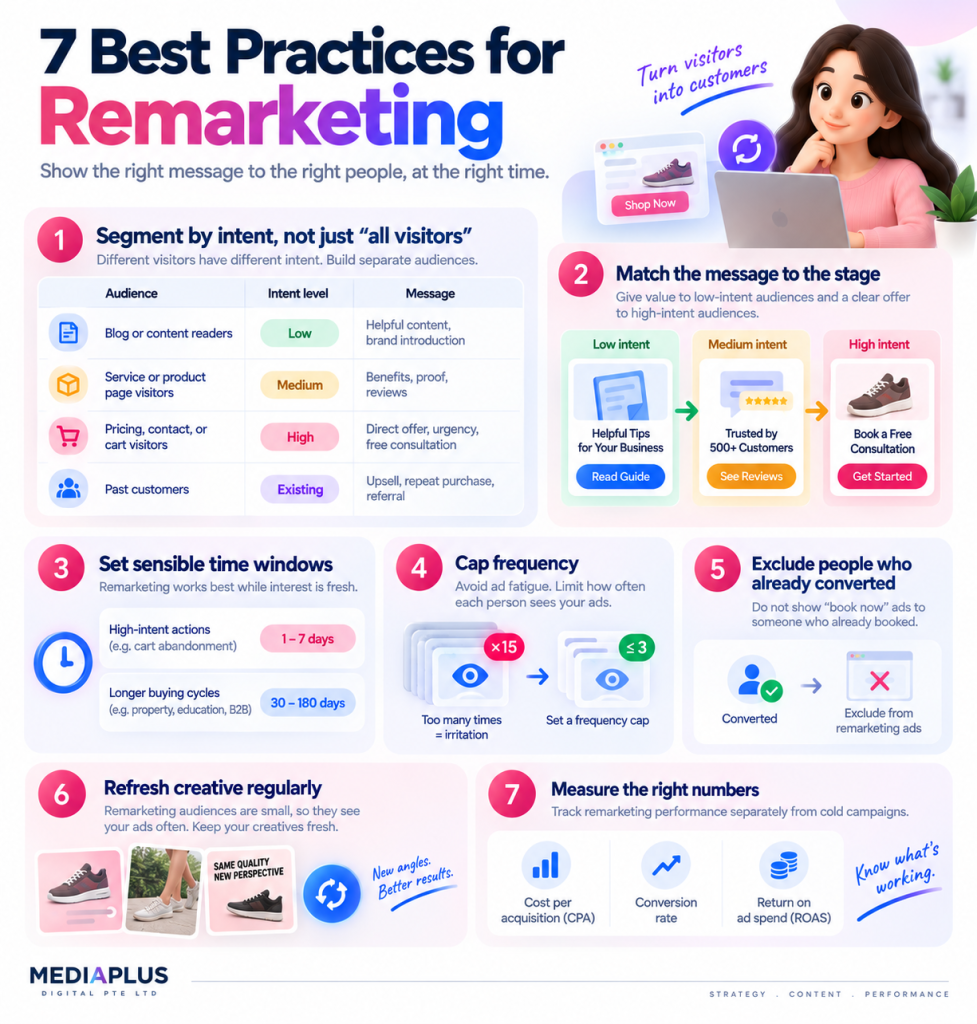
Building a remarketing strategy: 7 steps
1. Segment by intent, not just “all visitors”
The biggest mistake is one audience of everyone who visited. Someone who viewed your pricing page is far closer to buying than someone who read one blog post. Build separate audiences:
|
Audience |
Intent level |
Message |
|
Blog or content readers |
Low |
Helpful content, brand introduction |
|
Service or product page visitors |
Medium |
Benefits, proof, reviews |
|
Pricing, contact, or cart visitors |
High |
Direct offer, urgency, free consultation |
|
Past customers |
Existing |
Upsell, repeat purchase, referral |
2. Match the message to the stage
Low-intent audiences get value and proof; high-intent audiences get a clear offer. Showing a hard “buy now” to someone who read one article feels pushy. See sales funnel.
3. Set sensible time windows
Remarketing works best while interest is fresh. Short windows for high-intent actions (such as cart abandonment within a few days), longer windows for longer buying cycles like property, education, or B2B services.
4. Cap frequency
Seeing the same ad fifteen times a day turns interest into irritation. Limit how often each person sees your ads, and rotate creative.
5. Exclude people who already converted
Stop showing “book now” ads to someone who booked yesterday. Exclude converters, or move them into an upsell or retention audience instead.
6. Refresh creative regularly
Remarketing audiences are small, so they see your ads often. Rotate images, angles, and offers before fatigue sets in.
7. Measure the right numbers
Track cost per acquisition, conversion rate, and return on ad spend for remarketing campaigns separately from cold campaigns, so you can see what remarketing is actually contributing. See what is ROAS.
Remarketing examples
- Ecommerce: a shopper views running shoes, leaves, and later sees an Instagram ad showing those exact shoes with free shipping.
- Service business: a visitor reads the pricing page of a renovation company, then sees a Facebook ad with before-and-after projects and a free site visit offer.
- B2B: a prospect downloads a guide, then receives a short email sequence and sees LinkedIn or YouTube case study ads over the next few weeks.
- Abandoned cart: a customer leaves checkout and receives a WhatsApp or email reminder within hours. See reduce cart abandonment.
Budget: how much to spend on remarketing
Remarketing audiences are smaller than cold audiences, so they usually take a smaller share of the budget but deliver a large share of conversions. Start with a modest portion of your ad spend, then increase it as long as the cost per acquisition stays healthy. If your remarketing audience is tiny, the fix is more top-of-funnel traffic, not more remarketing budget.
Privacy and consent
Remarketing relies on tracking, so handle it responsibly: a clear privacy and cookie notice, consent for marketing messages, and proper handling of personal data. For email and WhatsApp remarketing, only message people who opted in. See making your website PDPA compliant.
Common remarketing mistakes
- One audience for all visitors instead of segmenting by intent.
- No frequency cap, so ads become irritating.
- Forgetting to exclude converters.
- Stale creative that audiences have seen dozens of times.
- Remarketing to a tiny audience and expecting large results.
- Broken tracking, so audiences never fill properly.
Frequently asked questions
What is remarketing?
Showing ads or messages to people who have already interacted with your business, such as website visitors, video viewers, or cart abandoners, to bring them back to convert.
Is remarketing the same as retargeting?
Yes, in practice. Google usually says “remarketing” and most other platforms say “retargeting”.
What is a good remarketing strategy?
Segment audiences by intent, match messages to each stage, use sensible time windows, cap frequency, exclude converters, refresh creative, and measure remarketing separately.
Why does remarketing work so well?
Because the audience already knows you. Warm audiences usually convert at a lower cost than cold audiences who have never heard of you.
Which platforms support remarketing?
Google Ads (display, search, YouTube), Meta (Facebook and Instagram), TikTok, LinkedIn, plus email and WhatsApp for opted-in contacts.
How long should a remarketing audience window be?
Short for high-intent actions like cart abandonment, and longer for products or services with long buying cycles.
The bottom line
Remarketing is usually where the cheapest conversions in your ad account are, because it targets people who already showed interest. The difference between remarketing that works and remarketing that annoys is strategy: segment by intent, match the message, cap frequency, exclude converters, and keep creative fresh.
Want remarketing that brings back customers instead of annoying them? Talk to MediaPlus Digital about Google Ads and Instagram Ads, and claim a free RM300 consultation.