Quick answer: An interior design website in Malaysia has two jobs: prove the quality of your finished projects, and turn the right homeowners or business owners into consultation requests. In practice that means detailed case studies (property type, floor area, style, timeline, budget band, before and after photos), separate service pages for condos, landed homes, offices and commercial spaces, a consultation form that asks about budget and property, WhatsApp click-to-chat, a verified Google Business Profile, and images light enough to pass Core Web Vitals. It also has to follow Malaysian rules. Only people registered with Lembaga Arkitek Malaysia (LAM) may call themselves an “Interior Designer”, renovation contractors need CIDB registration, and every enquiry form falls under the PDPA.
Most articles about interior design websites are inspiration galleries: twenty beautiful studio sites from New York or London, with little on how to build one that brings in enquiries. This guide is the build brief instead. It covers the sitemap, what goes on each page, a case-study template, image specs, form fields, local SEO and the Malaysian regulatory points your developer and copywriter need before launch.
Why an interior design website has a different job
A homeowner planning a renovation is about to spend a large sum on something they will live with for years, so they rarely hire the first firm they find. The usual path: save photos on Instagram or Pinterest, shortlist three or four firms, check each firm’s website to see whether the work is real and relevant to their property, then ask for a consultation. Your website is where a shortlisted firm either looks credible and easy to talk to, or gets dropped.
|
What the visitor wants to know |
Where your site should answer it |
|
Have you done a home like mine? |
Portfolio filtered by property type, with case studies |
|
Roughly what will it cost? |
Budget bands on case studies, plus a budget question in the form |
|
How long will it take? |
Process page with stages and a typical timeline |
|
Are you a real, registered business? |
About page with SSM number, LAM or CIDB registration where held, office address |
|
How do I start? |
Consultation button on every page, WhatsApp, short form |
Visuals carry far more weight here than on most business sites, because your photos are the product demo. That creates a technical problem: a portfolio full of large images is exactly the kind of site that loads slowly on mobile data.
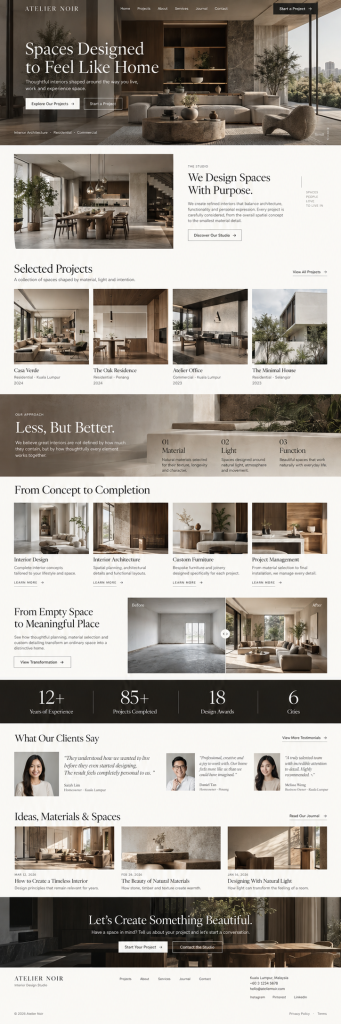
The sitemap an interior design and renovation firm needs
Keep the main navigation short and put the depth one level down. This structure works for a small studio and for a design and build firm with a renovation arm.
|
Page |
Example URL |
Must include |
|
Home |
/ |
Hero project, property-type shortcuts, featured projects, process summary, reviews, consultation CTA |
|
Portfolio |
/projects/ |
Filters by property type, style, location and budget band |
|
Project case study |
/projects/condo-mont-kiara-japandi/ |
Brief, floor area, timeline, budget band, before and after, renders, video |
|
Condo interior design |
/services/condo-interior-design/ |
Condo constraints, relevant projects, FAQ |
|
Landed house renovation |
/services/landed-house-renovation/ |
Extension and structural scope, approvals, landed projects |
|
Office interior design |
/services/office-interior-design/ |
Space planning, phasing, office projects |
|
Commercial interior design |
/services/commercial-interior-design/ |
Retail, F&B and clinic fit-outs, opening-date planning |
|
Renovation or design and build |
/services/renovation/ |
CIDB registration, scope, warranty |
|
Process |
/process/ |
Stages, approvals, typical timeline |
|
About and team |
/about/ |
Team bios, registrations, office, company details |
|
Consultation |
/consultation/ |
Qualifying form, WhatsApp, phone, map |
|
Location pages |
/interior-design-penang/ |
Only where you have a real local presence |
Add a reviews page, a guides section and a bilingual privacy notice under these. If your firm does both design and renovation, keep them on one site rather than two, so your reviews, links and portfolio build up in one place.
Page-by-page blueprint
Homepage section order
- Hero: one finished project photo (not a render) and a plain headline saying what you do and where, such as “Interior design and renovation for condos and landed homes in Klang Valley”. Two buttons: “Book a consultation” and “See our projects”.
- Property-type shortcuts: tiles for Condo, Landed, Office and Commercial. It is the fastest route to relevant work.
- Three to six featured projects: each card shows property type, area, style and floor area.
- Process strip: four or five steps with a typical timeline.
- Reviews: two or three testimonials that mention a specific project, plus your Google rating.
- Registrations and awards: CIDB grade, LAM registration if held, and awards you can back up.
- Consultation block with WhatsApp.
- Footer: address, hours, phone, privacy notice, company registration number.
Service pages by property type
A condo owner and a bungalow owner worry about different things. Separate pages let you speak to each one and give Google a clear page to rank for each search.
|
Service page |
What the visitor worries about |
Content to include |
|
Condo |
Management rules, renovation deposits, working hours, limited space |
How you handle management approval, space-saving carpentry, condo projects |
|
Landed |
Extensions, wet works, council approvals, living on site during works |
Structural and permit scope, phasing, before and after |
|
Office |
Downtime, headcount growth, meeting rooms, cabling |
Space planning approach, after-hours work, office projects |
|
Commercial |
Opening date, brand fit, landlord and authority requirements |
Fit-out schedule, coordination, commercial projects |
Give each page its own hero image, three to six relevant case studies, a short FAQ and the consultation CTA. Swapping the property type into the same paragraph on every page does not count.
Trust signals that carry weight
- CIDB grade and LAM registration where held, with numbers visitors can verify
- SSM company number and a physical office or showroom address
- Named team members with photos and roles
- Google rating, linked to your profile
- Workmanship warranty terms written out on the renovation page
- Awards with the year and awarding body
- A payment schedule on the process page, so clients know what they pay at each stage
Skip counters you cannot prove and stock photos of rooms you did not design.
WordPress, website builder or custom build?
|
Option |
Suits |
Watch out for |
|
Website builder (Wix, Squarespace) |
Solo designers with a small portfolio |
Limited control over image delivery, filters and schema |
|
WordPress with a custom theme |
Most studios and design and build firms |
Needs good hosting, image optimisation and updates |
|
Custom or headless build |
Large firms with many projects and complex filtering |
Higher cost and developer dependence |
For most Malaysian firms, a custom-designed WordPress website with a project post type (fields for area, budget band, style and timeline) is the practical choice, because your team can add projects without touching code.
How to choose a web developer for an interior design firm
|
Question to ask |
What a good answer looks like |
|
Can you show image-heavy sites you built, with their PageSpeed results? |
Live sites whose portfolio pages load quickly on mobile |
|
How will we add new projects ourselves? |
A project template with set fields, shown in an admin demo |
|
How do you handle image optimisation? |
Automatic WebP or AVIF, responsive sizes, CDN, lazy loading below the fold |
|
What lead tracking will you set up? |
GA4 events for forms, WhatsApp and calls, with the source page of each lead |
|
What do you know about LAM, CIDB and PDPA points for our industry? |
Specific answers on titles, registrations, consent and privacy notices |
|
Who owns the domain, hosting and design files? |
You do, in writing |
Red flags: a template with your logo swapped in, portfolio pages that are just a slider, no mention of mobile speed, and no plan for tracking enquiries. Our guide on how to choose a good web design agency in Malaysia lists more questions.
If your current site already gets traffic but few enquiries, a website redesign that keeps your URLs and rankings may be a better start than a new build.
Frequently asked questions
What should an interior design website include?
Detailed project case studies, service pages by property type, a process page, an about page with your team and registrations, reviews, and a consultation page with a qualifying form and WhatsApp. Add a privacy notice, fast-loading images and a linked Google Business Profile.
How much does an interior design website cost in Malaysia?
It depends on page count, how many case studies you need built, and features such as portfolio filters and CRM integration. Our web design cost guide puts a corporate site with a CMS (10 to 20 pages) at around RM6,000 to RM15,000 as a 2026 market range, with custom builds costing more.
How long does it take to build an interior design website?
Our cost guide puts a corporate site with a CMS at 4 to 8 weeks. The usual delay is content: project photos, case-study details and client consent, so start collecting them before design begins.
Can I call my company an interior designer if we are not registered with LAM?
Section 27A of the Architects Act 1967 restricts the title “Interior Designer”, its equivalent in any language and words implying it to people registered with LAM. If no one in your firm is registered, check with LAM before using the title on your website, profiles or signage.
Do renovation contractors need CIDB registration in Malaysia?
CIDB states that all contractors must register under Section 25 of Act 520 before undertaking construction work, apart from exemptions under Section 40(1). Check your position with CIDB and show your registration grade on your website.
Should I show prices on my interior design website?
Budget ranges on case studies help visitors judge fit and cut enquiries far outside your range. A fixed price list is risky because site conditions vary. Combine ranges with a budget question in the form.
Should I create separate pages for Kuala Lumpur, Selangor, Penang and Johor Bahru?
Only where you have real projects, staff or an office in that area and can write something specific about it. Near-identical city pages fall under doorway abuse in Google’s spam policies.
Is Instagram enough, or do I need a website?
Instagram is useful for inspiration and reach, but you do not control the platform, it cannot hold detailed case studies well, and it is not built to rank for searches like “interior design company kl”. Use it to send people to case studies and the consultation page on your own site.
The bottom line
A good interior design website works like a well-run showroom. Relevant projects are easy to find, each one tells the full story, and starting a conversation takes seconds. Build detailed case studies, split services by property type, qualify leads through the form, keep images fast, and get the LAM, CIDB and PDPA details right before launch.
Planning a new site or a rebuild? Request a quote from our web design and development team. If you already have a site, ask about our free website audit worth RM300 to see where speed, SEO and enquiries are falling short.