Performance marketing and digital marketing are often used interchangeably, but they are not the same. Confusing the two can lead to misaligned expectations, poor budget allocation, and inaccurate performance evaluation.
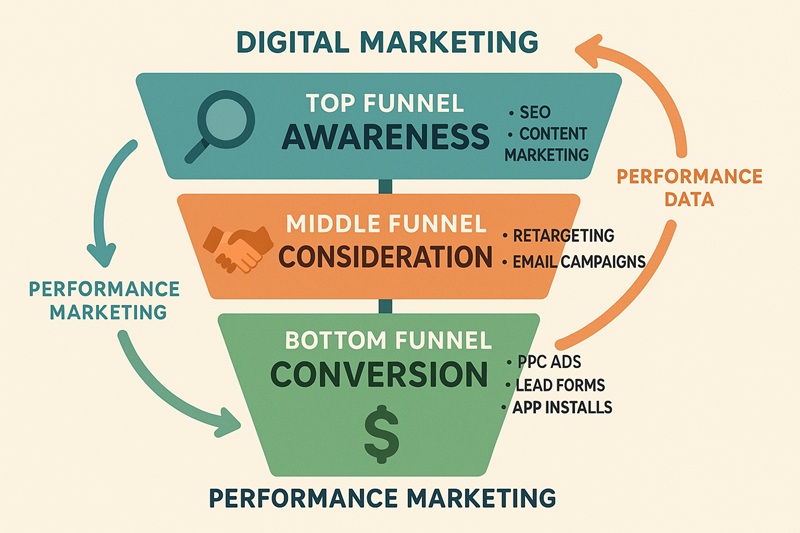
Simply put: Digital marketing is the big picture. Performance marketing is a results-focused subset within it.
Understanding how they differ and how they work together is critical for building a scalable and sustainable growth strategy.
What Is Digital Marketing?
Digital marketing refers to all marketing activities conducted online to build brand presence, attract audiences, and nurture customer relationships across the entire buyer journey.
The core focus of digital marketing is not just immediate sales, but long-term visibility, trust, and engagement.
Common Digital Marketing Channels
-
Search Engine Optimization (SEO)
-
Content marketing (blogs, videos, guides)
-
Organic social media marketing
-
Email marketing and automation
-
Influencer and affiliate marketing
-
Paid advertising (including performance campaigns)
Digital marketing answers the question:
“Where and how does our brand show up throughout the customer’s online journey?”
Typical Digital Marketing Metrics
-
Website traffic and traffic sources
-
Engagement metrics (likes, shares, comments)
-
Bounce rate and session duration
-
Email open and click-through rates
-
Brand search volume and awareness indicators
According to Harvard Business Review, companies with strong omnichannel digital strategies retain up to 89% of customers, compared to around 33% for those with weak or fragmented digital presence.
What Is Performance Marketing?
Performance marketing is a data-driven approach where advertisers pay only when a specific, measurable action occurs.
Those actions may include:
-
A click
-
A lead submission
-
A purchase
-
An app install
Performance marketing focuses on one core question:
“What result did each dollar generate?”
Common Performance Marketing Channels
-
Google Ads (Search, Shopping, Display, YouTube)
-
Paid social ads (Meta, TikTok, LinkedIn)
-
Affiliate marketing
-
Programmatic and Connected TV (CTV) ads
-
Retargeting and remarketing campaigns
Key Performance Marketing Metrics
-
Cost Per Click (CPC)
-
Cost Per Acquisition (CPA)
-
Return on Ad Spend (ROAS)
-
Conversion rate
-
Click-through rate (CTR)
-
Customer acquisition cost (CAC)
Performance marketing is especially attractive for brands that need clear ROI, fast feedback, and scalable results.
Performance Marketing vs Digital Marketing: Key Differences
1. Goals and Focus
Performance Marketing
Performance marketing is designed to drive immediate, trackable actions. Every campaign is built around a clear outcome, such as a lead, a sale, or a sign-up.
-
Focuses on short-term, conversion-driven goals
-
Optimised for leads, purchases, and direct response
-
Ideal when revenue growth or pipeline generation is the priority
Digital Marketing
Digital marketing takes a broader view, focusing on brand presence, trust, and long-term customer value across the entire funnel.
-
Builds brand authority and credibility over time
-
Covers awareness, consideration, conversion, and retention
-
Supports sustainable growth rather than quick wins
2. Measurement and Attribution
Performance Marketing
Measurement is one of performance marketing’s biggest strengths. Results are clearly tied to spend, making optimisation fast and precise.
-
Uses clear attribution models
-
KPIs are revenue- and conversion-focused
-
Campaigns can be optimised in real time based on performance data
Digital Marketing
Digital marketing looks at a wider set of indicators that reflect long-term impact rather than immediate action.
-
Tracks awareness, engagement, and content performance
-
Results compound gradually over time
-
Attribution is often multi-touch or indirect, especially across channels
3. Cost Structure
Performance Marketing
Costs are directly linked to outcomes, giving marketers strong control over budgets and efficiency.
-
Common models include pay-per-click, pay-per-lead, or pay-per-sale
-
Easy to scale spend up or down
-
When managed well, wasted spend is minimal
Digital Marketing
Digital marketing typically requires upfront investment, but becomes more cost-efficient as momentum builds.
-
Investment goes into SEO, content, and brand assets
-
Marginal costs decrease over time
-
Strong potential for higher long-term ROI
4. Speed of Results
Performance Marketing
Performance marketing delivers speed. Campaigns can start producing results almost immediately.
-
Traffic and conversions can appear within days
-
Highly effective for launches, promotions, and testing
-
Useful for validating offers and audiences quickly
Digital Marketing
Digital marketing rewards consistency rather than speed.
-
SEO and content usually take 3 to 6 months to show meaningful impact
-
Results are more stable and durable once established
-
Best suited for brands investing in long-term growth
| Aspect | Performance Marketing | Digital Marketing |
|---|---|---|
| Primary Goal | Drive immediate, measurable actions | Build brand trust and long-term growth |
| Focus | Conversions, leads, and sales | Full-funnel awareness to retention |
| Time Horizon | Short-term, results-driven | Long-term, sustainable impact |
| Measurement | Clear attribution and direct ROI tracking | Broader engagement and awareness metrics |
| Key KPIs | CPA, ROAS, conversions, revenue | Traffic, engagement, SEO rankings, retention |
| Attribution | Direct and precise | Often multi-touch or indirect |
| Cost Model | Pay-per-click, lead, or sale | Upfront investment in content and SEO |
| Budget Control | Highly controllable and scalable | Slower return, but lower cost over time |
| Speed of Results | Results in days or weeks | Results in 3–6 months or longer |
| Best Use Cases | Launches, promotions, testing, fast growth | Brand building, authority, inbound demand |
Are Performance Marketing and Digital Marketing Competing?
No. They are complementary, not competing.
Performance marketing works best inside a strong digital marketing ecosystem. Without solid branding, content, and SEO, paid campaigns become more expensive over time. Without performance marketing, digital strategies often struggle to scale quickly.
McKinsey reports that brands combining brand building with performance marketing achieve 30–50% higher ROI than those focusing on only one approach.
When to Prioritise Performance Marketing
Performance marketing is best when your business needs speed, predictability, and measurable results. It focuses on driving action now, not later.
1. You Need Leads or Sales Quickly
If your business depends on immediate revenue or pipeline growth, performance marketing is the fastest way to create demand. Paid channels like Google Ads or paid social allow you to reach high-intent users who are already searching or ready to convert.
This is especially critical for:
-
New businesses without organic traffic
-
Sales-driven campaigns
-
Time-sensitive promotions or seasonal offers
You can start generating clicks, leads, or purchases within days rather than months.
2. You Want Clear ROI and Fast Optimisation
Performance marketing provides clear visibility into what works and what doesn’t. Every campaign can be measured using metrics such as CPA, ROAS, and conversion rate.
This allows you to:
-
Pause underperforming ads quickly
-
Reallocate budget to top-performing campaigns
-
Optimise creatives, audiences, and landing pages in real time
For businesses that need accountability in spend, performance marketing offers transparency and control.
3. You Are Launching a Product or Entering a New Market
When launching something new, organic reach is limited. Performance marketing helps you instantly put your offer in front of the right audience without waiting for SEO or brand awareness to build.
It is particularly effective for:
-
Market entry campaigns
-
New product launches
-
Testing demand in a new geography
Paid data from early campaigns also helps refine messaging and positioning before scaling.
4. You Are Testing Offers or Audiences
Performance marketing is ideal for experimentation. You can quickly test:
-
Different value propositions
-
Pricing strategies
-
Audience segments
-
Creative angles and formats
Instead of guessing what works, you let real data guide decisions. This reduces risk before investing in long-term marketing efforts.
When to Prioritise Digital Marketing
Digital marketing should be prioritised when your focus is sustainable growth, brand authority, and long-term demand rather than immediate conversions.
1. You Want Long-Term Organic Growth
SEO, content marketing, and brand-led social strategies take time, but they create compounding returns. Once established, organic channels can generate consistent traffic and leads without paying for every click.
This is ideal for:
-
Businesses with longer sales cycles
-
Brands investing in thought leadership
-
Companies planning for multi-year growth
Over time, organic traffic becomes one of the most cost-efficient acquisition channels.
2. You Aim to Reduce Dependency on Paid Ads
Relying entirely on paid media can be risky. Ad costs fluctuate, competition increases, and platform changes can impact performance overnight.
Digital marketing helps:
-
Diversify traffic sources
-
Lower blended acquisition costs
-
Create demand that is not tied to ad spend
Strong organic visibility gives your business more stability and negotiating power in media planning.
3. You Are Building Trust in a Competitive Market
In crowded industries, customers rarely convert on first touch. They research, compare, and seek reassurance.
Digital marketing builds trust through:
-
Educational content
-
Case studies and reviews
-
Consistent brand messaging across channels
Brands that appear credible, helpful, and visible across multiple touchpoints convert more effectively over time.
4. You Want Consistent Inbound Demand
Inbound demand comes from customers finding you, not the other way around. SEO, content, and email marketing nurture prospects throughout their decision journey.
This results in:
-
Higher-quality leads
-
Shorter sales cycles
-
Stronger customer relationships
Inbound-focused digital marketing supports predictable growth without aggressive selling.
The Smart Approach: Use Both Strategically
Most successful businesses do not choose one over the other. They sequence and balance both approaches.
-
Performance marketing drives immediate traction and insights
-
Digital marketing builds long-term authority and demand
When aligned properly, performance campaigns convert better, and digital channels grow faster.
Final Thoughts
Digital marketing builds visibility, trust, and long-term authority.
Performance marketing drives action, efficiency, and measurable revenue.
High-performing brands don’t choose one over the other. They align both, adjusting the balance based on business stage, growth goals, and market conditions.
Rely only on performance marketing, and acquisition costs will rise over time.
Rely only on digital marketing, and growth will be slow when you need momentum.
The most sustainable growth comes from integrating performance marketing into a well-structured digital ecosystem.
At MediaPlus, we do exactly that. Our digital marketing service focuses on building strong foundations through SEO, content, and brand visibility, while our performance marketing service is designed to drive immediate, measurable results through paid media, optimisation, and conversion-focused strategies.
By combining both under one strategy, MediaPlus helps brands scale efficiently today while building long-term value for tomorrow.